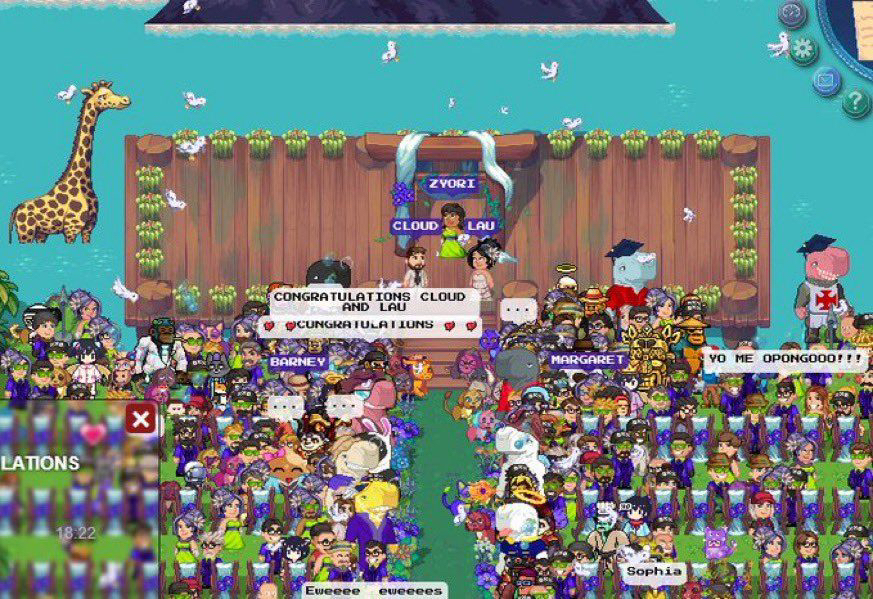
I logged into Pixels expecting a normal session.
Check the land, run the routine, leave. That’s how most sessions go when nothing new is happening. You enter with a task, complete it, and move on.
On the way to my farm, I noticed players moving in one direction. Not randomly, but consistently enough that it felt intentional. I followed without thinking much about it.
The area was already crowded.
Avatars packed together, chat messages overlapping, no clear structure. From a gameplay perspective, it wasn’t efficient to stay there. Nothing was being produced and no tasks were progressing.
Still, nobody moved away.
I’ve seen crowds like this before in other games.
They usually form around something measurable. A drop, a boss, a timed event. You stay as long as there is value, then you leave. The crowd disappears once the output is gone.
This wasn’t that.
There was no visible reward tied to being there.
No system prompt asking players to gather.
No urgency.
I stayed longer than I planned.
Not because there was something to gain, but because leaving didn’t feel necessary.
That difference is important.
In most Web3 games, time feels expensive. If you are not extracting value, you are falling behind. That pressure shapes behavior. Players don’t stay unless there is a clear return.
Pixels removes part of that pressure.
It does that through structure, not messaging.
Everything inside Pixels holds its state. Land doesn’t reset. Progress doesn’t disappear. With Tier 5, production became more connected and resources cycle back through systems like Deconstruction instead of being lost after use.
Because of that, your position inside the game doesn’t collapse when you stop optimizing.
That changes how time feels.
You are not forced to convert every minute into output.
That is why the crowd stayed.
Not because the wedding was rewarding, but because the system didn’t require players to leave in order to stay efficient.
This is where Pixels separates from most designs.
It is not only building loops that produce value.
It is building a structure where players can pause without losing position.
That sounds simple, but it changes behavior completely.
If leaving has no penalty, staying doesn’t need justification.
The wedding itself was small.
Two players, a simple moment, people reacting and watching. From the outside, it looks insignificant.
Inside Pixels, it worked because the system had already done its job before the event started.
Players had land, routines, and progression that remained stable. They weren’t entering as temporary users. They were returning to something that already belonged to them.
That’s why no one rushed away.
Most games try to create engagement by increasing rewards.
Pixels creates it by reducing the cost of staying.
That’s harder to design.
Because it requires the system to manage persistence, progression, and value flow without forcing constant activity.
I went back to my land after that.
Nothing had changed mechanically. My setup was the same. The loops were still there.
The difference was how I approached them.
I wasn’t rushing through actions anymore.
That’s when I understood what I was actually seeing.
Pixels isn’t trying to make every moment productive. It’s making sure players don’t feel punished for staying.
And once that happens, moments like that wedding don’t need to be designed as features.
They happen because the system allows them to exist.