
I remember the moment it stopped feeling like a farming game.
Not dramatic. No big cinematic shift. Just a quiet realization… the kind that sneaks up on you while you’re doing something simple—planting, harvesting, moving between plots—and suddenly you notice the pressure underneath.
Pixels wasn’t soft anymore.
That surprised me.
Because when I first stepped in, it felt almost fragile. Cozy. A little too innocent for Web3, honestly. I’ve seen what this space does to “nice” systems. It chews them up. Fast. Turns them into extraction loops or abandons them when the hype fades.
So yeah… I didn’t expect much.
And that’s exactly why I kept watching.
At the start, Pixels does something most projects don’t—it lets you arrive as a person, not a participant in some tokenized ego trip. No immediate pressure to optimize. No frantic race for yield. You farm. You craft. You wander.
You learn the rhythm.
But here’s the problem. That kind of openness? It doesn’t last unless the system grows up.
And Pixels… did.
Slowly.
I’ve had moments in other Web3 games where the economy breaks before the gameplay even settles. Bots flood in. Rewards get farmed into oblivion. The whole thing turns into a stomach-turning cycle of inflation and exit liquidity.
Pixels flirted with that risk.
It had to.
Because the moment you get scale—real players, real volume—you’re not running a game anymore. You’re running an economy. And economies don’t care about vibes. They care about pressure.
That’s where things started to shift.
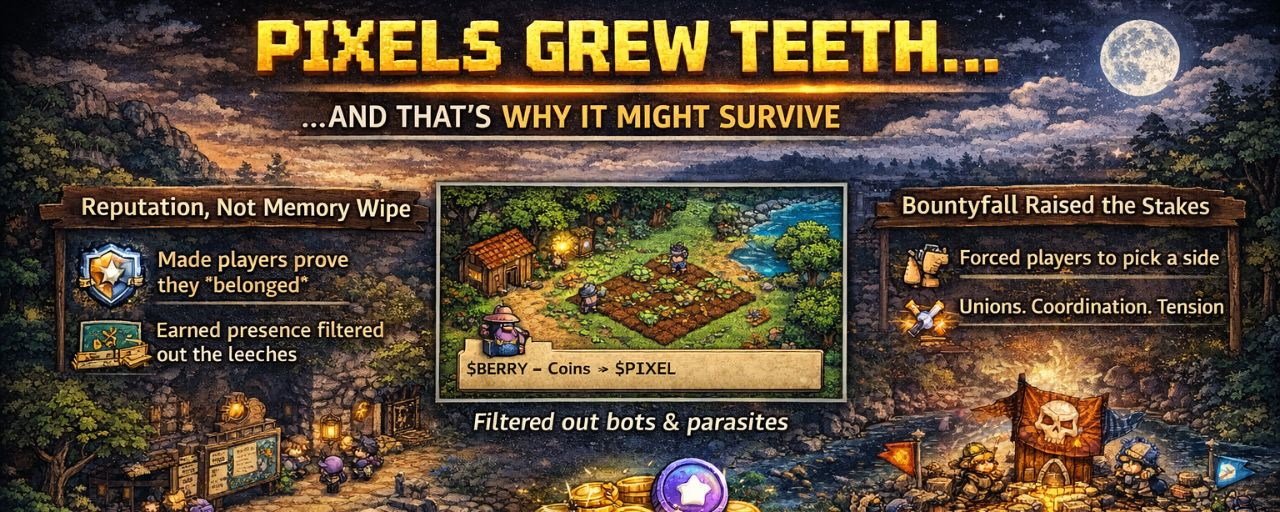
Reputation came in. Not as some flashy feature… but as a filter. A way to separate people who actually wanted to be there from those just passing through to strip value and leave.
I’ll be honest, I’m usually skeptical of systems like that. They can tilt into control pretty fast. But here? It felt more like memory. Like the game was starting to remember who you are.
And that matters.
Because Web3 has a forgetting problem. Everything resets. Every new platform treats you like a stranger again. Pixels started pushing against that. Quietly.
Then came the harder move.
The economy reset.
You could feel it. Not just on paper—but in how people reacted. That shift from BERRY to Coins and $PIXEL… it wasn’t just technical. It was emotional. I remember thinking, this is where most projects lose people.
Because change breaks trust.
And trust is the only thing holding these worlds together.
Pixels didn’t dodge that tension. It leaned into it. Coins took over the day-to-day. Cleaner. Less abuse. Meanwhile, $PIXEL moved up—premium access, deeper participation, real stakes.
Two layers.
Less noise. More structure.
It wasn’t perfect. Still isn’t. There’s always that lingering question—does this hold when things scale? Or does it slowly crack under the same pressure every other system does?
I don’t think anyone knows yet.
But then… Bountyfall happened.
And that’s when things got interesting.
Because now it wasn’t just about your farm. Your loop. Your progress. You had to pick a side. Join a union. Coordinate. Compete.
And suddenly… the game had tension.
Real tension.
I’ve seen “faction systems” before. Most of them are surface-level—just another layer to keep people engaged. But here, it felt different. Outcomes weren’t fixed. Rewards shifted. Player behavior actually moved the system.
That changes everything.
Now you’re not just playing. You’re participating in something that reacts back. You’re watching other groups. Timing actions. Thinking ahead. Sometimes even second-guessing your own side.
It gets messy.
Human messy.
And that’s the part most Web3 games never reach.
Because real systems—ones that last—aren’t clean. They’re shaped by trust, rivalry, coordination… and yeah, sometimes bad behavior too. Pixels didn’t avoid that. It absorbed it.
Adapted.
That’s why I don’t see it as “just a farming game” anymore.
It’s a system learning in real time. A world that started small—almost too soft for this space—and decided to grow teeth instead of disappearing.
Still… I’m not blindly optimistic.
I’ve watched too many projects evolve just enough to survive, then stall out before they become necessary. That middle zone is brutal. Not exciting enough for hype. Not essential enough for permanence.
Pixels is somewhere in there right now.
Balancing.
Trying to stay human while becoming durable.
And maybe that’s the real test—not whether it grows… but whether it grows without losing the reason people stayed in the first place.
So now I’m watching for one thing…
When the pressure really hits, does Pixels hold together… or does it quietly turn into the same system it once avoided?