I did not expect this to be the part of Pixel that would stay in my head.
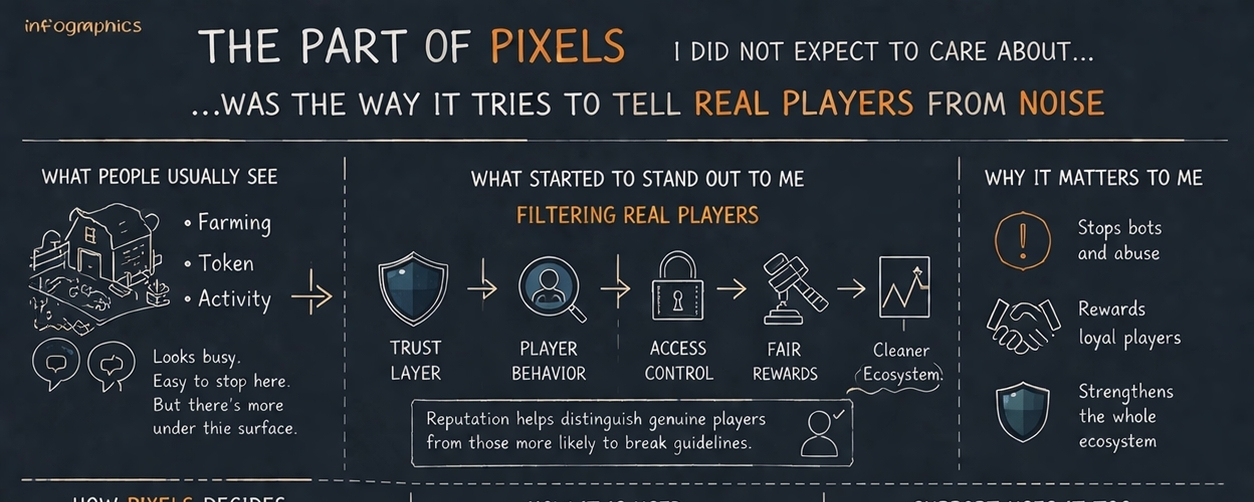
Most people look at Pixels and notice the obvious layer first. The farm. The grinding. The token. The movement. I saw the same thing at first. It is easy to stop there and think you already understand the project. But the more I looked at the official material, the more I felt the more interesting part was sitting under the surface. Not only what players can do, but how the system tries to figure out which players are actually real, committed, and worth trusting.
That is where Pixels started feeling different to me.
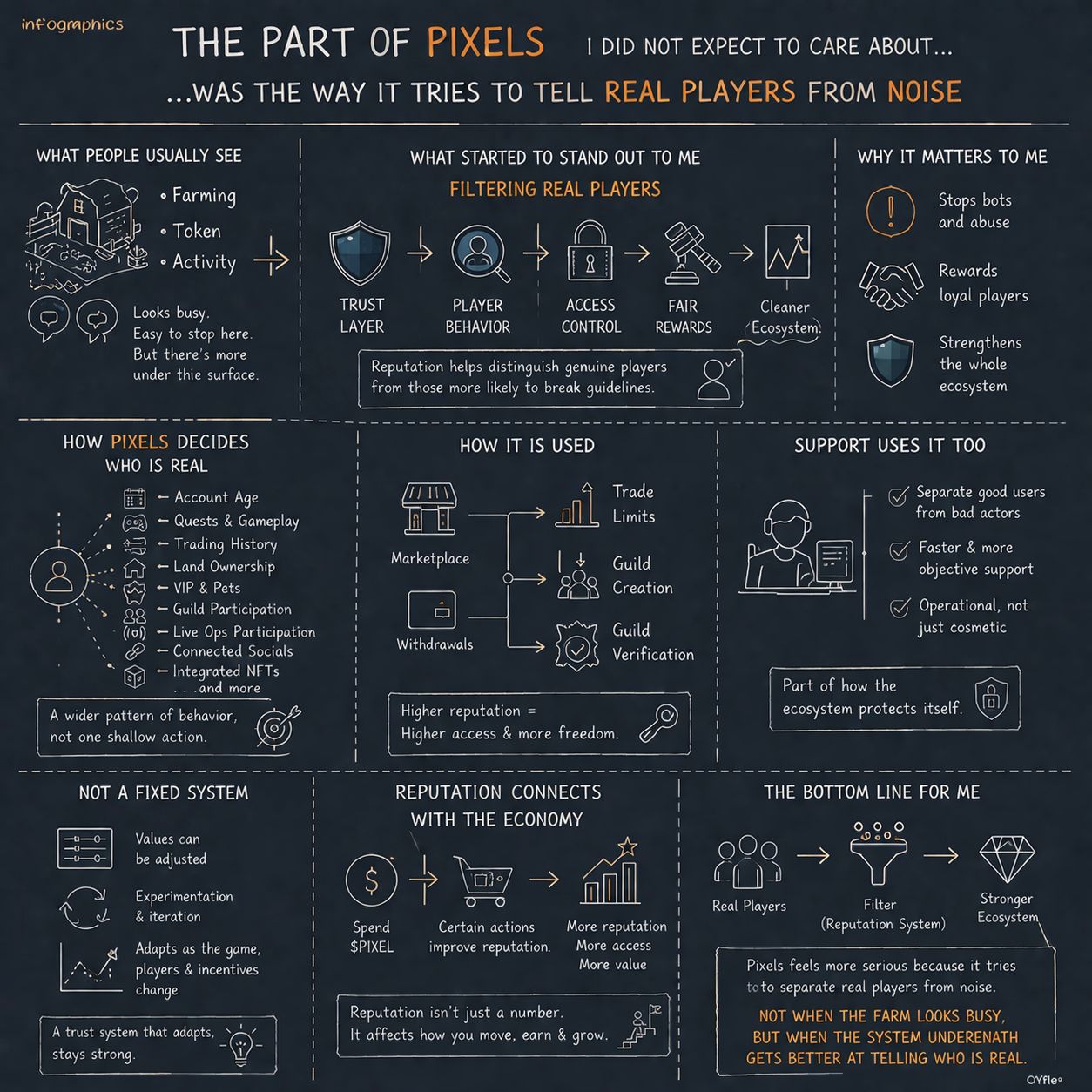
What caught my attention was not just that Pixels has a reputation score. A lot of projects can throw a score on a dashboard and act like it means something. That alone does not impress me. What made me pause was the way Pixels explains it. The official Help Desk says reputation is meant to recognize its best and most loyal users, but it also says the system plays a crucial role in distinguishing genuine players from those more likely to break guidelines. It even says support uses it to separate good users from bad actors more objectively and move faster. That matters, because it tells me reputation is not being treated like a cosmetic badge. It is being treated like part of the trust layer of the game.
And honestly, that is where a lot of weaker systems lose me.
I have seen plenty of projects that look active on the surface. Lots of wallets. Lots of tasks. Lots of movement. But once you look a little deeper, everything is mixed together. Real players, low-effort farming, abuse, spammy behavior. All sitting in the same bucket. And when that happens, the whole experience starts getting weaker. Rewards stop feeling clean. Access becomes easier to abuse. Support becomes harder to manage. The outside still looks busy, but the inside starts getting messy. Pixels feels more serious to me because it is at least trying to put a filter underneath that activity instead of pretending all activity is equally valuable. That is a much stronger mindset.
That is why this part of Pixels stood out to me.
The more I read, the more I liked that reputation here is not built on one lazy signal. Pixels says the score is calculated from different types of data points, including account age, quest and gameplay completion, trading history, and more. The official guide on improving reputation goes even further and lists things like land ownership, VIP, pets, quests, Live Ops participation, connected socials, guild participation, playing the game, and owning integrated NFTs. I like that. It feels more grounded. It feels like the system is trying to read a wider pattern of behavior instead of giving too much importance to one shallow action.
That difference matters to me more than people admit.
Because once a project starts doing this, reputation stops looking like a side feature. It starts looking like part of the structure. And in Pixels, that structure has real consequences. The official Help Desk ties reputation to actual access and limits: marketplace use, withdrawals, trading thresholds, guild creation, and guild verification are all gated by reputation levels. Even the dashboard visibility of your score makes it clear this is meant to be an active part of the player experience, not some hidden backend number. That tells me Pixels is not only asking, “Is this player here?” It is asking, “Has this player earned broader access yet?” That is a better question.
I keep coming back to that point.
A weak system usually wants growth without enough discipline. It wants more users, more movement, more noise. But it does not want to be strict about trust until the damage is already done. Then it starts fixing things late. Pixels feels more deliberate to me because the trust filter is not being added after the fact. It is built into the way the ecosystem works day to day. Even the support angle matters here. If support can use reputation more objectively, then this is not just there for show. It is operational. It is part of how the world protects itself while it grows.
That is where Pixels starts feeling smarter to me.
I also like that the system is not fixed forever. Pixels says it can adjust the values behind reputation on an ad-hoc basis and that it prioritizes experimentation and iteration. I think that is important. A trust system that never changes usually gets outdated very fast, because player behavior changes, incentives change, and the ways people try to game a system change too. If the filter underneath cannot adapt, then sooner or later it becomes weak. So the fact that Pixels leaves room to keep tuning this makes the whole thing feel more alive to me.
There is one more reason this angle stayed with me.
The archived updates show that Pixels has even tied certain actions to reputation improvement, including a quest that involved spending $PIXEL to buy a coin coupon from the bank store to increase reputation. That may look like a small detail, but I do not think it is small. It shows reputation is not floating outside the economy as some useless profile number. It can intersect with progression, access, and value flow inside the system itself. Once I saw that, Pixels stopped looking to me like just a game trying to hold attention. It started looking like a game trying to build a better quality layer under its growth.
That is the part that stays with me.
I do not think a game ecosystem becomes stronger just because it looks full. I think it becomes stronger when the system underneath gets better at knowing who is real, who is contributing, and who has actually earned deeper access.
For me, that is where Pixels starts feeling more serious.
Not when the farm looks busy.
When the system underneath gets better at separating real players from noise.