
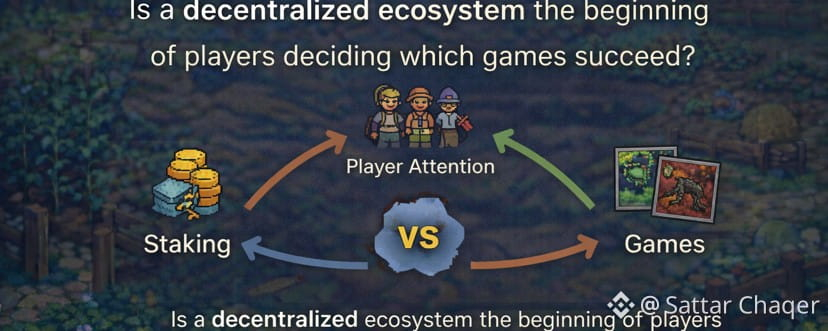


I keep noticing that Pixels isn’t just building a game ecosystem.
It’s changing who decides which games actually grow.
Traditionally publishing in gaming has always been top down. A company decides where resources go which titles get promoted and which ones slowly disappear.
Pixels is trying something different.
Instead of a central decision the system lets players and stakers decide where attention and incentives flow. Games inside the ecosystem don’t just launch and hope for users. They compete for stake activity and retention.
That changes the structure completely.
Because now growth isn’t assigned. It’s earned.
If a game attracts more players keeps them engaged and generates real activity it receives more support from the system. If it doesn’t it fades out over time.
So publishing starts to look less like a decision and more like a market.
But not a normal one.
In this system players aren’t just users. They’re also signal providers.
Where they spend time where they stake what they engage with all of that feeds into which games receive more resources and visibility.
And over time this creates a feedback loop between:
attention
capital
game growth
Which is something traditional publishing never really had.
But there’s a tradeoff here.
When games depend on constant attention and staking to grow they don’t just compete on quality. They compete on their ability to attract and maintain signals.
That can push innovation forward.
But it can also push systems toward optimization over experience.
Because the goal shifts slightly.
Not just
build a good game
But
build a game that attracts the most sustained attention
And those two things don’t always align.
So the idea is powerful.
A publishing system where
players influence outcomes
capital follows engagement
and games evolve based on real usage
But it also introduces a new question.
If games start competing for attention inside a system like this does it create better games
or just better systems for capturing attention?