

Most traders only look at #pixel supply as a threat. They see unlock schedules, circulating increases, and assume more tokens automatically means more downside. That thinking is too shallow for where the market is now. Supply matters, but mature supply often matters differently than expanding supply. This article argues that Pixel’s token story is changing because supply maturity can reduce uncertainty, and most people are missing how markets often reprice assets once dilution fear starts fading. Early-stage tokens are usually handicapped by one constant question: how much more is coming? When that overhang becomes clearer, smaller, or better absorbed, valuation frameworks can shift from fear of emissions toward actual business performance. That transition is subtle, and many traders notice it late.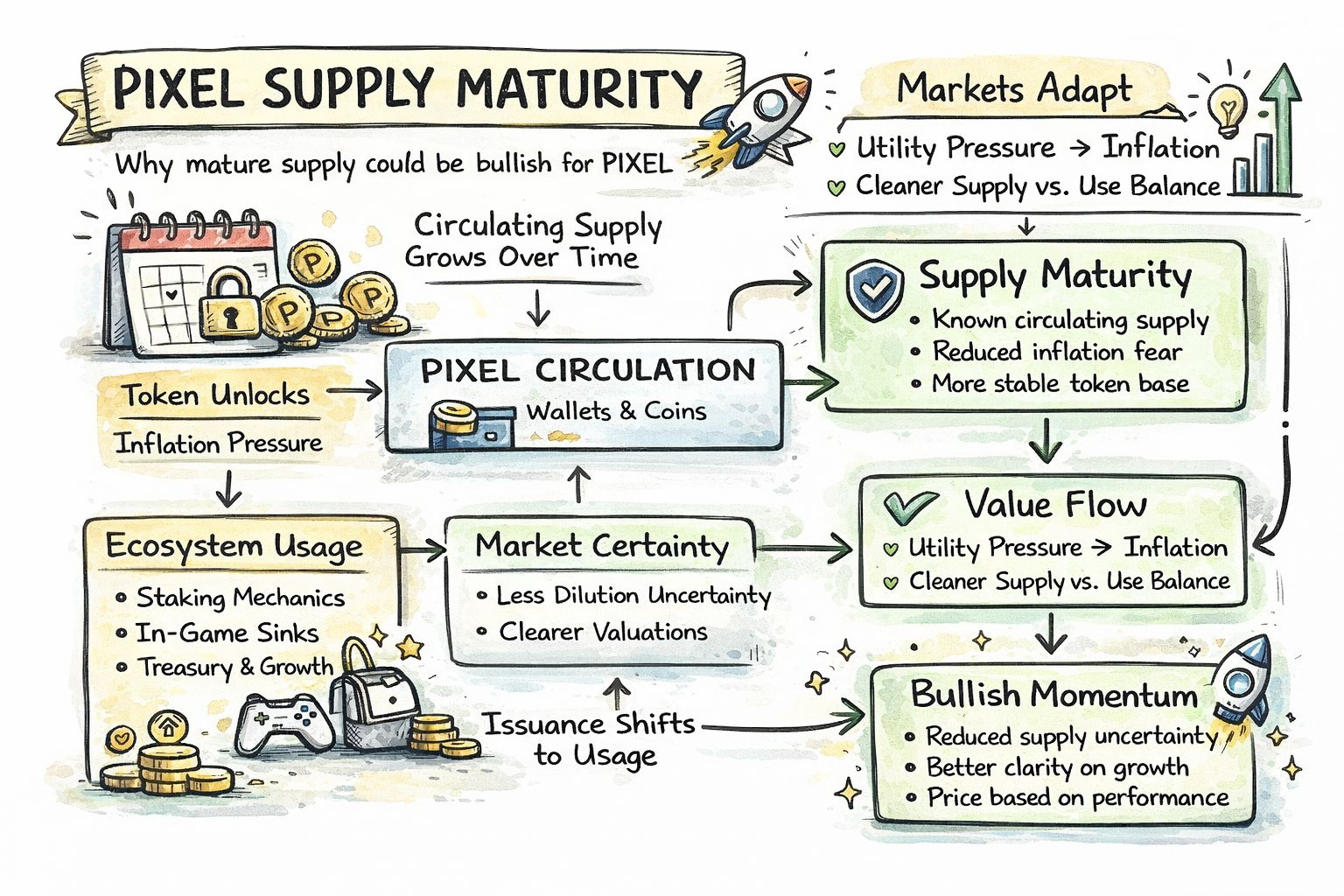
What I’m watching is not the headline number of total supply, but how issuance interacts with real usage. If more of $PIXEL is already circulating, then future demand has a cleaner path to matter. That demand can come from in-game sinks, staking mechanics, ecosystem participation, treasury-led initiatives, or renewed user growth. Most people believe token inflation is a permanent condition. In reality, inflation pressure is often front-loaded, then gradually replaced by utility pressure if the product survives long enough. That’s a major distinction. In Pixel’s case, tokens are issued through the designed distribution model, markets verify value through trading and holder behavior, and users determine real demand through spending or holding inside the ecosystem. Value flows when users need the token for access, status, rewards, upgrades, or participation not when people simply speculate on ticker movement. If emissions slow relative to ecosystem usage, the balance changes. I’ve seen many markets stay bearish long after the worst dilution phase has passed because participants anchor to old narratives. They remember prior selling pressure but ignore that token structure may now be more transparent and more digestible than before. Once uncertainty declines, even modest demand improvements can have a larger pricing effect than traders expect.
That’s why timing matters now. Supply maturity alone won’t save any token with weak products or fading users, and I’m not pretending it’s magic. But when a project still has recognizable brand presence, active community memory, and functioning products, cleaner token structure can become an underrated catalyst. It allows investors to focus on metrics that actually matter next: retention, spending loops, treasury discipline, expansion strategy, and network growth. If @Pixels continues building while dilution concerns fade into the background, sentiment can shift from “too much supply” to “maybe this was mispriced.” Markets often move hardest when the reason everyone stayed bearish quietly disappears. I’d rather track that transition than chase random momentum candles. This isn’t about counting tokens. It’s about understanding when uncertainty stops dominating value.