
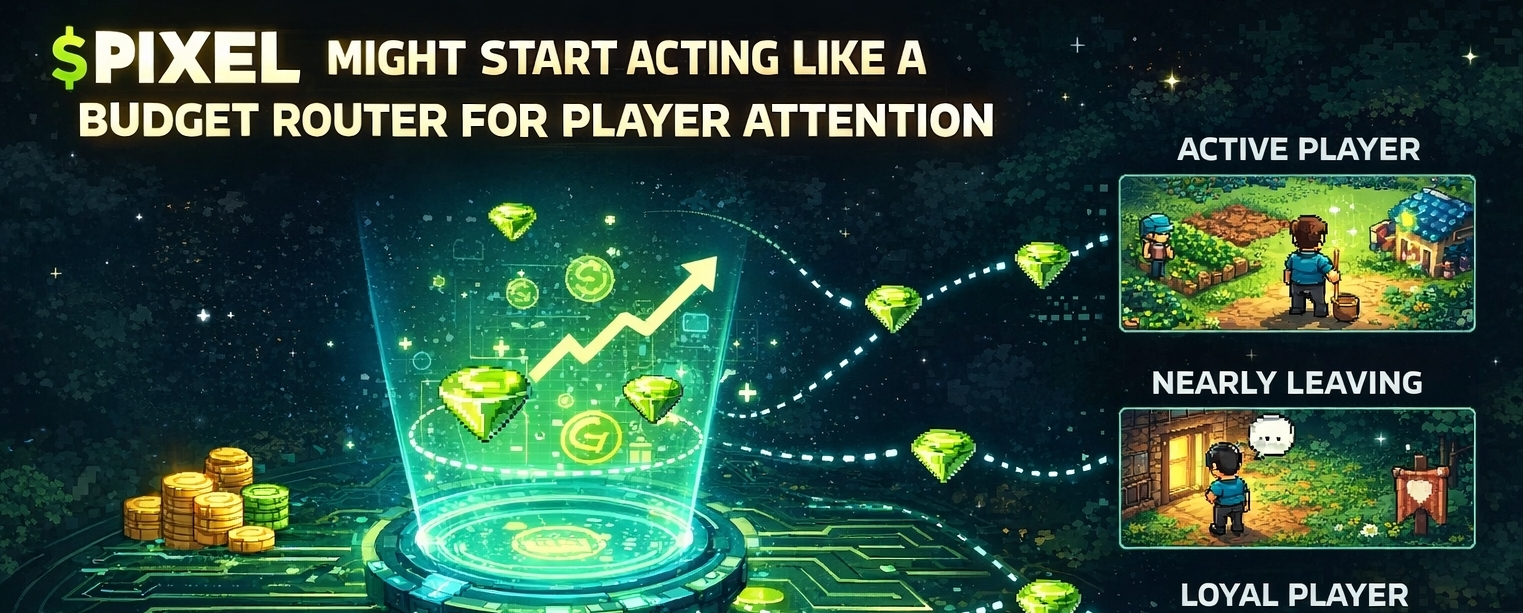
A few days ago I caught myself staying inside a game longer than I planned. Not because it was suddenly more fun. It wasn’t. I think it was just the timing of something small… a reward popping up right when I was about to leave. Nothing huge. But it worked. I didn’t exit.
That moment keeps coming back when I look at $PIXEL. Because the more I think about it, the less it feels like a normal game token. It’s not just sitting there waiting to be spent. It feels like it shows up at specific moments. Almost like it’s being placed, not just earned.
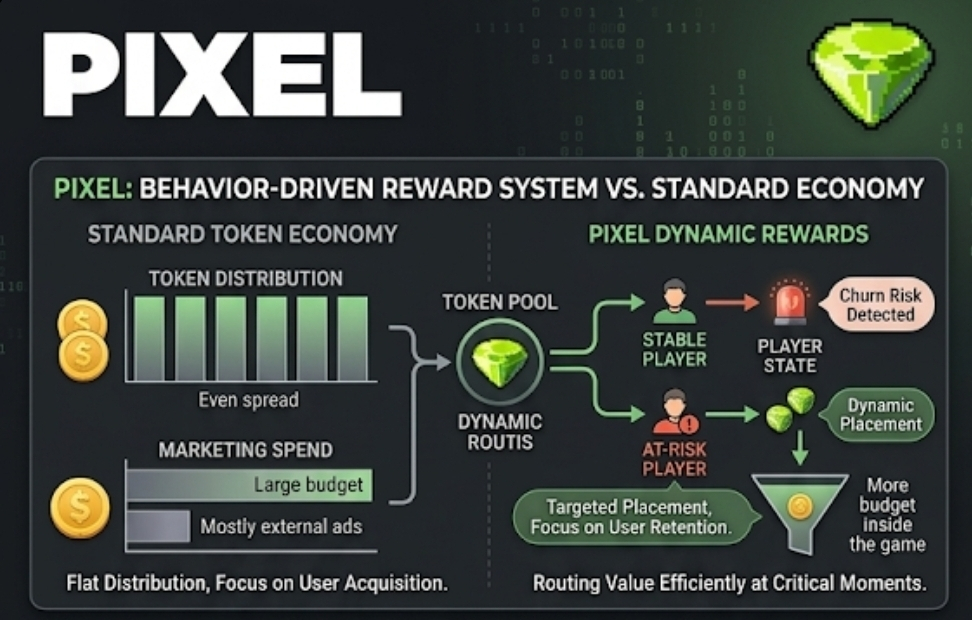
At first I ignored that thought. It sounded like overthinking. Game tokens are simple, right? You play, you get rewarded, you spend. That loop is familiar. But Pixels doesn’t seem to rely on that loop alone. There’s something else happening underneath. Rewards don’t look evenly distributed. Some players get more at certain times, others less. It’s uneven, and I don’t think that’s accidental.
They call it data-driven rewards. Which sounds complicated, but it’s basically the system watching behavior and deciding who matters more in that moment. Not permanently. Just… right now. If someone is about to leave, maybe they get something. If someone is already deep in the game, maybe they don’t need anything extra.
That’s where $PIXEL starts to feel different. It’s not just a reward. It’s part of the decision. Almost like a budget being moved around quietly. Not a fixed salary, more like spending that shifts depending on what the system wants to achieve.
And what it seems to want is attention. Not in a loud way. Just keeping people inside a bit longer, coming back a bit more often.
I keep thinking about how games usually spend money. Most of it goes outside the game. Ads, user acquisition, paying platforms to bring players in. That’s where the budget lives. Players don’t really see it. But Pixels seems to flip a part of that. Instead of spending everything to attract users, it tries to spend inside the system to keep them.
If that’s true, then $PIXEL isn’t just tied to gameplay. It’s tied to those spending decisions. Where should we put value today? Which players are worth holding onto? It’s subtle, but that’s a very different role for a token.
There’s also that AI layer they talk about. Honestly, I don’t fully trust how that gets explained in most projects. “AI game economist” sounds impressive, but in simple terms it’s just software looking at patterns and making guesses. Who might churn. Who might stay. What action leads to longer sessions.
Still, even a basic system can shape behavior if it controls rewards. People don’t always realize they’re adjusting. They just follow what works. If certain actions keep getting rewarded, those actions become the game.
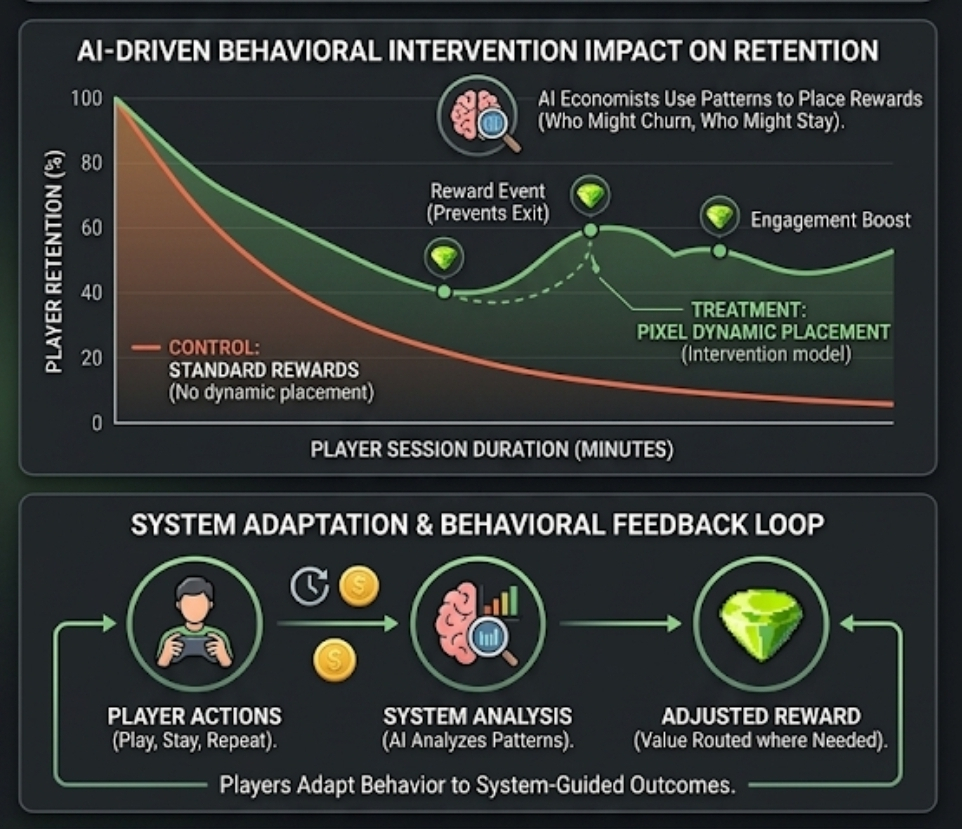
And that’s where things get a bit uncomfortable, at least for me. Because at some point, you stop playing naturally. You start playing in response to the system. Not fully aware, but not completely free either.
From a market angle, this makes $Pixel harder to read. Usually, you look at user growth, volume, maybe transaction activity. But here, the real signal might be hidden in how efficiently rewards are being used. Not how many rewards exist, but how well they are placed.
That’s not something you can easily track on a chart.
It actually reminds me of Binance Square in a strange way. You can post anything, but not everything gets seen. There’s some internal scoring happening. Engagement patterns, timing, maybe even how content is written. You start noticing that certain types of posts travel further. Others don’t.
After a while, people adapt. Not always consciously. They adjust tone, structure, even the kind of ideas they share. The system shapes behavior without explaining itself.
Pixels feels similar, just inside a game economy. Instead of posts, it’s player actions. Instead of visibility, it’s rewards. And $Pixel sits somewhere in between, carrying that value to where the system decides it should go.
There’s a clear upside to this. If rewards are targeted properly, you avoid waste. You don’t just give tokens to everyone and hope something sticks. You focus on players who actually contribute. That could make the whole system more stable over time.
But it also creates dependency. The system has to keep making good decisions. If it starts rewarding the wrong behavior, things drift quickly. Players notice. Or worse, they don’t notice, but the experience becomes shallow.
And then there’s the question of expansion. Pixels isn’t staying as one game. It’s moving toward a network of games. That sounds good on paper. More places to use $PIXEL, more demand. But behavior doesn’t transfer cleanly between games. What keeps someone engaged in a farming loop might not work in something else.
So now you’re not just routing attention inside one environment. You’re trying to route it across different ones. That’s a much harder problem.
I’m not sure $Pixel fully solves that yet. It might not need to right now. It just needs to keep working where it already exists.
That small moment I mentioned earlier… staying in a game a little longer than planned. It didn’t feel important. But multiply that across thousands, maybe millions of players, and it becomes something else entirely.
Maybe that’s where $Pixel actually lives. Not in the big obvious parts of the economy, but in those small decisions. The ones that don’t look like decisions at all.