
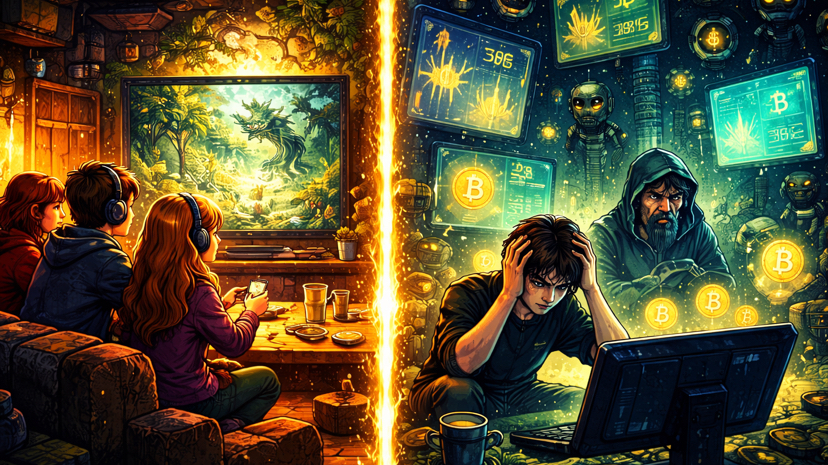
If you ask most people why Web3 gaming hasn’t beaten traditional gaming yet, they’ll say the graphics aren’t good enough. Or the games aren’t fun enough. Or crypto is too complicated for normal players.
Those things are true. But they’re not the real gap.
The real gap is simpler and more uncomfortable.
Traditional gaming figured out one thing that Web3 still hasn’t fully solved. How to make you want to come back tomorrow. Not because of rewards. Not because of tokens. Because the game itself pulls you in.
Think about it. Nobody logs into FIFA because they might earn something. Nobody grinds Dark Souls because there’s a token at the end. They come back because the experience is designed so well that leaving feels like a loss. The progression feels real. The stakes feel personal.
Web3 gaming looked at that and said — what if we add financial incentives on top?
Which sounds smart. But in practice it created a weird problem. The moment money enters the equation, the relationship between player and game changes completely. You stop asking “is this fun?” You start asking “is this worth my time financially?” Those are very different questions. And the second one is exhausting to answer every single day.
That’s why so many Web3 games feel like work. Because financially, that’s exactly what they became.
And here’s where it gets interesting.
The games in Web3 that are actually surviving — @Pixels being one of the clearest examples — are the ones that figured out the order of operations matters. Fun first. Ownership second. Rewards third. Not the other way around.
Pixels is not surviving because $PIXEL has a great chart. It’s surviving because people genuinely enjoy the world. The farming. The exploration. The social layer. The token economy sits on top of something that already has reason to exist.
That’s the gap. Not technology. Not graphics. Not onboarding flows.
It’s that most Web3 games built the financial layer first and assumed the fun would follow. Traditional gaming never made that mistake. The business model always came after the experience.
Web3 gaming will close the gap eventually. The infrastructure is getting better. The tools are getting smarter. Games like Pixels are proving the model can work when the priorities are right.
But until more teams start with the experience and work backwards to the economy not the other way around — traditional gaming isn’t losing any sleep.
And honestly? It shouldn’t.