
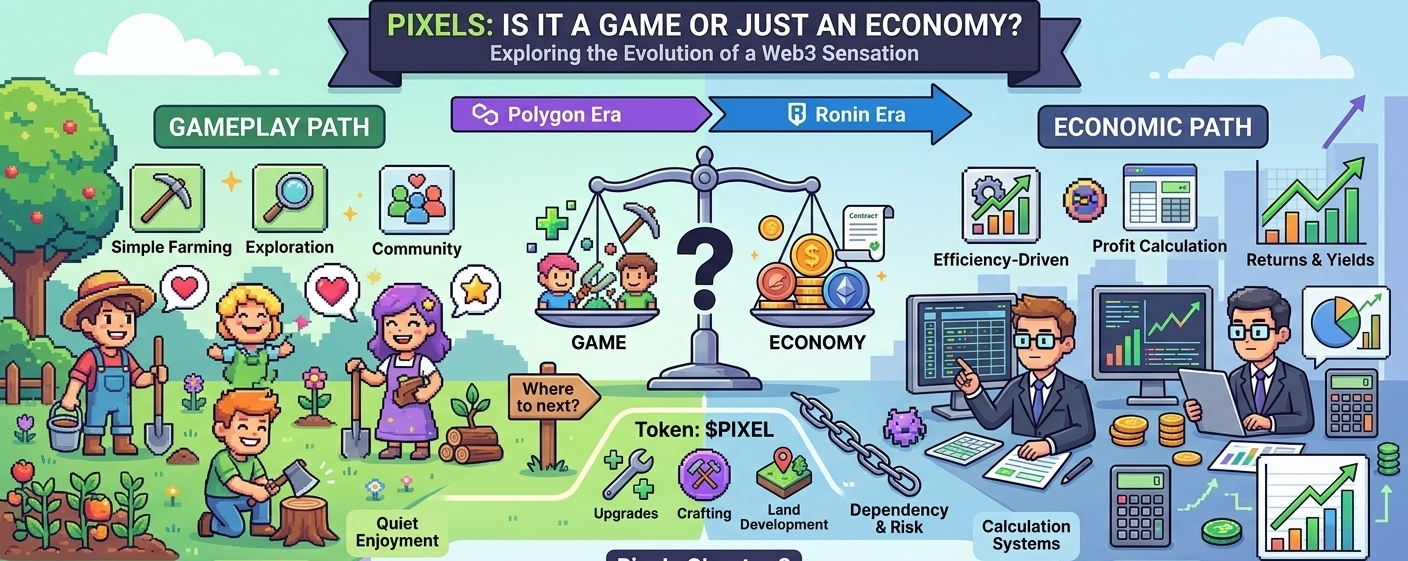
For a long time, one simple but uncomfortable question has been on my mind…
when a game slowly turns into an economic system, is that real progress — or are we quietly losing the fun?
Honestly, this question is hard to ignore when we talk about @Pixels.
From the outside, it looks like a success story 🚀
More players, higher volume, growing hype — everything looks strong.
But when you look deeper, things become more complicated. And that’s where the real discussion begins.
In the beginning, on Polygon, Pixels was a simple farming-style onchain game.
The gameplay was easy, light, and actually felt like a game.
Then came the shift to Ronin.
Ronin is a gaming-focused ecosystem — low fees, fast transactions, and an already active player base.
This move clearly helped Pixels grow faster.
But here’s the real question —
did Pixels grow because the game became better, or because the infrastructure made it easier for users to join?
Because not all “growth” is the same.
Sometimes it’s real engagement… and sometimes it’s just more traffic due to less friction.
If we look at the structure 🤔
Pixels is built on three main things: land, resources, and token economy.
Land works as NFTs and also as a source of income.
Players take different roles — some own land, some rent it, and some produce resources.
It creates a small in-game economy where everyone has a role.
This sounds strong…
but this is also where a shift starts to happen.
The game slowly becomes “efficiency-driven.”
Instead of focusing on fun, players start thinking about returns —
which action gives more profit, which resource gives better yield.
At that point, the game starts to feel less like a game… and more like a calculation system.
Now let’s talk about the token — $PIXEL, which is called the heart of the game.
It has real utility: upgrades, crafting, premium features, land development — everything depends on it.
But there’s a deeper issue here.
As token utility increases, dependency also increases.
And when dependency grows, the whole game becomes more sensitive to market changes.
This can be powerful… but also risky.
Because now players are not just playing —
they are part of a financial system.
People talk about burn mechanisms and balance, and yes, those exist.
But the real question is:
is this balance coming from gameplay…
or is it supported by external demand?
Now looking at the Chapter 2 update —
production chains, industry systems, and deeper mechanics.
This direction makes sense.
Simple “tap and harvest” games don’t last long. Games need more depth.
But again, the same question comes back —
is this added complexity making the game more enjoyable?
or is it just adding more economic layers?
In Web3 gaming, we often see a pattern —
systems grow, but fun becomes smaller.
When everything is optimized, the game can start to feel mechanical.
Ronin gave Pixels a big advantage —
liquidity, users, infrastructure — everything was already there.
It’s like opening a shop in a busy market.
But long-term success is a different challenge.
If incentive-driven players leave,
will the core game still be strong enough?
Or will activity drop along with the economy?
Here’s an uncomfortable truth…
Web3 games are often measured by how active their economy is,
but “quiet fun” — the simple enjoyment that keeps players coming back — is often ignored.
And that might be the most important part.
I’m not saying Pixels is not successful.
In fact, it’s a very interesting experiment —
a game trying to become an economy.
And experiments always come with uncertainty.
In the end, the question remains:
Do we want games where every action has financial value?
Or do we want games where some things are just fun, even if they have no value?
Maybe the future will find a balance between both…
or maybe it won’t.
For now, Pixels is not just a game —
it’s a test. 🚀
