
For most of February 2026, $PIXEL was trading around $0.0045. A number so far from its starting point that it had stopped feeling like a price and started feeling like an abstraction. People who bought near the top had been watching it for two years. People who bought the dip were wondering which dip they meant.
And then, in March, something shifted. Volume exploded — not 20%, not 50%, but over 6,000% in a single 24-hour window. The price moved from roughly $0.007 to nearly $0.020 before settling. 193% in a day. The kind of number that empties Discord threads of nuance and fills them with price targets instead.
The interesting thing wasn't the move. Thin-liquidity altcoins make moves like that. The interesting thing was what the move exposed about how people were holding.
Some wallets that had been underwater for eighteen months finally had a window to exit at a smaller loss. Some wallets that had been staking through the entire decline saw their position appreciate in hours. Some wallets — the ones that had just found the token three days earlier on a trending list — were making decisions about an asset they barely understood in a timeframe that rewarded instinct over analysis.
All three of those behaviors happened simultaneously in the same market. And none of them had much to do with whether Pixels the game had gotten better or worse, whether Stacked had meaningful traction, whether the RORS was sustainable. The price moved because liquidity shifted and sentiment ignited, not because the fundamentals changed in 24 hours.
That gap — between what a price does and what a project is — is the oldest tension in this space. People talk about it endlessly in bear markets and forget about it completely during green candles. The Pixel rally was a reminder that neither extreme is accurate.
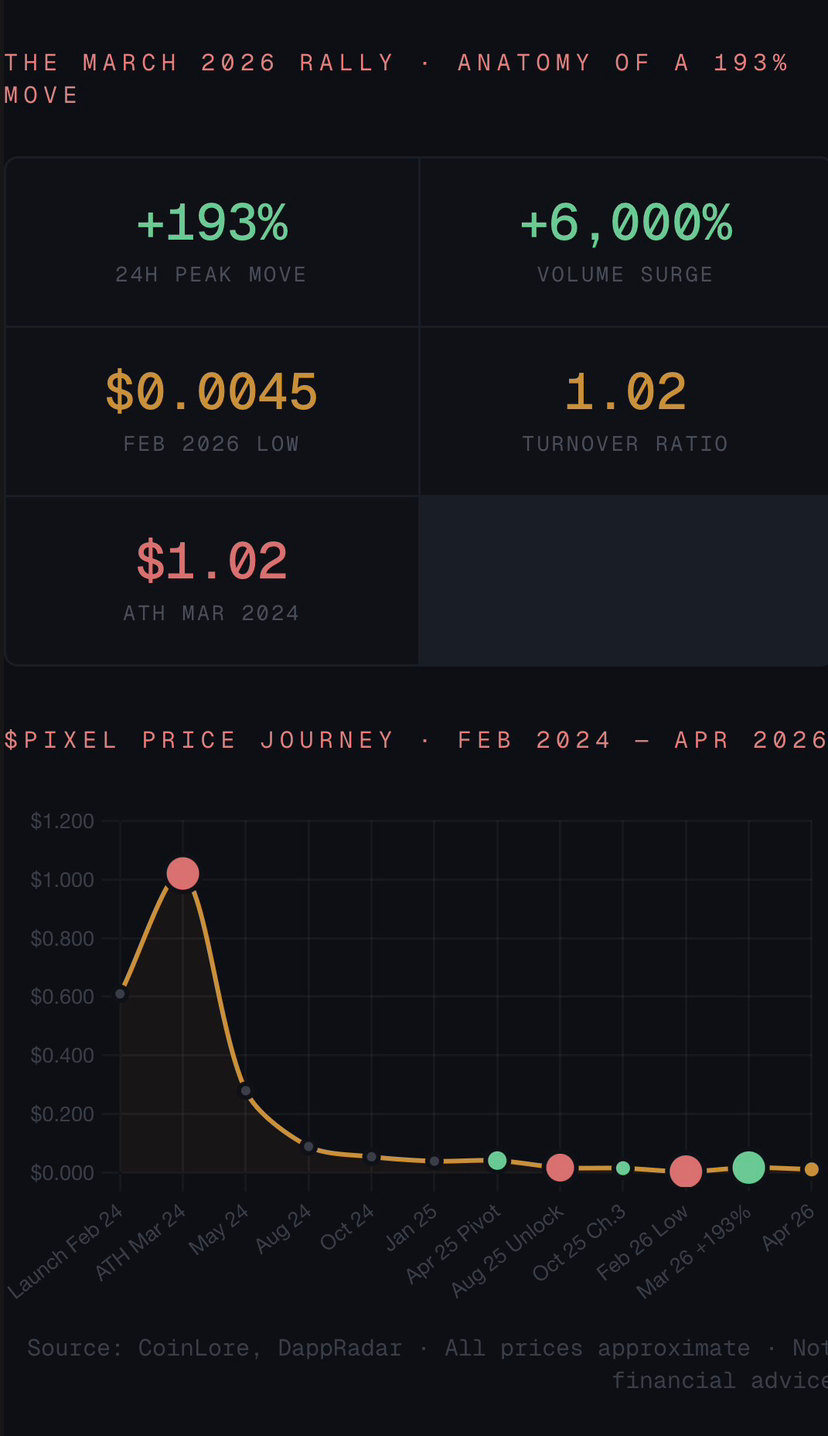
The on-chain data from that rally is actually reassuring in one specific way. The turnover ratio — the proportion of circulating supply that traded hands during the move — came in at 1.02. That's not an empty pump driven by one whale and a lot of wash trading. It's a liquid market where buyers and sellers genuinely found each other at scale. The fundamentals, as the on-chain analysts noted at the time, were holding underneath the volatility.
But "holding underneath" is different from "being recognized by the market." A game with one million daily active users, $25 million in revenue, a positive RORS, and 139 million staked tokens still trades at a market cap of roughly $22 million. The math doesn't resolve cleanly. Either the market is severely underpricing a working ecosystem, or there is something it's seeing in the supply schedule and vesting structure that hasn't fully landed in the community narrative yet.
Both can be true. Usually, both are.
The rally happened. Then it settled. And now Pixel sits where it usually sits — between what it has built and what the market has decided to price that building at. The distance between those two points is either an opportunity or a warning, depending on which questions you're willing to hold without answering them
@Pixels (https://www.binance.com/en/square/profile/pixels) · $PIXEL #pixel