I didn’t think about bots when I first got into Pixels again.
I thought about them when my loop stopped behaving the way it used to.
Same actions, same timing but the returns weren’t exploding the way you’d expect if this was a typical Web3 farming setup. No obvious abuse, no flooded rewards, no sudden collapse in value from overfarming.
That’s unusual.
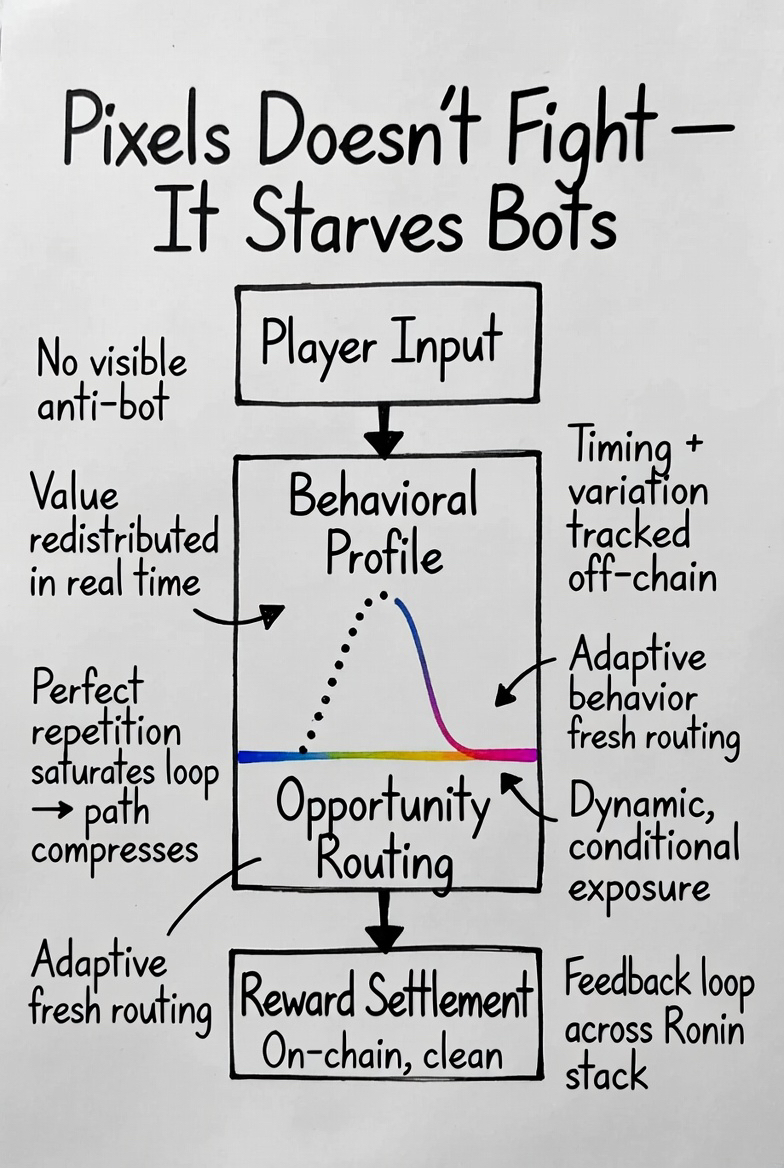
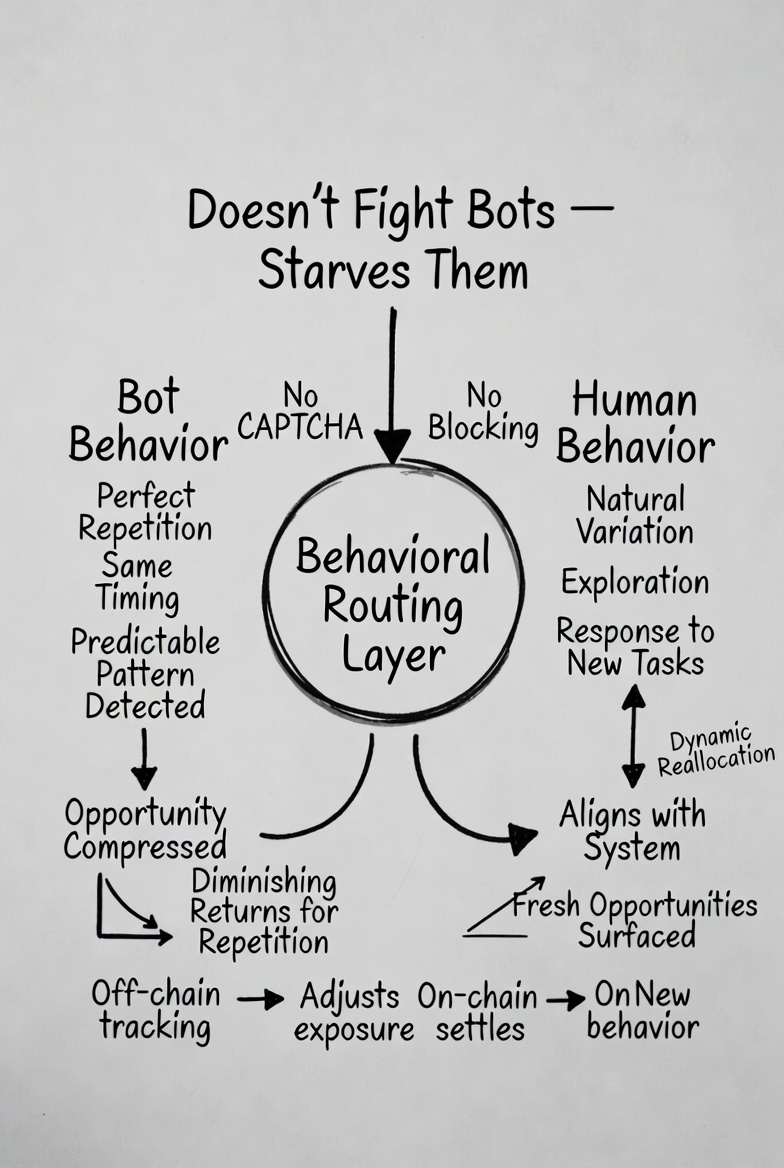
Pixels doesn’t block bots. It makes them irrelevant by controlling where value can actually accumulate.
At first, I couldn’t tell why. There’s no visible anti bot system popping up in your face. No CAPTCHA moments, no explicit friction. You just play.
But the resistance shows up in a different place.
Not at the entry point inside the reward flow itself.
That’s where the architecture starts to reveal itself.
The obvious layer is on-chain. That’s where assets live, where rewards settle, where ownership is clear. But that layer is not where decisions are made.
By the time something hits on chain, it’s already been filtered, shaped, and economically weighted.
The real control sits off chain.
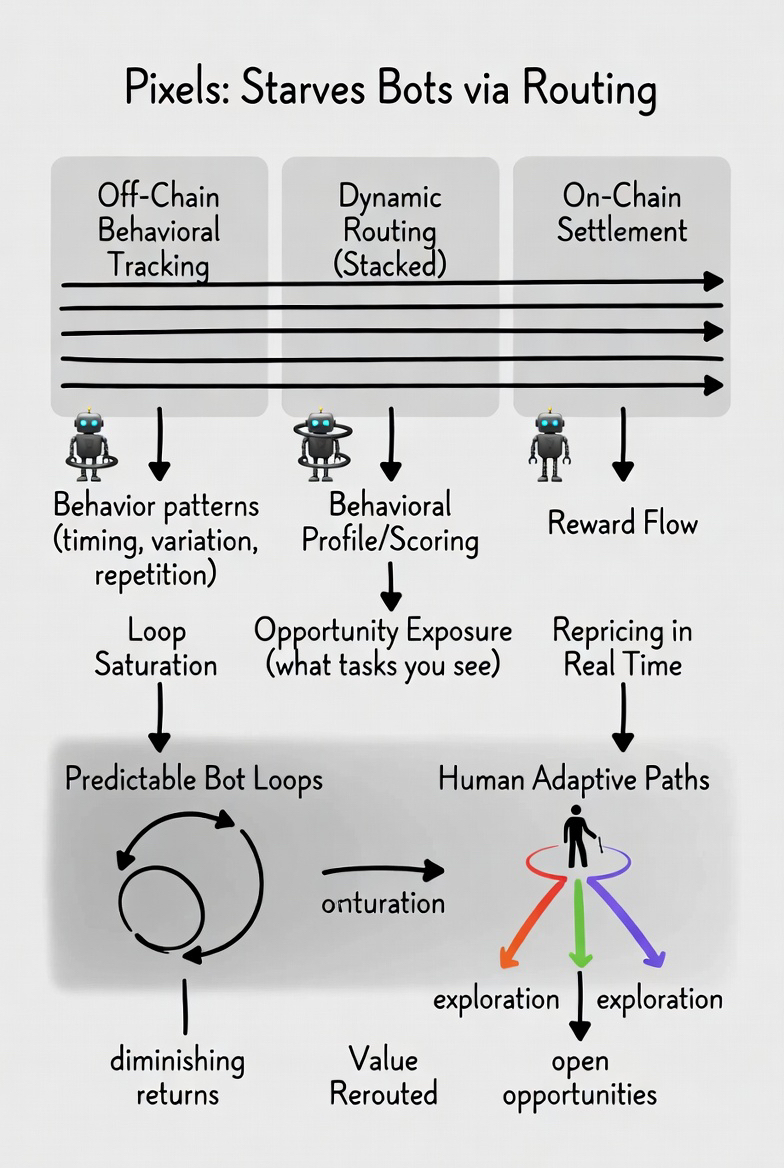
That’s where behavior is tracked continuously not just did you complete a task, but how you move through the system. Timing between actions, loop repetition, variation in behavior, response to new tasks.
It’s not identity in the traditional sense, but it builds a behavioral profile likely translated into a hidden scoring or weighting system that influences what opportunities you’re eligible to see next.
I didn’t realize it at first, but I was being pushed out of my own loop.
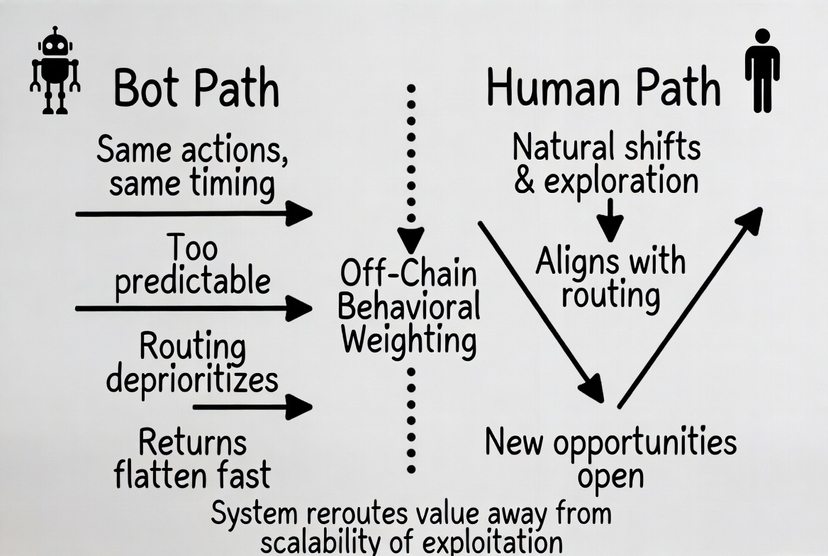
Bots struggle here, not because they can’t act, but because they act too perfectly.
They optimize for repetition. Same loop, same timing, same output. That’s efficient for extraction, but it’s also predictable.
And predictability is exactly what gets deprioritized at the routing level.
This is where routing comes in.
Stacked the layer sitting above Pixels inside the Ronin stack doesn’t distribute rewards evenly. It routes tasks and opportunities dynamically based on behavioral weighting, participation density, and loop saturation.
You don’t see the full menu of possibilities. You see what the system chooses to surface to you and that exposure is conditional, not fixed.
That’s the first shift most people miss.
Fraud resistance isn’t happening by blocking bots.
It’s happening by controlling what bots can repeatedly access and scale.
If a loop gets saturated whether by humans or bots it doesn’t need to be shut down. It just starts compressing. Returns flatten. Follow up opportunities disappear. The path stops compounding.
From the outside, nothing changed. The loop still exists. You can still do it.
But it stops being worth it.
You feel it as a player.
I stayed in one loop longer than I should have because it used to work. But over time, it just stopped scaling. I wasn’t getting the same follow up tasks, and the ones I did get didn’t really lead anywhere.
That’s when I realized it wasn’t just rewards changing.
Even what I could access was being repriced in real time.
Then I tried something else a less crowded path and it just worked better.
Not dramatically. Just enough that it made sense to stay there.
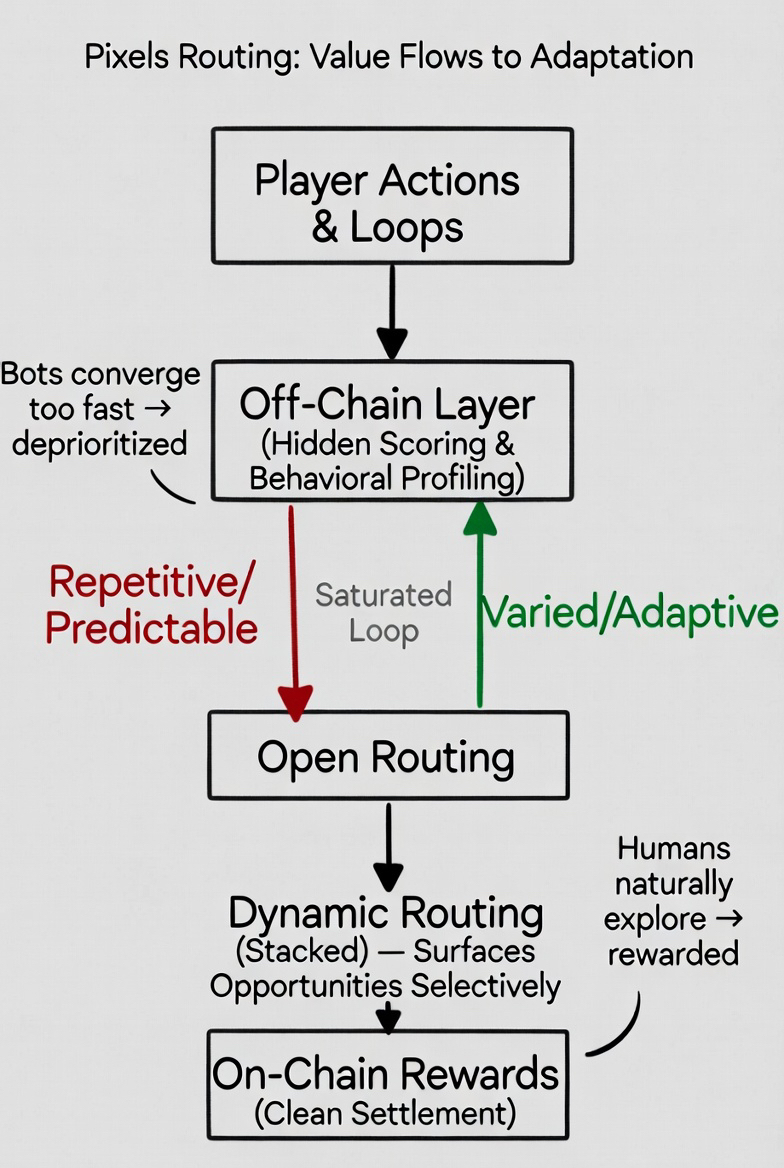
That’s routing in action.
The system isn’t telling you this is bad or this is good.
It’s dynamically reallocating opportunity based on where marginal value still exists.
And because this happens before rewards are finalized, the onchain layer stays clean. There’s no need for constant patching or reactive balancing. The economy adapts in real time based on participation.
That’s also how emission quality is preserved without constantly modifying tokenomics.
That creates a different kind of moat.
Bots can still enter the system. They can still perform actions. But scaling becomes inefficient because the system won’t keep feeding them the same profitable path.
They hit diminishing returns faster because their behavior converges too quickly into detectable patterns.
Meanwhile, human players who naturally explore, shift behavior, respond to new opportunities align better with the routing logic without even trying to.
That’s the asymmetry.
It’s not that bots are banned.
It’s that the system continuously reroutes value away from predictable behavior.
Another piece that matters is how Pixels sits between these layers.
It’s not just a game on top of infrastructure. It’s the environment where this routing actually becomes visible across the Ronin stack. Every quest, every loop, every progression path feeds data back into the off-chain layer, which then influences future routing not just here, but across connected reward surfaces.
It’s a feedback loop.
Off chain tracks behavior → routing adjusts opportunity exposure → on chain settles outcomes → new behavior emerges → back into off chain.
That cycle keeps running without needing to expose itself.
Which is why, as a player, you don’t feel like you’re being controlled.
You just feel like some paths stop making sense and others open up.
That’s the tension resolved.
At the start, it feels like something is off.
Why isn’t this loop paying the same? Why does this path feel better?
The answer isn’t randomness.
It’s that the system is constantly redistributing advantage quietly, before rewards even reach you.
And once that clicks, the whole design makes sense.
Fraud resistance here isn’t about catching bad actors.
It’s about removing the conditions that make exploitation scalable in the first place.
So the system doesn’t fight bots directly.
It just stops feeding them and quietly reroutes the edge to those who can adapt.