
I’ve seen enough GameFi whitepapers promise revolutionary ecosystems while quietly repeating the same single-title fragility.
They design one strong gameplay loop.
They tie everything to a single token.
They claim perfect community alignment.
Then player interest in that one game fades, rewards feel stale, and the entire economy goes quiet like it always does.
Pixels’ whitepaper leans into a conceptually sharper foundation.
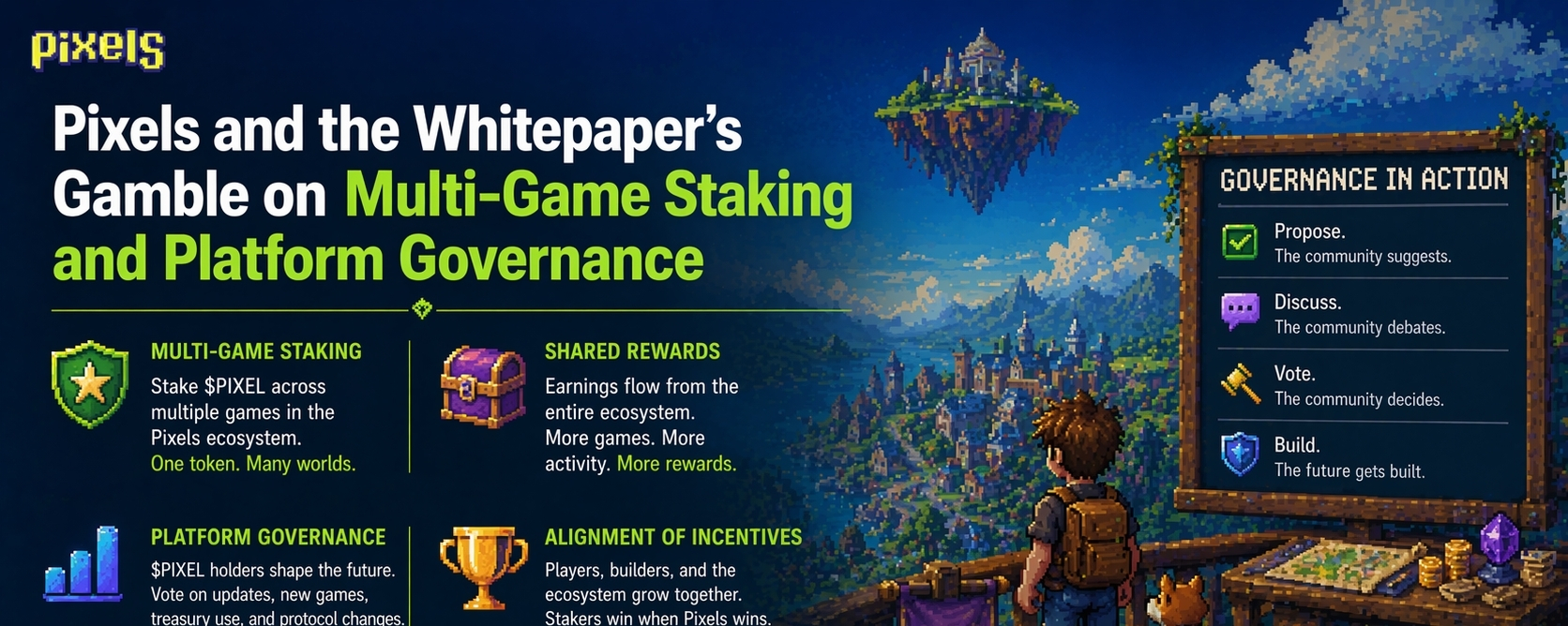
It starts with a simple, almost stubborn assumption: one farming sim alone won’t cut it long-term. The real play is turning Pixels into a true multi-game platform where ecomes pixel the shared utility and governance layer across titles. Players stake pixel into different game-specific pools or validators, earning a slice of monthly ecosystem rewards currently capped at 28 million tokens to keep inflation in check. Staking isn’t just passive yield anymore — it gives holders real voting power on which new games or features receive visibility, funding, and development resources from the ecosystem treasury.
Pixel isn’t positioned as the everything-token that collapses under pressure. It gates meaningful actions across the platform: NFT minting for new assets, VIP memberships that unlock better earning rates or exclusive content, guild joins that grant access to coordinated high-yield activities, and upcoming governance votes that shape the roadmap. Everyday casual play runs on lighter off-chain systems or Coins that can be purchased with Pixel , keeping the core free-to-play feel intact while creating actual in-game demand for the token.
The broader ambition goes beyond farming roots. Pixels is actively expanding with titles like Chubkins — a mobile-friendly Tamagotchi-style pet game with simple nurturing loops and social sharing — alongside Pixel Dungeons and future experiences. Chapter 3’s Bountyfall introduced team-vs-team competitions and Union mechanics where players stack resources, sabotage rivals, and compete for scalable prize pools. Chapter updates follow a tight three-to-four-month cycle, bringing new quests, procedurally generated realms, and social reputation systems that reward consistent contribution. LLM-powered NPCs add unscripted conversations that can unlock hidden trades or side quests, boosting immersion without relying solely on token incentives.
Recent infrastructure moves reinforce this. Stacked, the AI-powered rewards hub, now extends to external studios, letting them tap into targeted missions and LiveOps while experimenting with USDC payouts to reduce direct selling pressure on pixel . Multi-game staking turns token holders into active platform participants — stake into a pet game pool to support Chubkins development, or into combat-focused pools for future expansions. Guilds have evolved into economic corporations where staking or contributions to the guild treasury grant influence and shared rewards. Social reputation and Trust Scores add another layer, turning consistent play and positive community behavior into measurable advantages.
It’s a cleaner conceptual framework than most. Retention and growth become platform-level metrics, not tied to one title’s daily active users. Adaptive loops where staking choices and governance votes shape what gets built next — less brain-dead single-game yield chasing, more intelligent alignment that could theoretically survive when interest in any individual experience naturally ebbs. The 2026 milestone of crossing one million daily active users on Ronin shows early traction, with the platform pivot aiming to turn that into sustained, diversified engagement.
But here’s the deeper tension the whitepaper can’t fully paper over with staking caps or governance promises.
The smarter and more interconnected the multi-game staking and platform governance gets, the higher the risk that players eventually sense the economic machine working underneath. When every stake allocation, vote, and guild treasury contribution is tied to optimizing overall ecosystem health, the experience can shift from joyful pet nurturing or team competitions to participating in someone else’s decentralized investment committee. Players have a sharp nose for when fun is being gently steered by token-weighted influence rather than freely discovered through play. No amount of capped monthly emissions, AI-supported LiveOps, or USDC off-ramps can manufacture genuine attachment once the calculation behind the cute Tamagotchi mechanics or Bountyfall sabotage becomes visible.
Execution gaps remain too. Multi-game platforms sound scalable on paper, but coordinating development cycles, balancing prize pools across titles, and maintaining fun when governance votes favor certain mechanics over others doesn’t always cooperate with human creativity or market sentiment. If the core experiences in new games aren’t sticky enough on their own, even the most thoughtful staking flywheel may only delay the familiar fragmentation. Governance helps direct resources, but it can’t create hit gameplay where none exists.
So the real test the whitepaper quietly sets up is brutal and conceptual:
Can Pixels engineer multi-game staking and platform governance so intelligently — with capped rewards, vote-driven funding, and cross-title utility — that the economic layer stays completely invisible? Can the vision of a community-shaped universe actually produce organic, long-term engagement without anyone ever feeling like they’re inside a finely tuned platform optimization model?
If the fun in each game leads and the staking quietly enables deeper participation, if new titles like Chubkins hook players on nurturing loops while govern pixel ance feels like genuine ownership rather than weighted influence, this could evolve into something that genuinely outlives most GameFi experiments and reshapes how Web3 platforms scale beyond single hits.
If not, even the most ambitious multi-game whitepaper risks becoming another smartly packaged version of the same old story — prettier governance mechanics, more sophisticated staking layers, but the identical quiet exit when player attention fragments and the platform ambition was never quite deep enough to hold the ecosystem together.
I’ve read too many of these documents. Pixels at least confronts the old single-title failures head-on with harder questions about what actually survives when one chapter ends and the next must carry the weight. Whether the on-chain reality of multi-game staking and platform growth matches the theory is what players, governance votes, and time will judge next.
@Pixels #pixel $PIXEL $HIGH $BULLA
#AltcoinRecoverySignals? #CharlesSchwabtoRollOutSpotCryptoTrading #Kalshi’sDisputewithNevada