
I've read hundreds of Web3 whitepapers. Most share the same structure: big vision, complex diagrams, token allocation pie charts, and a "roadmap" that extends three years into the future.
Very few share what actually happened.
Stacked is different. Not because the team is smarter. But because they built it first, then talked about it second.
The Numbers That Matter
Let me put this in perspective.
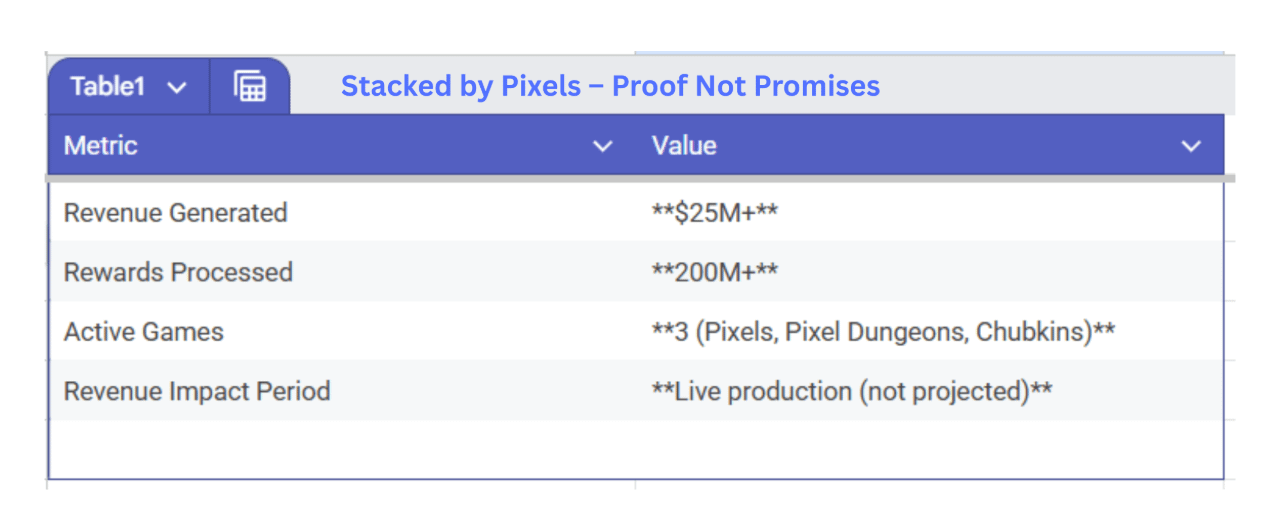
200 million rewards processed. Not projected. Processed. Live. Across real players who were farming, crafting, trading, and sometimes trying to break the system.
$25 million in revenue. Not a target. Not a forecast. Actual revenue that helped make Pixels sustainable when most Web3 games were collapsing.
These numbers come from the official Pixels talking points for the CreatorPad campaign. They're not hidden in some audited report — they're being shared openly because the team knows the receipts speak for themselves.
What Stacked Actually Does
Most people hear "AI game economist" and imagine something futuristic. Here's what it actually does today:
Analyzes player cohorts — It can tell you why whales are dropping between Day 3 and Day 7. Not through a dashboard you have to interpret. Through direct questions you can ask.
Spots churn patterns — Before players leave, there are signals. Stacked finds them.
Suggests reward experiments — Instead of guessing which rewards work, the AI recommends what to test next.
Filters out bots — Rewards go to real players, not automated scripts. This alone separates Stacked from almost every other rewards platform.
Why This Matters for $PIXEL
Pixel isn't just a token for one game anymore. It's becoming the fuel for a growing ecosystem of games using Stacked.
Every new studio that adopts Stacked creates more demand for $PIXEL. Every reward distributed in $PIXEL Strengthens the token's utility. Every player who earns Pixel spends it on upgrades or land becomes part of a closed loop that doesn't leak value to ad platforms.
The "Redirect Ad Spend" Thesis
Here's the part that convinced me this is sustainable.
Gaming studios spend billions of dollars every year on user acquisition. Ads. Influencers. Campaigns. Most of that money goes to platforms like Google, Meta, and TikTok.
Stacked flips this. Instead of paying ad platforms, studios can redirect that budget directly to players who actually show up and engage.
The ROI becomes measurable. The reward loop becomes auditable. And players get paid for behavior that matters — not for watching ads or completing spam quests.
One Concern I Still Have
Stacked is opening to external studios now. The real test isn't whether it works for Pixels — it's whether other studios actually adopt it at scale.
If they do, $PIXEL s a cross-ecosystem rewards currency with real demand. If they don't, this remains a Pixels-only tool.
I'm watching for the first external studio announcement. That will tell us more than any token price chart.
Bottom Line
Stacked isn't flashy. It doesn't have a meme. It doesn't promise to 100x your portfolio overnight.
But it does something rarer than all of those things: it works. And in Web3, that's the real moat.