
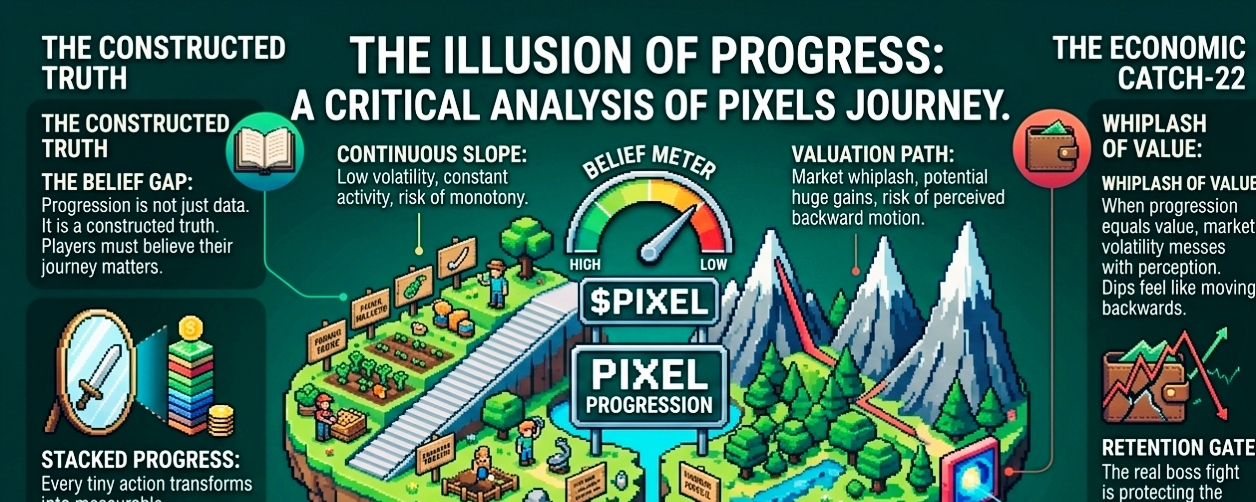
Let's think about Pixels for a second. Can it actually give us a genuine sense of continuous progress?
Honestly, when you strip the question down to its core, it’s not really about gameplay mechanics anymore. It’s about something much more basic: can the game keep up the illusion that we're actually getting somewhere? It sounds a bit dramatic, but progression in any game—whether it's traditional Web2 or on-chain—is basically a constructed truth. It’s a system designed entirely to make us feel good about moving forward.
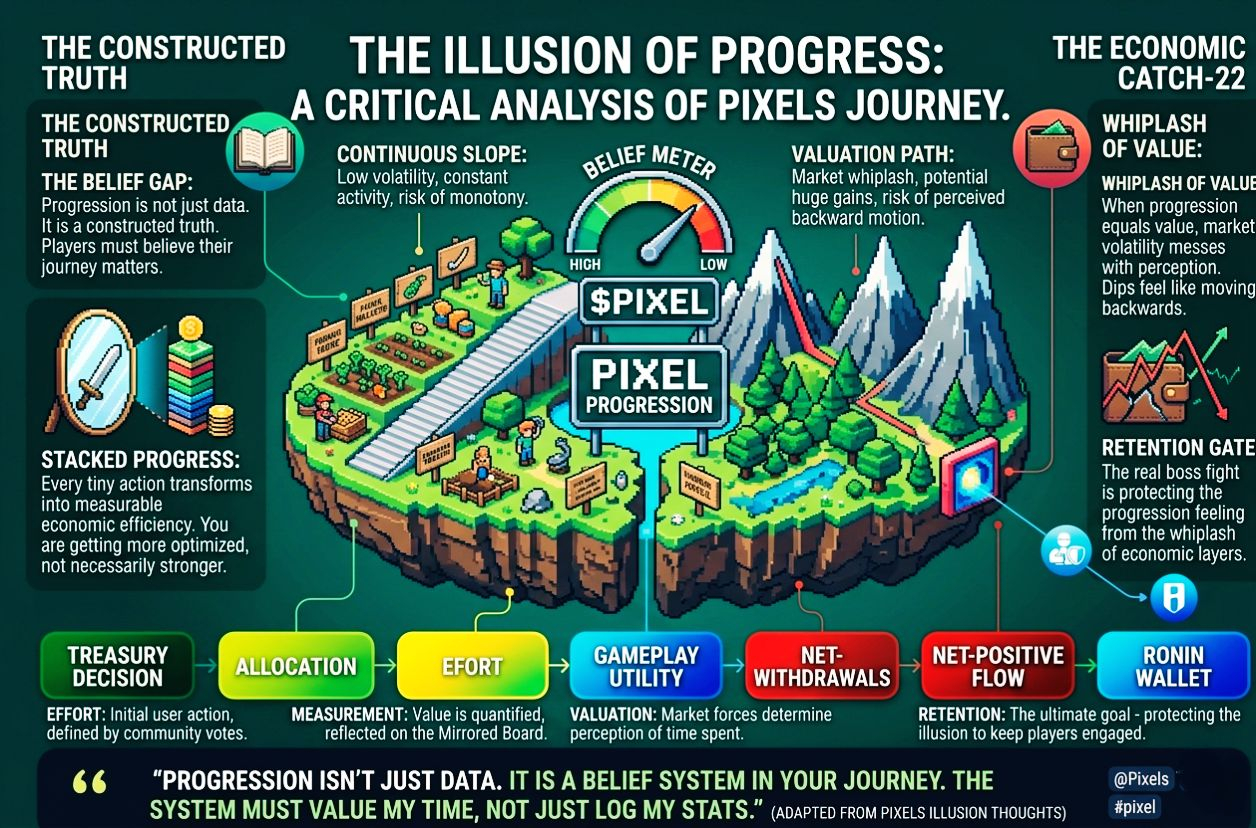
In Pixels, progression isn't just about dinging a new level or unlocking a shiny new item. It’s a form of "stacked progress." Every tiny action you take is recorded and transformed into tangible economic value. You aren't necessarily getting "stronger"; you're getting more efficient and more optimized. And because it's so measurable, it feels incredibly objective on the surface.
But here's the catch: the feeling of progress doesn't come from a server logging your stats. It comes from believing your journey actually matters. This is where the gap between Web2 and Pixels becomes incredibly clear.
The Closed Loop vs. The Open Market
The Web2 Experience: Progression is a closed, controlled loop. It's relatively linear—you know where you are, you know what the next boss or milestone is, and you're rarely stopping to ask, "Is this grind actually worth it?" Because it's controlled, the feeling of moving forward is incredibly smooth.
The Pixels Experience: Because progression is tied directly to an economy, that closed loop is broken. You aren't just thinking "I’m moving forward." You’re thinking, "I’m moving forward, but is the system valuing my time?" That completely flips how we perceive our in-game achievements.
To its credit, Pixels tries to juggle this by offering overlapping paths. You can optimize your resources, your assets, your farming efficiency, or your market hustle. There's always something to tweak. It’s a brilliant way to minimize downtime and keep players from feeling stuck.
Peaks vs. Slopes: The Danger of the Hamster Wheel
But does constantly having something to optimize mean you're actually progressing? That’s the real kicker.
If every step forward is just numbers going up—better yield, tighter efficiency—it eventually feels mechanical. You’re advancing, sure, but without standout moments, the grind just turns into a smooth, endless hamster wheel.
Web2 keeps you hooked with clear "peaks" (boss fights, new zones, big level-ups).
Pixels relies on a continuous "slope." This is a double-edged sword. You can always move forward, but you might never get that satisfying rush of having actually finished something specific. A continuous slope is great for short-term engagement because you’re never bored. But long-term? Without those big, memorable anchor moments, players can easily lose their sense of direction.
The Economic Catch-22
Pixels tries to solve this engagement issue by letting progression accumulate as real economic value. But that opens Pandora's box: when progression equals value, market volatility messes with your head.
You might be grinding efficiently and moving forward in the game's systems, but if the token or asset value dips, you feel like you're moving backward economically. When those two realities diverge, the illusion of progress shatters.
The Final Verdict
At the end of the day, it all comes back to player retention. A game only creates a true sense of progress when players aren't constantly doubting the value of their time.
I don't think Pixels has failed here, but I'm not convinced they've solved the problem yet. They have the tools to create a massive amount of progression. But protecting that feeling of progress from the whiplash of the economic layers? That’s the real boss fight.
Maybe the right question isn't "Does Pixels have progression?" It’s "Do the players actually believe in it?" Because if progression is just a constructed truth, its real value isn't in the code—it's in whether we buy into the illusion.