
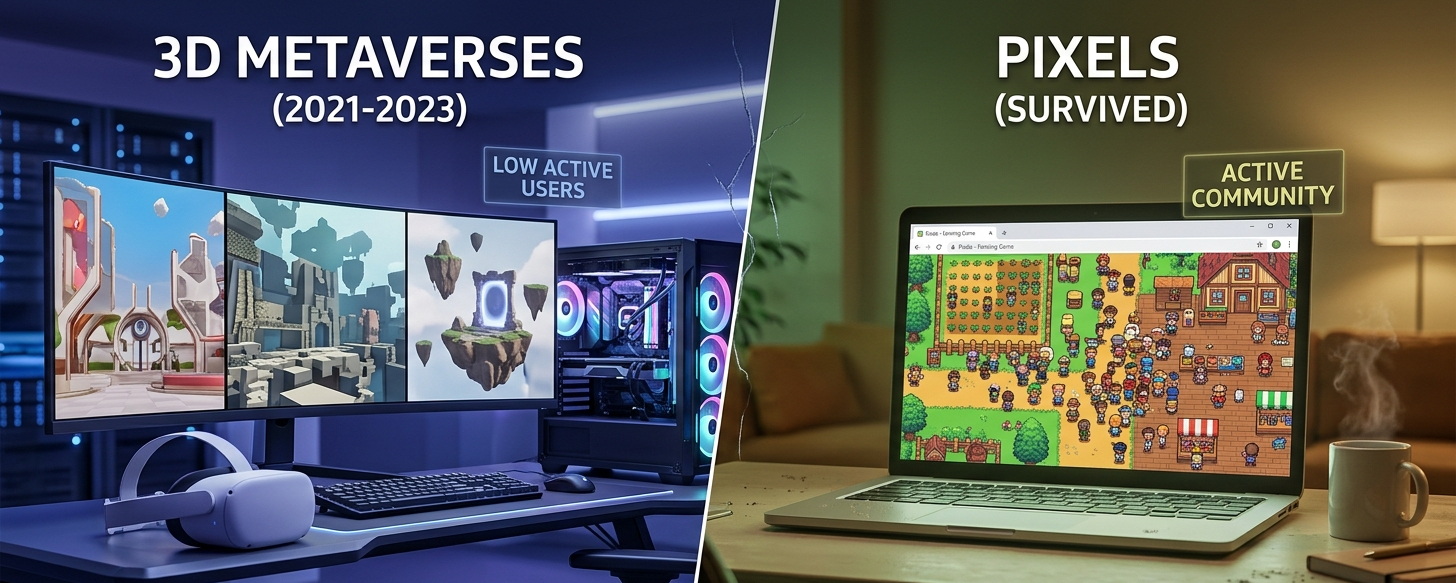
The 2021–2023 cycle in Web3 gaming was defined by a specific kind of architectural hubris. The industry became obsessed with the idea that digital ownership required a sense of physical presence. To justify the prices of virtual land and the scale of venture capital rounds, the "metaverse" had to look like a world you could disappear into.
We saw the rise of Decentraland, The Sandbox, and eventually Yuga Labs’ Otherside. These were massive, ambitious undertakings. They promised high-fidelity, immersive 3D environments where global brands would set up shop and players would spend their lives. The logic was simple: if we build a world that looks like the future, people will inhabit it.
But while the industry was distracted by photorealism and spatial audio, Pixels took a different path. They chose 2D pixel art.
On the surface, it looked like a compromise or a nod to nostalgia. In reality, it was a brutal calculation of friction. The 3D metavers built a wall between the user and the experience. To enter those worlds, you often needed a dedicated GPU, a massive client download, or at the very least, a high-speed connection and the patience to wait for a complex environment to render. The technical barrier to entry was inversely proportional to the actual activity available once you arrived.
Pixels bet on the browser. By choosing a low-fidelity aesthetic, they ensured that a player could go from hearing about the game to harvesting their first crop in under sixty seconds. No hardware requirements. No configuration. Just a tab in a browser.
This raises a fundamental question about what actually constitutes immersion. The 3D projects gambled on visual immersion the idea that if your eyes are convinced, your heart will follow. Pixels gambled on mechanical immersion. They bet that gameplay loops, social progression, and community integration are what actually hold a player’s attention. They sacrificed the "wow" factor of a cinematic trailer for the "one more minute" factor of a functional game.
Of course, this choice has its limits. Pixel art caps visual ambition. You cannot tell every kind of story with sprites, and players raised on AAA standards often find the aesthetic cheap or reductive. It is a ceiling that 3D worlds don't have to worry about.
However, as we look at which worlds are populated today and which ones feel like abandoned digital museums, the lesson is clear. Accessibility is a feature, not a compromise.
Have you ever walked away from a game Web3 or otherwise simply because the process of getting started felt like a chore, before you even spent an hour actually playing?