
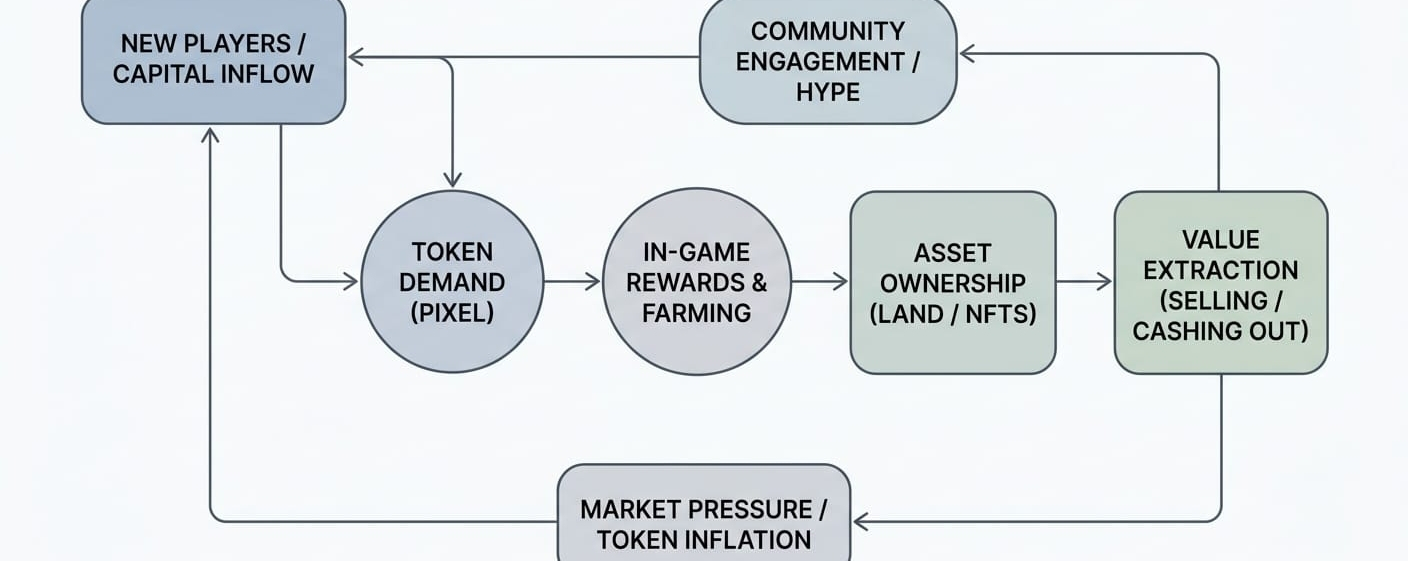
Let’s be clear from the outset: Pixels is not a game with an economy. It is an economy with a game attached.
That distinction matters. It always has.
I’ve watched this cycle repeat for two decades — from early MMO gold farming to the last wave of “play-to-earn” hype. The packaging changes. The incentives do not. Whenever entertainment is fused with extraction, the latter wins.
Pixels sells calm. It monetises participation.
And the people being monetised are not the ones being promised empowerment.
---
Ronin’s Controlled Playground — Decentralisation in Name Only
The Ronin Network is marketed as infrastructure built for players. Fast, cheap, accessible.
What it actually offers is control.
This is not the open terrain Web3 once promised. It is a managed environment where friction is reduced, but so is autonomy. The architecture favours efficiency over independence — and that is not an accident.
Because true decentralisation is messy. Hard to steer. Difficult to monetise cleanly.
So instead, we get a curated ecosystem where power is simply rebranded, not redistributed.
It’s not liberation. It’s optimisation.
---
From Play to Pressure — The Economics Are Doing the Talking
The sales pitch was simple: play and earn. A tidy inversion of traditional gaming.
That illusion has not survived contact with reality.
What emerges in Pixels is the same drift seen across the sector. Rewards compress. Competition intensifies. Participation starts to look less like leisure and more like obligation. The casual player is quietly pushed to the margins unless they are willing to spend or commit disproportionate time.
This is not a failure of design. It is the design.
An economy cannot afford to be generous indefinitely. It tightens. It always tightens.
And when it does, the fantasy of “earning while playing” collapses into something far less appealing: working for diminishing returns.
---
PIXEL Token — Utility, or Just a Story Holding the System Together?
The PIXEL token is presented as functional. Necessary. Embedded in the fabric of the game.
But utility here is overstated.
What sustains the token is not intrinsic demand. It is belief — belief that the system will grow, that participation will continue, that value will hold. That belief is carefully maintained through design choices that encourage circulation while postponing reckoning.
Supply expands. Demand is managed. Confidence becomes the real currency.
And confidence is fragile.
When a token relies more on narrative than necessity, it stops being a tool and starts being a liability.
---
Ownership Without Power — The Return of Digital Landlords
Ownership is the cornerstone of the Web3 pitch. Own your assets. Control your destiny.
In practice, ownership concentrates. Quickly.
Early entrants secure land. Capital does what capital always does — it moves first and claims the best positions. Latecomers are left to operate within a system they do not control, extracting value for those who do.
It is not empowerment. It is replication.
A familiar hierarchy reappears, this time rendered in pixels. Those who own the land capture the upside. Those who don’t provide the activity that sustains it.
The language is new. The structure is not.
---
Community as Fuel — And Eventually, as Exit Liquidity
The visible strength of Pixels is its community. Active, engaged, constantly signalling growth.
Look closer.
Community here is not just social glue. It is economic infrastructure. It sustains attention, attracts new participants, and underwrites the perception of momentum. Without it, the system stalls.
But that same community is also the exit mechanism.
When sentiment shifts — and it always does — engagement drops, confidence erodes, and the very people who sustained the system become the ones absorbing its decline.
This is not a side effect. It is the risk baked into the model.
---
The Sustainability Myth — Where the Logic Starts to Crack
Pixels aspires to durability. A long-term economy. A stable loop of value.
That ambition runs into a simple constraint: games and economies obey different rules.
Games need accessibility and enjoyment. Economies require scarcity and discipline. Combine them, and you create a permanent imbalance. Too much reward, and the system inflates. Too little, and players disengage.
There is no stable middle ground. Only temporary fixes.
The longer the system runs, the more visible the tension becomes.
---
Regulation Is Coming — And It Won’t Be Kind
There is an unresolved question hanging over all of this.
What is Pixels, legally speaking?
If players are committing capital, expecting returns, and engaging in token-driven activity, the line between game and financial product becomes thin. Uncomfortably thin.
Regulators are beginning to notice.
And when they act, they rarely do so gently. The industry has enjoyed ambiguity. That window is closing.
When classification arrives, it will not be on the industry’s terms.
---
The Exit Problem — The Oldest Weakness in the Room
Every system built on continuous inflow eventually faces the same test.
What happens when growth slows?
In Pixels, value extraction depends on ongoing participation. New players. New capital. New belief. Without that, the internal economy begins to cannibalise itself.
Everyone can farm. Not everyone can cash out.
That imbalance is not theoretical. It is structural.
And when too many participants try to realise gains at once, the system reveals what it always was: a mechanism that works best for those who leave early.
---
This Isn’t a Game. It’s a Cycle.
Pixels is not unique. It is simply the latest iteration of a well-worn pattern.
Take a familiar mechanic. Add financial incentives. Wrap it in a narrative of empowerment. Sustain it with community. Delay the moment of reckoning.
It looks compelling — until it doesn’t.
Because once profit is the primary motive, everything else becomes secondary. Design, community, even the notion of play itself bends around extraction.
And when extraction weakens, participation follows.
At that point, there is no game left to defend.
Only the question of who exited first — and who didn’t.