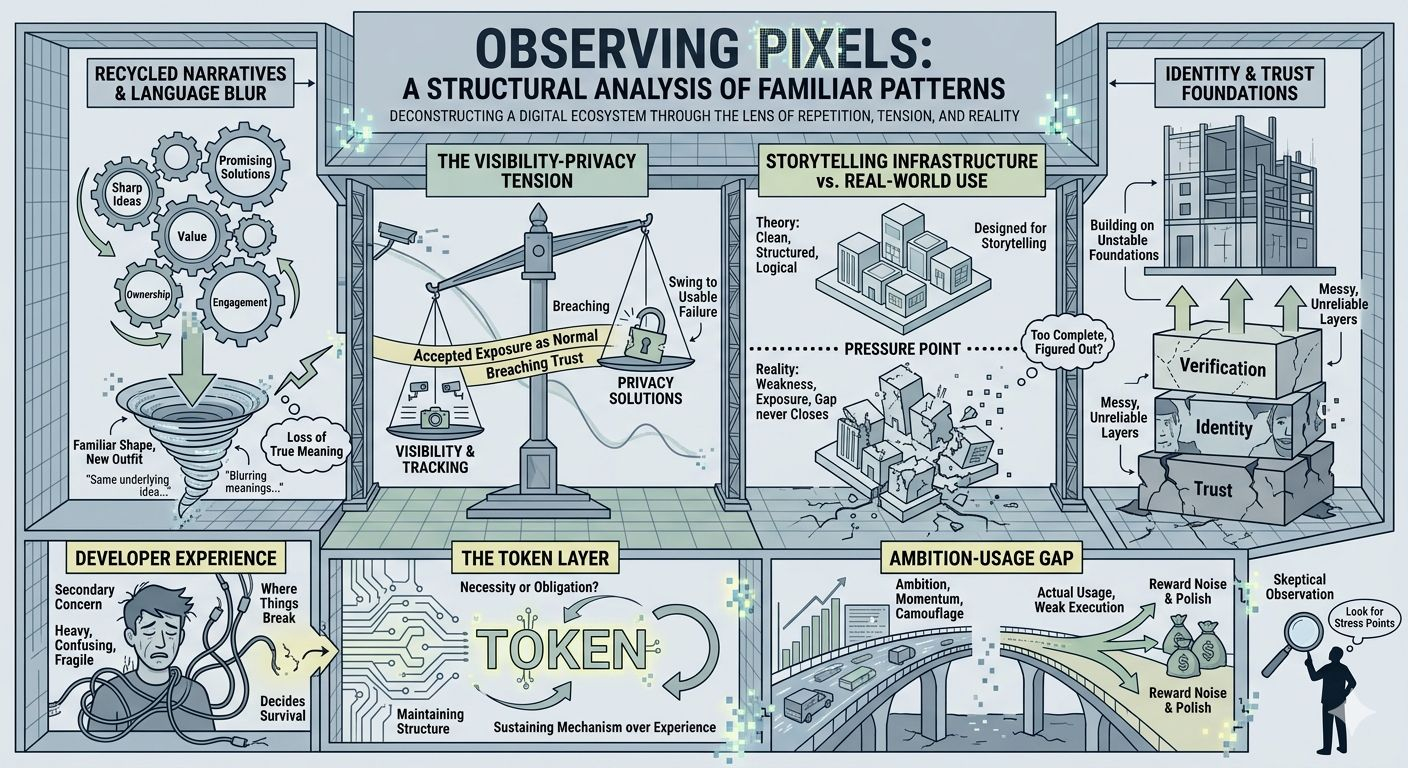
I keep coming back to the same thought whenever I look at something like Pixels, and it’s not excitement anymore, it’s more like a quiet pause. I’ve seen this shape before. Not the exact form, not the same language, but the same underlying idea dressed in a slightly different outfit. And maybe that’s what’s been bothering me the most lately. It’s not that the ideas are bad, it’s that they feel familiar in a way that makes me question whether anything is actually changing or if we’re just getting better at retelling the same story.
With Pixels, I catch myself thinking about how often I’ve watched narratives get recycled until they lose meaning. At first, everything sounds sharp and promising, like it’s finally addressing the problems that have been sitting unresolved for years. But then, over time, the language starts to blur. Words like value, ownership, and engagement get stretched so thin that they stop anchoring to anything real. I’m not even sure when that shift happens, but I feel it. It’s like I’ve heard it all before, just rearranged in a way that makes it sound new again.
Pixels also brings me back to this constant tension I can’t seem to ignore, the one between transparency and privacy. Every system claims to balance both, but in reality, I keep seeing trade-offs that no one really wants to admit. Either everything becomes visible and trackable, or it becomes so hidden that it breaks trust in a different way. And somehow, we’ve reached a point where too much exposure is just accepted as normal. That part doesn’t sit right with me. I don’t think it ever will. At the same time, the so-called privacy solutions I’ve come across often swing so far in the other direction that they stop being usable. It turns into this strange cycle where neither side actually works, and yet we keep building around that tension as if it’s already solved.
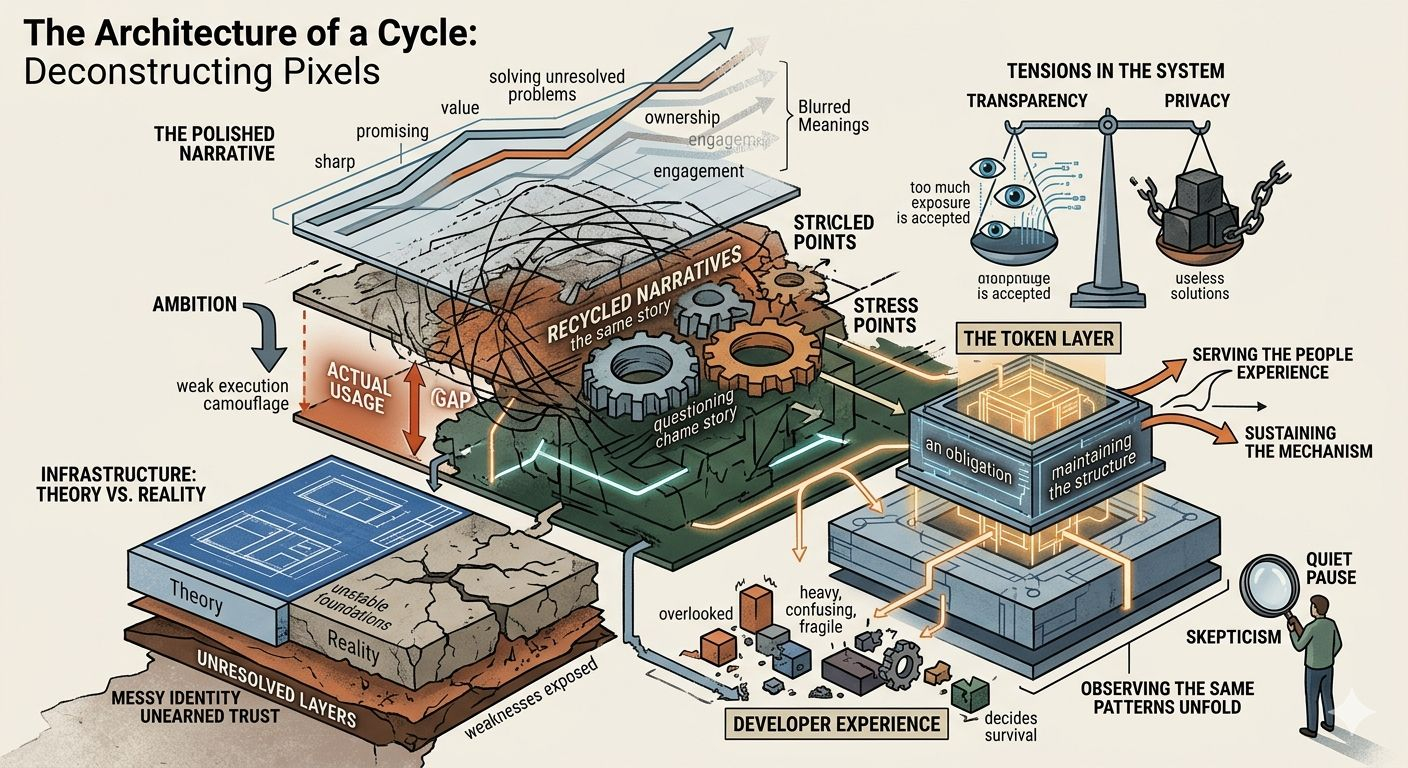
When I think about Pixels from that angle, I also start noticing how many systems feel like they’re designed more for storytelling than for real-world use. The ideas sound complete, almost too complete, like everything has already been figured out. But then I look for signs of actual pressure, real usage, the kind that exposes weaknesses, and that’s where things usually start to fall apart. Infrastructure always sounds convincing in theory. It’s clean, structured, logical. But theory doesn’t carry weight the same way reality does, and I’ve seen too many cases where that gap never really closes.
Another thing that keeps coming back to me with Pixels is how quietly developer experience gets overlooked. It’s rarely the headline, but it’s almost always where things break. If building on top of something feels heavy, confusing, or fragile, people just won’t stick around long enough to make it matter. That’s the part that doesn’t show up in polished narratives. It doesn’t look impressive on the surface, but it decides whether anything actually survives. And yet, it keeps being treated like a secondary concern.
Then there’s the token layer in Pixels, which always makes me pause a bit longer. I’ve seen so many systems where the token feels less like a necessity and more like an obligation. As if it has to exist to complete the story, even when the system itself doesn’t clearly need it. And when that happens, everything starts to revolve around maintaining that structure instead of serving the people using it. It creates this subtle pressure that shifts the focus away from experience and toward sustaining the mechanism itself.
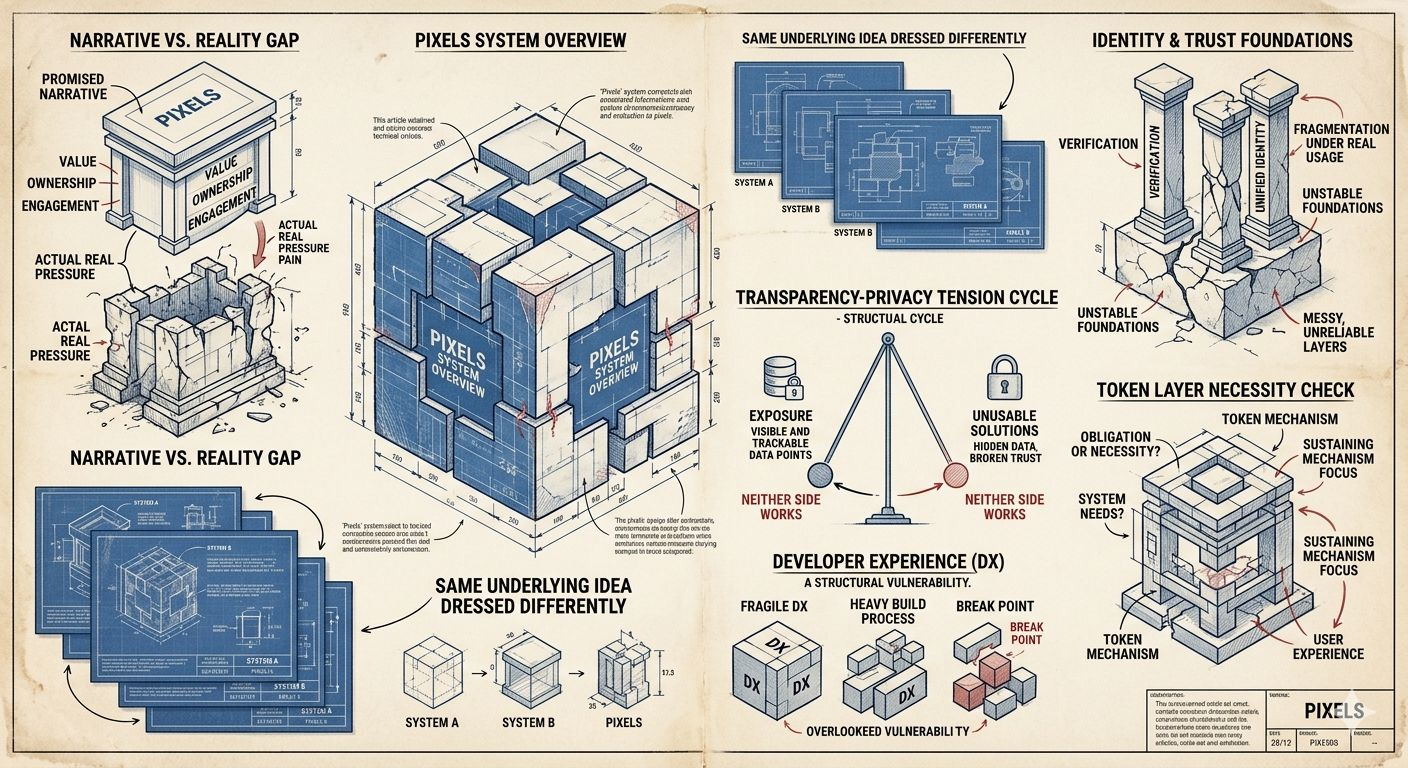
Pixels also brings up the same unresolved issues around identity and trust. Every time I look at these systems, I’m reminded of how messy and unreliable those layers still are. Verification sounds simple until you actually try to make it work across different contexts. Identity sounds unified until it fragments under real usage. Trust is always assumed, but rarely earned in a way that holds up over time. These aren’t new problems, and that’s exactly why they stand out to me. We keep building on top of foundations that are still unstable.
What I notice most when I step back from Pixels is the gap. The one between ambition and actual usage. It’s always there, and it rarely shrinks as much as people expect. Big ideas have a way of acting like camouflage. They draw attention, they create momentum, but they also make it easier to overlook weak execution. And the market doesn’t really help with that. It tends to reward noise, polish, and confidence far more than it rewards something quietly working as intended.
That’s probably why I’ve become more skeptical over time, especially when looking at something like Pixels. Not in a dismissive way, but in a way that makes me slow down instead of leaning in too quickly. I don’t trust polished narratives the way I used to. I find myself looking for stress points instead, the places where things might break, because those tend to reveal more than anything else.
And even with all of that, I’m still watching Pixels. Not because I’m convinced, but because I’m curious. There’s still a part of me that wants to see if something eventually pushes past this cycle. I don’t know if it will happen here or somewhere else, but I know I’ll recognize it if it does. Until then, it feels like I’m just observing the same patterns unfold again, trying to understand where, if anywhere, they might finally shift.