

I Will Be Honest...
I’ve been thinking About something lately: why do so many crypto games lose people So quickly?
Yeah... At first, They attract attention because of Rewards, token prices, and the feeling that Players can finally “earn” something from their time. But after a few weeks, Many people leave. The economy becomes weak, rewards feel less meaningful, and the game Itself often starts to feel like work.
That has always been the strange contradiction inside play-to-earn.
Games are supposed to feel fun, social, and immersive. But many early crypto games treated Players like short-term workers inside a Digital economy. People Logged in to farm tokens, not because they Loved the experience, but because they hoped to make money before the System slowed down.
The problem is that this creates the wrong kind of behavior.
When players are only there for rewards, They Usually leave as soon as those rewards become smaller. That creates Pressure on the token, pressure on the Economy, And pressure on the developers to keep giving away More and more value Just to keep attention Alive.
I think this is One of the biggest unanswered questions in crypto gaming Today.
What are we really trying to build?
If the goal is only To create another rewards machine, then most of these systems will Continue to collapse under their own weight. But if the goal is to create games People genuinely Enjoy, while also using blockchain to reward meaningful Behavior, then the Conversation Becomes Much more interesting.
That is why PIXEL GAME caught my attention.
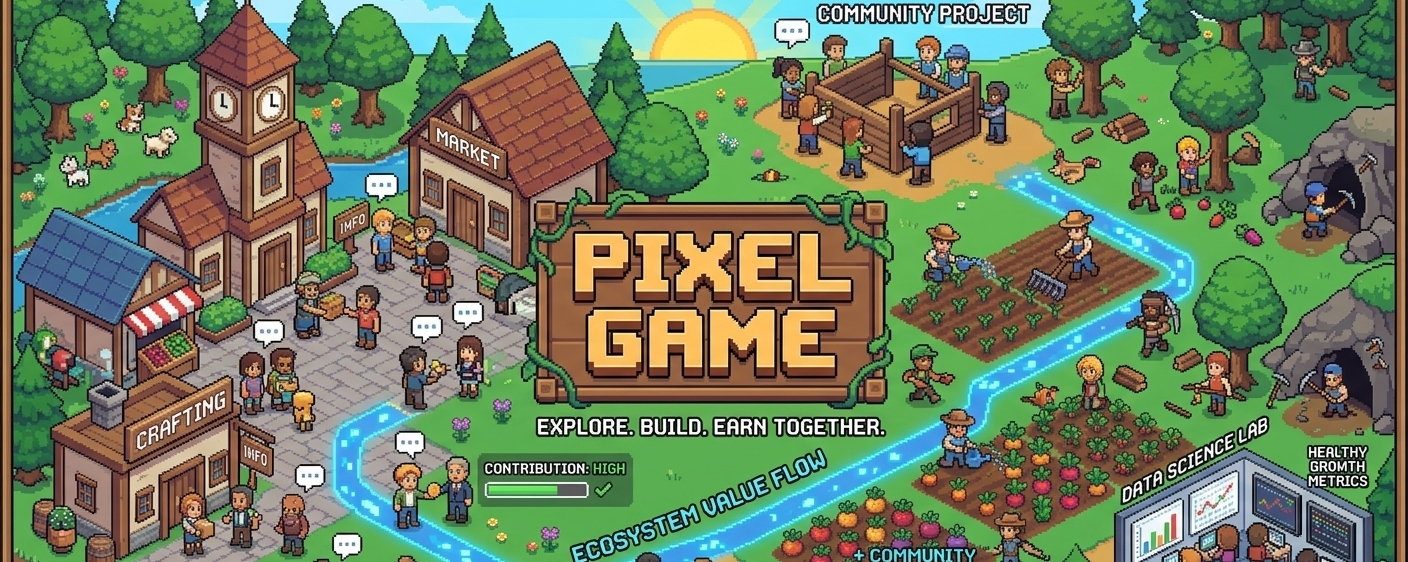
What stands Out to me is not that it became popular As a farming game. We have already Seen many games grow Quickly in crypto. The more important idea is that PIXEL GAME seems to understand that Rewards alone are not enough.
The team Appears to be approaching play-to-earn From a different angle. Instead of asking, “How do we give everyone tokens?” They seem to be asking, “Which player behaviors actually help the Game grow, and how Can we Reward Those behaviors in a smarter way?”
That difference matters.
Not every Player action creates real value. Someone who invites friends, builds a Community, stays active for months, or contributes to the in-game Economy in Healthy ways is very different from Someone who arrives only to Farm Rewards for a few days.
Most crypto Games do not separate those two Groups very well.
PIXEL GAME Seems to be trying to solve that with data.
In simple terms, The project appears to use player Behavior as a signal. It looks at what people Do inside the game, which actions lead to long-term engagement, And which players are more likely to contribute to the ecosystem over Time. Rewards can then be directed toward those stronger behaviors Instead of Being spread blindly across Everyone.
That may sound simple, but I think it could be One of the most important shifts in Web3 Gaming.
For years, the industry has treated incentives Like a faucet: turn it on, give everyone rewards, hope people stay. But smarter Targeting could make the entire system More sustainable.
It reminds me a little of how digital advertising evolved.
In the early days, companies spent money broadly And hoped for results. Over time, data made advertising More precise. Brands Learned which Users were likely to stay, buy, or Engage. User acquisition Became more efficient.
PIXEL GAME seems to be applying a similar idea to gaming.
If the platform Can understand which users bring long-term value, then it can reduce Wasted rewards, Lower the cost of growth, and build healthier economies around games.
There is also an interesting second layer here.
If one game Becomes good at understanding player behavior, that information Can potentially help future games too. Better data can attract better developers. Better developers can attract more players. More players Create more Data. Over time, that cycle can become a Kind of publishing engine instead of just a single game economy.
I think that part is easy to underestimate.
Most people still look at crypto gaming as isolated Projects competing for attention. But the bigger opportunity may be creating Networks where games Learn from each other and share Systems for Growth, rewards, and retention.
At the same Time, I do not think this is an easy model To execute.
There is Always a risk when rewards become too targeted. Players may feel like they are being Judged by invisible algorithms. Some may worry that only a small Group of “valuable” users will benefit While Casual players get ignored.
That balance will matter.
A healthy game economy still needs fairness, Transparency, and room for different kinds of players. Not everyone wants to become a Power user. Some People just want to relax, explore, and Enjoy the Experience.
That is why the “fun first” idea inside PIXEL GAME is Probably more important than The token model itself.
If the game is Not enjoyable without rewards, then no amount of data science can Save it.
But if the Game is genuinely fun, and rewards are Used carefully to strengthen Healthy behavior instead of replacing Enjoyment, Then maybe play-to-earn has a Future that looks very Different from its first Generation.
I keep coming back to the same thought.
Maybe the next stage of crypto gaming is not about paying people more.
Maybe it is about understanding people better.
What are we actually building when we combine games, data, and incentives?
Can reward systems ever feel fair without becoming exploitative?
And if projects like PIXEL GAME succeed, Could they change not only how games Grow, but also how people think about value, loyalty, and participation in Digital worlds?
For me, that is the real story here. Not whether one Game becomes bigger than another, But whether the industry finally learns How to reward people without turning Play into labor.