
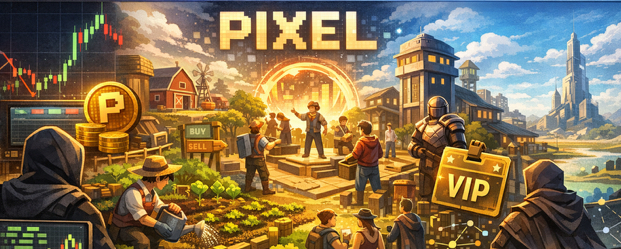
PIXEL is usually packaged as a gaming token, and I get why people do that. It is the easiest label to stick on it. Clean, familiar, disposable. But after looking at enough of these projects over the years, I don’t trust the clean version of the story anymore. I’ve seen too many tokens get wrapped around half-finished worlds, too many “economies” that were really just exit liquidity with better art direction, too many communities built on momentum and then left to sit in the dust once the chart rolled over.
So when I look at PIXEL, I’m not really asking whether it’s a game token. That question feels stale already. I’m asking whether there’s actually a world here, or just another layer of market noise sitting on top of routine gameplay.
That’s the split that matters.
Because a token by itself means nothing. I can’t stress that enough. Crypto has spent years recycling the same basic trick — take a game, add ownership language, add a currency, add some scarcity, add a social layer, and hope people mistake activity for depth. For a while, that worked. It worked because the market was loud, money was loose, and almost nobody wanted to admit how fragile most of those systems were. People were calling things economies when they were really just incentive loops with a shorter shelf life than the marketing campaign.
PIXEL, at least from where I’m sitting, looks like it wants to be more than that. I’m careful with that phrasing. Wants to be. Not is. Not yet.
Because this is where the grind starts.
The real test for a project like this is never launch hype. It’s never the first rush of attention. It’s what happens after the easy optimism burns off and everyone left in the room has to decide whether there is still enough here to care. That’s where most projects break. The language stays ambitious, the roadmap stays busy, the community account keeps posting, but the actual world underneath it starts thinning out. You can feel it. Less curiosity. Less attachment. More people talking about price than play. More management than momentum.
That’s what I’m watching for with PIXEL.
Not whether it can attract interest for a week. Plenty of projects can do that. I’m looking for whether the thing has actual internal weight. Whether players are just passing through, or whether they’re starting to build habits inside it. Whether ownership means anything beyond resale. Whether progression creates real attachment or just more friction. Whether the token is part of a functioning environment, or just sitting there as a financial object that people politely pretend is tied to gameplay.
Because if the world doesn’t come first, the whole thing turns hollow fast.
That’s been the pattern, over and over. The project says it’s building a player-driven economy. Fine. Then you look closer and it’s mostly people trying to optimize extraction before the music stops. Nobody is there because the world feels alive. They’re there because they think they got in early enough to matter. Different thing entirely. Once that mood creeps in, everything starts to flatten. Every system gets interpreted through yield. Every mechanic gets reduced to efficiency. Every update gets judged by whether it improves the farm. At that point you don’t really have a game anymore. You’ve got a grind loop with a market attached.
PIXEL seems aware of that trap, which is one reason I’m still paying attention.
There’s a sense that it wants the token to sit inside a broader world rather than replace the world. That matters. Probably more than people think. I don’t care much for projects that treat the economy as the product and the game as decoration. That structure usually eats itself. What I want to see instead is whether the economic layer grows out of actual participation — out of players spending time, building familiarity, wanting better positioning, caring about access, caring about progress, caring about status even if they won’t admit that’s what it is.
That’s where a digital economy starts to feel real, at least to me. Not when there’s buying and selling. That part is easy. It starts feeling real when different people begin to occupy different roles in a world and those roles actually matter. Some people gather. Some build. Some coordinate. Some own. Some speculate. Some just hang around long enough to understand how value moves before everyone else does. Then the project starts behaving less like a game session and more like a place with internal gravity.
And that’s interesting. Rare, too.
Still, I’ve been around this market long enough to know how quickly that gravity can turn into dead weight.
Because the moment a project starts layering in ownership, access, scarcity, premium advantages, and all the rest of it, the mood changes. It has to. The experience stops being flat. Some players move faster. Some get better positions. Some have more leverage. Some are effectively priced into the better version of the world while others circle the outer edge of it. That can make a project richer. It can also make it feel quietly rigid, like the hierarchy settled in before the world had enough life to justify it.
That’s the part people tend to romanticize. They talk about digital economies as if they naturally produce agency. Sometimes they do. Sometimes they just produce a better organized version of the same old imbalance. I’ve seen plenty of projects confuse structure with health. A system can be structured and still feel dead. It can have markets, assets, guilds, access tiers, all of it, and still feel like nobody actually loves being there.
I don’t think PIXEL gets a free pass from that. Not even close.
If anything, the more a project tries to become a persistent world, the harsher I get with it. Because now I’m not just asking whether the mechanics function. I’m asking whether the place feels inhabited. Whether players have a reason to come back that isn’t just financial inertia. Whether the token deepens the world or adds more noise to it. Whether the social layer creates attachment or just one more ladder for people to climb.
And honestly, that last part matters more than whatever the market is pricing in on a given day.
Price is the loudest signal in crypto and usually the dumbest one. I’m tired of watching people use price action as a shortcut for understanding. A token can rip because the market is bored and needs a new object. It can bleed for months while the underlying product is still trying to find its shape. Neither of those things tells me much on its own. What I care about is slower. More annoying, too. I care about whether the world can survive after the excitement fades and the people left inside it stop acting like tourists.
That’s where I think PIXEL becomes worth discussing.
Not because it solved anything. Not because it proved gaming has become an economy. That kind of grand statement is exactly the sort of polished nonsense this market has produced too much of already. What it may be showing instead is something narrower, and probably more honest: that some games are drifting into a middle state where they are no longer just entertainment, but not cleanly economies either. They become these strange digital spaces where play, status, ownership, repetition, access, and money all start rubbing against each other until the distinction gets blurry.
That blur is the real story.
And I don’t think enough people are comfortable with what it implies. Because once a game starts remembering your position, once your time inside it hardens into assets or standing or leverage, it stops feeling like pure leisure. It starts carrying the weight of maintenance. You log in not just to play, but to protect your place, improve it, maybe defend it from drift. That can be compelling. It can also be exhausting. Depends on the project. Depends on the player. Depends on whether the world gives enough back.
That’s what I’m still trying to figure out with PIXEL.
I can see the outline of something more durable than the usual tokenized game pitch. I can also see all the usual risks sitting right beside it. Recycling. Noise. Friction. The same old market habits waiting to swallow the thing if the actual world isn’t strong enough.
So I keep coming back to the same question, and it’s not whether PIXEL can be traded, or marketed, or dressed up as the future of anything. I’ve heard all of that before. I’m asking whether people will still care when the incentives feel less immediate, when the chart stops doing the storytelling for them, when staying starts to feel a little like work.
And if they do, what exactly have we built at that point?