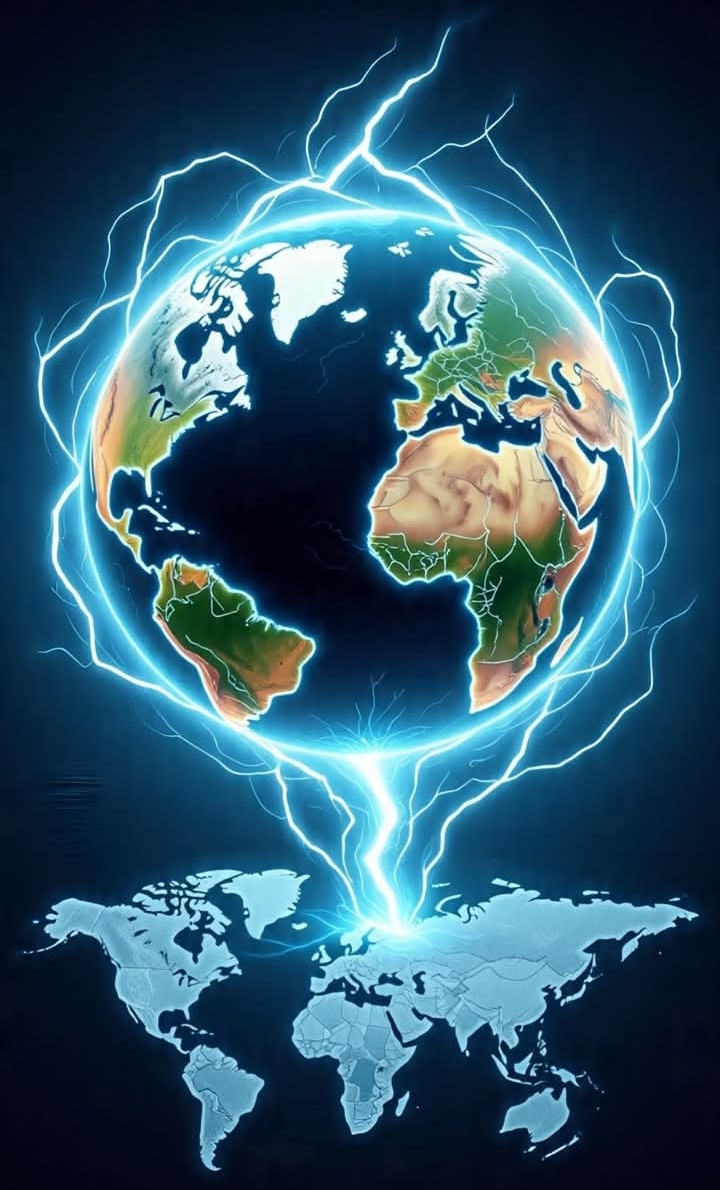
The world will be divided into three centers of power.
The Middle East will be affected the most, where the geographical structure of many countries may not remain the same.
The era of the United States as a superpower seems to be coming to an end.
If India does not swallow the bitter pill, its fate could be similar to that of the Soviet Union.
NATO may become irrelevant, and the United States could end up almost confined within its own borders.
This article by Suhail Yaqoob was published on page 11 of today’s Express newspaper. If you wish to read it in the newspaper, the link is available in the first comment.
The Expected Geography of the World
Astrologers around the world had declared 2026 as a year of change (or even destruction), but no one imagined that these changes would occur so rapidly. While it was already being observed that the United States’ time as a superpower might be ending, few expected that its military strength—especially against Iran (along with China, Russia, and North Korea)—would falter in such a manner.
Pakistan always needs millions of dollars, but the million-dollar question now is: what happens next? Every era has discussed the concept of a “New World Order,” and those who speak of it often attempt to outline a new global map. Today, once again, a new global classification is being discussed. According to this view, the world will be divided into three major power centers. This article attempts to outline their possible features.
It appears certain that a new alignment is forming globally, which could reshape the world’s geography. The Middle East will be most affected, where some countries may not retain their current borders and may even need to merge with others for survival. Even Israel, if it wishes to survive, may have to abandon the dream of a “Greater Israel” and accept ground realities.
Oil wealth will continue to come from the Middle East as long as oil exists, but investments may shift away from the US dollar into other currencies. Wealthy individuals may also begin seeking new regions for living and investment.
Asia is expected to emerge as a strong, unified force, led by China. Pakistan could play a key supporting role, and surprisingly, Japan and South Korea may also align with this new direction.
For Pakistan, the future is extremely important. It has the potential to play a significant global role, but only if internal issues like corruption, poor governance, and inefficient systems are addressed. A strong global role requires a satisfied and stable population.
As for India, its future role remains uncertain. It would benefit from aligning with China-led Asia, but its current leadership may find that difficult. Poor decisions under pressure could lead to serious consequences, possibly even a collapse similar to the Soviet Union.
China’s investments in Africa through its Belt and Road Initiative could position it as a dominant partner there. Africa, rich in resources, may gain importance globally, with China benefiting the most.
In Europe, the situation has evolved. The UK weakened after distancing itself from the European Union, while countries like France, Germany, and Italy now lead Europe’s direction. A more unified Europe may emerge, potentially reducing NATO’s relevance.
Finally, the “old lion” — the United States. China and Russia aim to limit US influence to the Americas. The US may eventually be forced to adapt to these new realities, as global power continues to shift.
Conclusion:
This is a general overview of a possible future world order. Some may see it as premature or unrealistic, but such ideas are shared in the hope of provoking thought. Even if the writer is gone tomorrow, the ideas will remain.