
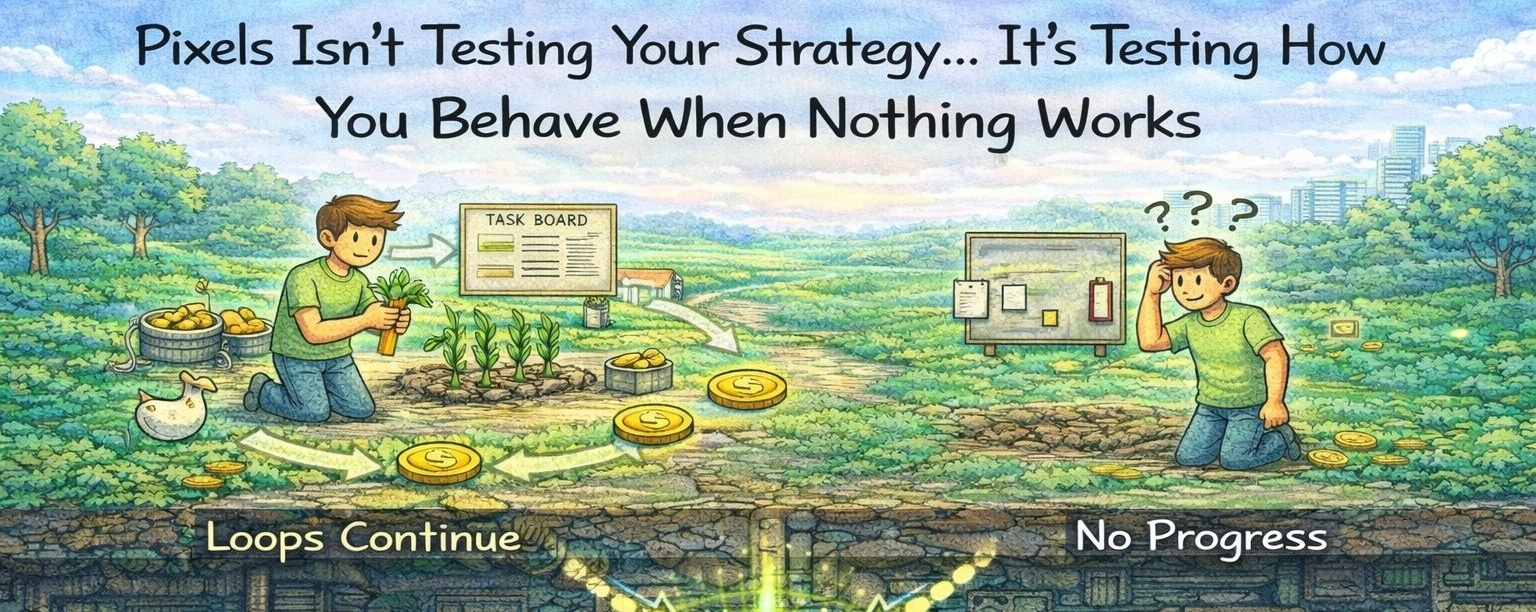
at first, Pixels feels like a strategy game.
optimize your loop, pick the right tasks, manage energy, produce what’s needed… everything looks like it should come down to decisions.
better choices → better outcomes.
that’s the assumption.
but the longer i stay inside Pixels, the less it behaves like that.
because strategy only works when the system responds directly to what you do.
and here… it doesn’t always.
you can run the “right” loop and still get nothing that connects.
same route, same tasks, same timing…
different result.
so naturally, you adjust.
try something else.
different crops, different tasks, different flow.
and sometimes it works.
sometimes it doesn’t.
but not in a way that feels tied to the change you made.
and that’s where it starts breaking.
because if outcomes don’t reliably follow decisions…
then what exactly is being tested.
inside Pixels, nothing really stops you.
you can always continue.
there’s always another loop.
Coins keep flowing no matter what you choose.
so the system isn’t testing whether you can act.
it’s testing something else.
what you do…
when acting stops working.
because those sessions exist.
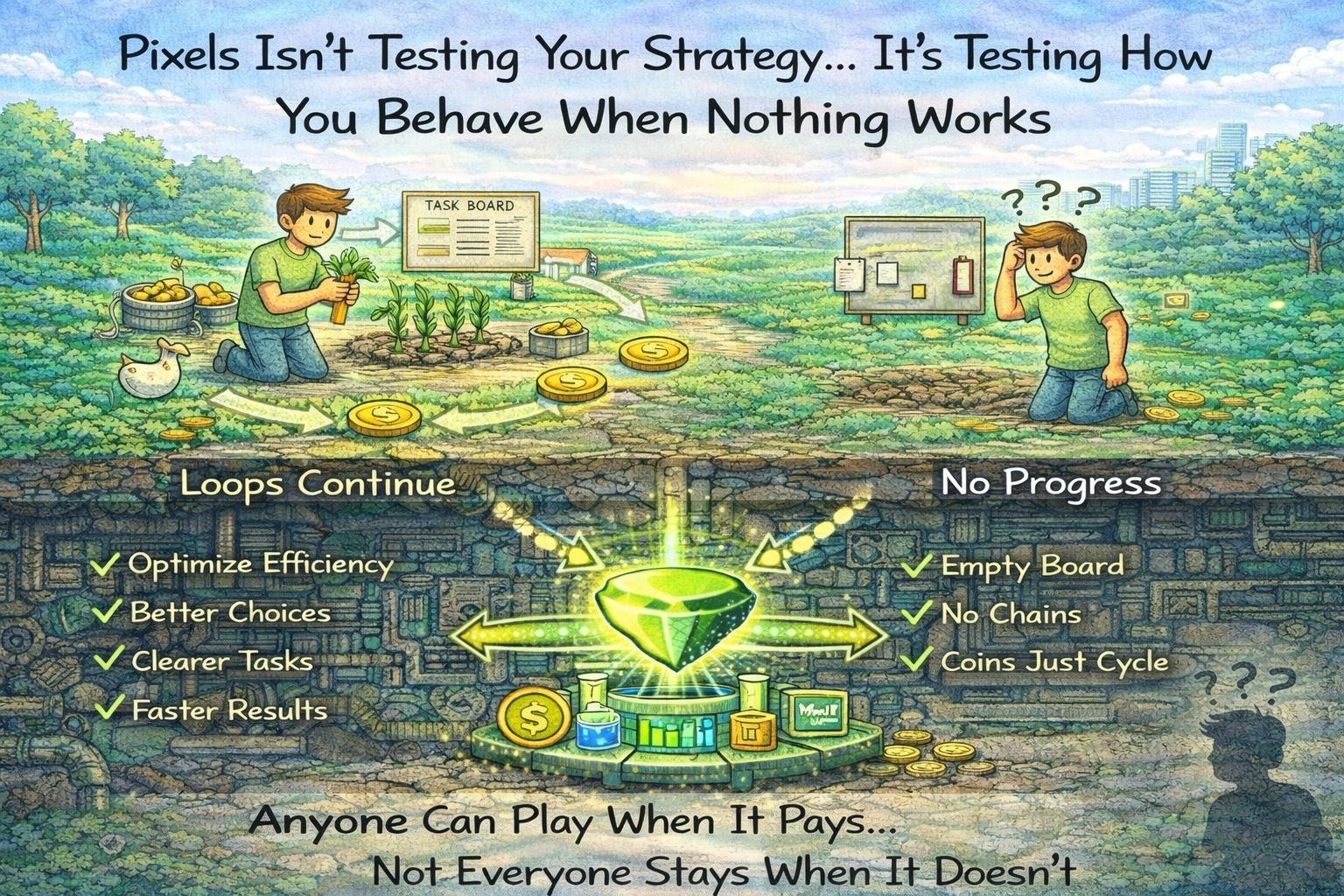
the ones where the board feels empty.
where nothing chains.
where everything you do just cycles back into Coins.
and those are the moments that feel pointless from the player side.
like wasted time.
no feedback.
no signal.
nothing to optimize.
but what if those moments aren’t empty at all.
what if that’s the actual test.
not when rewards are high.
but when they disappear.
“anyone can play when it pays… not everyone stays when it doesn’t”
that’s the part that starts to stand out.
because behavior changes in those sessions.
some players log out.
some switch loops constantly trying to force something.
some just continue… without expecting anything immediately.
and even if it’s not obvious, it feels like the system notices that difference.
not instantly.
not directly.
but over time.
because eventually, something shifts.
not dramatically.
just slightly.
better boards.
more connections.
more consistency.
and it doesn’t feel tied to a single action.
it feels tied to how you handled the absence of results.
which is uncomfortable in a different way.
because now the game isn’t just observing what you do when things are working.
it’s observing what you do when they’re not.
and that’s harder to fake.
strategy can be copied.
loops can be shared.
routes can be optimized.
but behavior under uncertainty…
that’s personal.
so maybe Pixels isn’t really testing your ability to play efficiently.
maybe it’s testing your response to friction that doesn’t look like friction.
because there’s no visible barrier.
no message saying “you failed.”
no cooldown that locks you out.
just a system that keeps running…
while quietly deciding what to do with your presence inside it.
and that’s why those empty sessions feel different.
not because nothing is happening.
but because everything is being observed without immediate reward.
“it’s not the action… it’s the reaction to the lack of outcome”
once that clicks, the loop changes slightly.
you still farm.
you still craft.
you still check the board.
but now you’re also aware of something else running alongside it.
something that doesn’t care about your last move…
but about your consistency across moments that don’t pay.
and that creates a strange tension.
because you don’t know when it matters.
there’s no signal.
no confirmation.
just delayed shifts that may or may not connect back to what you did earlier.
so you keep playing.
not just for rewards…
but through the absence of them.
and at some point, something connects again.
a chain appears.
the board opens up.
pixels shows up.
and it feels like a response.
but not to what you just did.
to everything you didn’t stop doing before that.
which leaves one question that doesn’t resolve cleanly:
if the system is watching how you behave when nothing works…
then are those empty sessions actually the most important ones
and we’ve just been treating them like they don’t matter.