
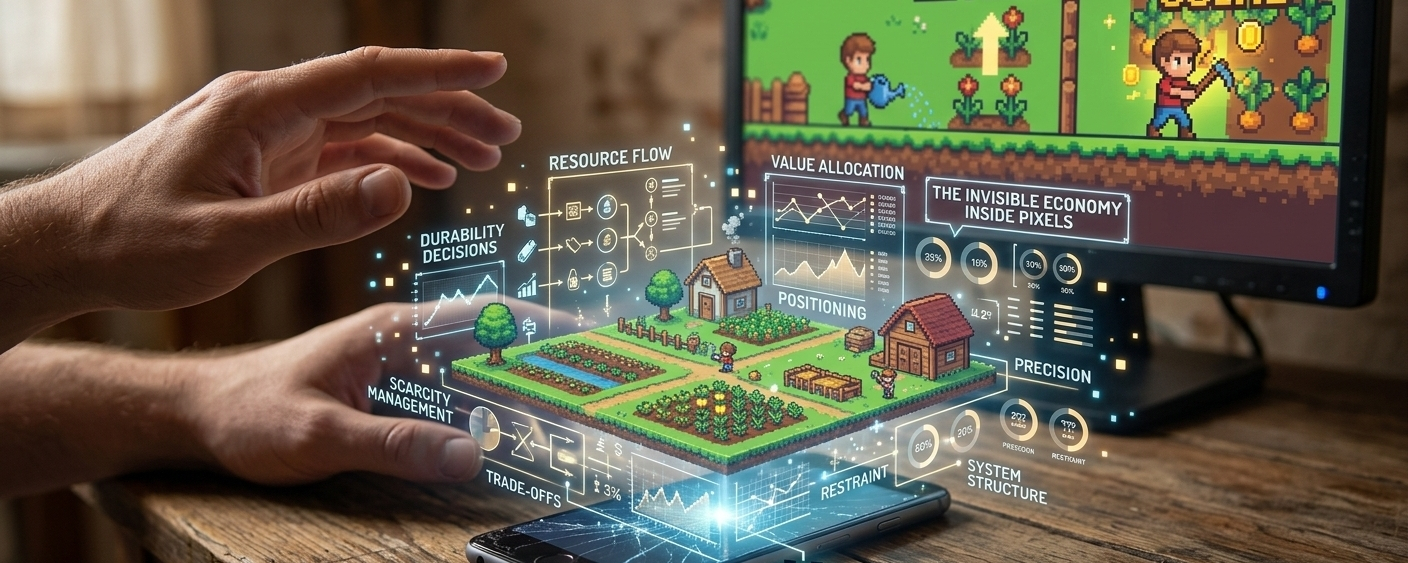

There’s a moment in @Pixels that doesn’t announce itself.
No level-up animation. No reward chest. No milestone badge.
Just a quiet shift.
At first, everything feels familiar. You move fast. You farm, craft, spend energy, earn, repeat. It’s instinctive—almost automatic. Like every other loop you’ve known. Progress feels tied to action. Do more, get more. Simple.

But then something changes.
Not in the game.
In you.
You begin to hesitate.
Not because you’re stuck—but because you’re thinking.
“Is this worth it?”
That question is where Pixels stops being just a game.
By the time Tier 5 settles in, the system reveals its real shape—not by adding complexity, but by introducing consequence.
Scarcity starts to matter.
Durability isn’t just a stat—it’s a decision.
Resources stop being things you use and start becoming things you allocate.
And suddenly, doing everything feels inefficient.
So you don’t.
You slow down.
You skip actions.
You wait.
Not because you have to—but because you’ve learned that movement without intention costs more than standing still.
This is where the divide appears.
New players are still playing.
Veteran players are managing.
Same world. Same mechanics. Completely different mindset.
One sees opportunity everywhere.
The other sees trade-offs.
One maximizes activity.
The other maximizes value.
And the system never explicitly teaches this.
It just quietly rewards those who figure it out.
Then comes the deeper realization—the one that reframes everything.
Your effort isn’t creating value.
It’s positioning you for it.
Pixels doesn’t reward output the way traditional games do. You’re not generating infinite value through grind. You’re aligning yourself with a controlled flow—one that exists above your individual actions.
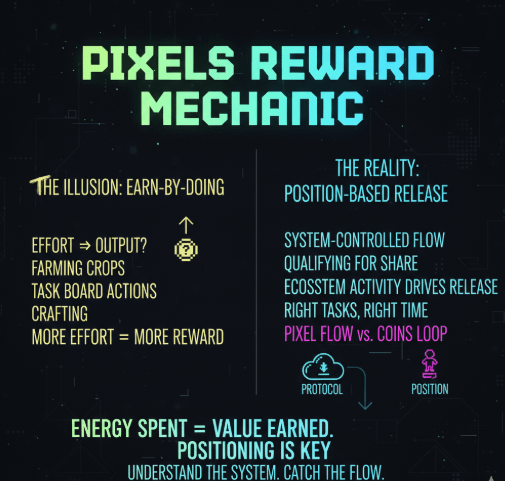
That’s why high-effort sessions don’t always feel different from moderate ones.
Because the ceiling isn’t yours to break.
It’s already set.
The system decides how much value moves through players—and your role is to be in the right place, doing the right things, when it does.
This is where most players fall behind.
They mistake motion for progress.
They burn energy inside loops that sustain activity but never touch real value.
They optimize effort… inside the wrong layer.
Meanwhile, the players who understand the system aren’t doing more.
They’re doing lessbbut with precision.
They watch.
They adapt.
They position.
And when value flows—they’re already there.
Mmm? Mmm
Pixels doesn’t punish you for playing casually.
But it quietly rewards you for thinking structurally.
And that changes something fundamental about what “fun” feels like.
It becomes quieter.
Less reactive.
More deliberate.
Sometimes the best move is restraint.
Sometimes the smartest action is no action at all.
So the question isn’t whether Pixels is a good game.
It’s something deeper.
If your success depends more on positioning than effort…
If your rewards come from alignment rather than action…
If your mindset shifts from playing to managing…
Then what exactly are you participating in?
A game?
Or a system that’s teaching you how economies really work?
Maybe that’s the real value.
Not the token.
Not the assets.
Not even the progression.
But the moment you stop playing blindly…
…and start seeing the structure underneath.