



I didn’t expect this shift to feel uncomfortable.
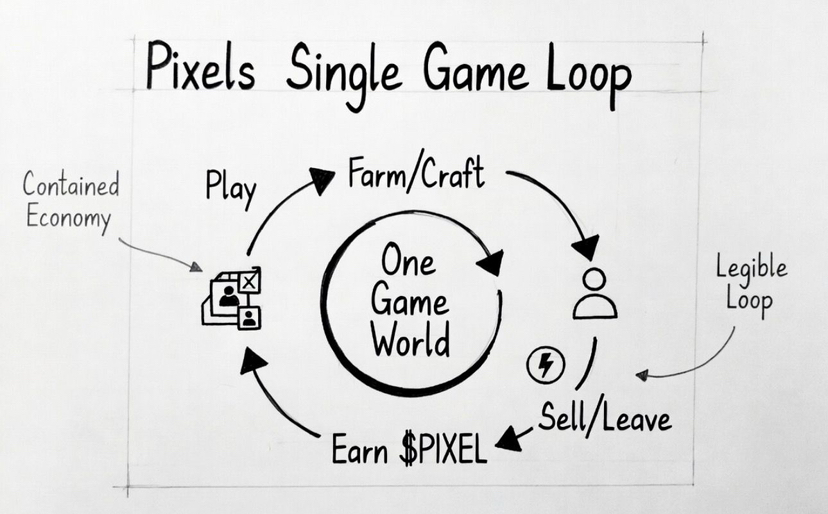
For a long time, Pixels made sense because it stayed contained. One world, one loop, one economy you could mentally map. You understood where value came from, where it leaked, and why people stayed or left. Even when things broke, they broke inside a system you could see.
Stacked quietly breaks that containment.
At first glance it looks like expansion. Another layer, another product, another surface where rewards flow. But the more I sat with it, the more it started to feel like Pixels stepping away from being a single game entirely.
And that creates a tension most people are missing.
Because once you stop being one game, you lose the simplicity that made your economy legible in the first place. You’re no longer tuning one loop. You’re coordinating behavior across multiple environments, each with different pacing, different skill curves, different player intent. The risk isn’t just imbalance anymore. It’s fragmentation.
So the real question isn’t “what is Stacked?” It’s whether Pixels can actually hold a shared economic logic across different types of play without collapsing into either chaos or sameness.
That’s where the architecture starts to show.
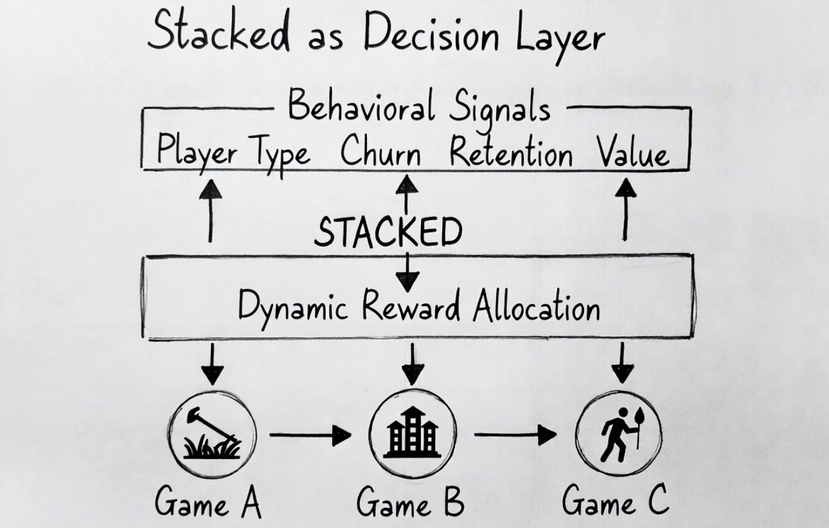
Stacked isn’t just distributing rewards. It’s sitting above the games as a decision layer. That changes everything. Instead of each game deciding its own incentives in isolation, there’s now a system that observes behavior across contexts and allocates rewards based on what actually moves the economy forward.
This is the part that doesn’t look flashy but matters the most.
A normal game loop rewards completion. You farm, you craft, you earn. The system doesn’t really care what that action means beyond the immediate loop. But a LiveOps engine like Stacked doesn’t look at actions in isolation. It treats them as signals.
What kind of player is this? Are they early-stage, mid-loop, or late-game? Do they churn after certain actions? Do they convert into spenders? Do they return after incentives, or just extract and leave?
That data isn’t new. Every game tracks it. But Pixels is doing something different with it.
They’re tying reward distribution directly to those signals.
So instead of static missions, you get dynamic tasks that exist because the system has decided a certain behavior is worth funding. Not because it’s fun in isolation, but because it pushes the overall economy toward something healthier.
That’s where “return on reward spend” stops being a phrase and starts becoming a constraint.
And constraints are where systems get real.
Because once you force rewards to justify themselves, you kill a lot of habits that most Web3 games rely on. You can’t just inflate emissions to keep activity high. You can’t hide behind vanity metrics like daily active users if those users don’t translate into retention or value creation. Every reward becomes a cost that needs to produce something measurable.
This is where Stacked feels less like a feature and more like infrastructure.
It’s essentially turning rewards into a capital allocation problem.
And that creates a different kind of loop.
Instead of: play → earn → sell → leave
You start seeing: play → behavior tracked → reward adjusted → behavior reinforced (or discouraged)
The system is learning which actions are worth paying for.
That feedback loop is slow, and it’s messy at the beginning. That’s why the soft launch matters more than people think. You can’t deploy something like this at scale without understanding how players will try to exploit it.
Because they will.
Any system that allocates rewards dynamically becomes a target. Players will test edges, find low-effort high-reward paths, and try to farm the system itself instead of the game. If the engine isn’t grounded in real behavioral signals, it turns into another optimization problem for extractors.
That’s why starting small is not caution. It’s necessity.
You need to see how real players behave when incentives shift under them. You need to understand where the system overpays, where it underpays, and where it completely misreads intent. Only then can you tighten the logic.
And this is where Pixels is pulling from its past, whether they say it directly or not.
They’ve already lived through reward inflation. They’ve seen what happens when emissions run ahead of value. They’ve watched loops fill with players who aren’t there for the game at all. That experience is embedded into this design.
Stacked feels like a response to that history.
Not by removing rewards, but by making them accountable.
The multi-reward direction ties into this in a way that’s easy to overlook.
Single-token systems always end up overloaded. One asset has to do everything: incentivize behavior, reward players, capture value, attract speculation, and maintain alignment. That tension eventually breaks something. Either the token becomes too volatile to function as a reward, or it becomes too inflationary to hold value.
By separating rewards, Pixels is creating room to specialize.
Different rewards can target different behaviors without dragging the entire economy with them. Some rewards can be short-term incentives. Others can be tied to longer-term engagement. Some can be experimental without risking the core token.
That frees $PIXEL from being a constant emission engine.
It can start behaving more like a settlement layer for the ecosystem rather than the fuel for every single action. That shift is subtle but important. It means the growth of the system doesn’t automatically translate into more sell pressure on one asset.
But it also introduces a new challenge.
Coherence.
When you have multiple reward types across multiple games, you risk losing a shared sense of value. Players start optimizing for whichever reward is easiest or most profitable, not necessarily what the system actually needs.
This is where Stacked’s role becomes even more critical.
It’s not just distributing rewards. It’s coordinating them.
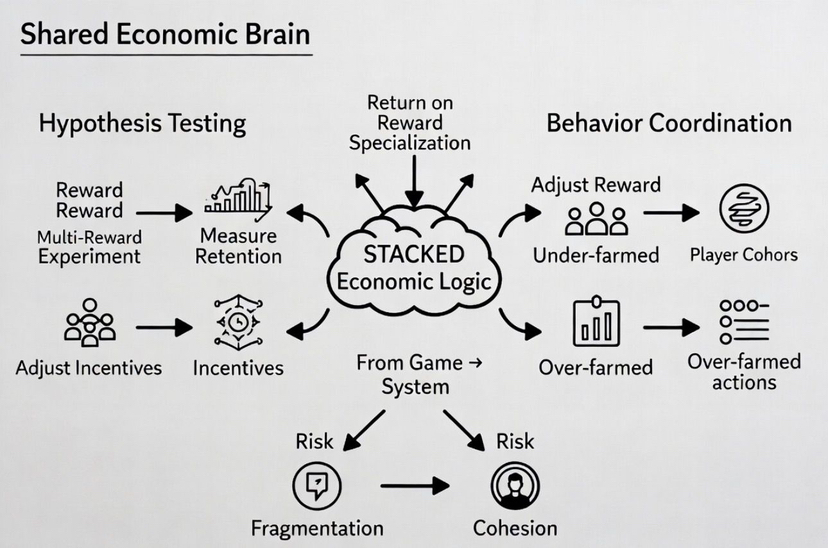
It decides which reward type appears where, for which cohort, and under what conditions. That’s how you avoid turning the ecosystem into a fragmented set of mini-economies that don’t talk to each other.
In a way, Stacked is acting like a market maker for player behavior.
It’s constantly adjusting incentives to balance supply and demand for specific actions. If a certain activity is underperformed but important, rewards increase. If it’s overfarmed, rewards compress. Over time, this should guide players toward behaviors that keep the economy stable.
But this only works if the signals are real.
If the system starts optimizing for the wrong metrics, everything drifts. You end up rewarding activity that looks good on paper but doesn’t translate into actual value. That’s the hidden risk in any data-driven reward system.
You’re only as good as what you measure.
And this is where Pixels’ approach feels different from earlier cycles.
They’re not pretending rewards are inherently good.
They’re treating them as something that can go wrong.
That mindset changes how you build.
You don’t design rewards to attract users. You design them to test hypotheses. Does this behavior increase retention? Does this cohort respond to this incentive? Does this loop produce players who stay longer or spend more sustainably?
Every reward becomes an experiment.
And Stacked is the system running those experiments at scale.
That’s why the bigger story here isn’t expansion into multiple games.
It’s the creation of a shared economic brain that sits above them.
Pixels is trying to move from: a game with rewards
to: a system that understands rewards
That’s a much harder problem.
Because now you’re not just building content. You’re building decision logic. You’re encoding what the system believes is valuable and continuously updating that belief based on outcomes.
Most games never get there.
They either rely on static design or reactive patches. They adjust numbers, tweak drop rates, maybe redesign a loop. But they don’t build a system that actively reallocates incentives in real time based on behavior.
That’s what makes this shift feel different.
It’s less visible, but it’s deeper.
And it also explains why it doesn’t feel like a “new feature.”
Features don’t change how a system thinks.
This does.
If it works, Pixels won’t just be a collection of games connected by a token. It will be an economy where behavior flows across titles, guided by a shared logic that decides what deserves to be rewarded.
If it doesn’t, it fragments. Players chase rewards without cohesion, games lose identity, and the system becomes harder to reason about than it’s worth.
That’s the real tension.
Not whether Stacked succeeds as a product, but whether this shift from game design to economic orchestration can hold under real player behavior.
Because once you stop thinking like a single game, you don’t get to go back.