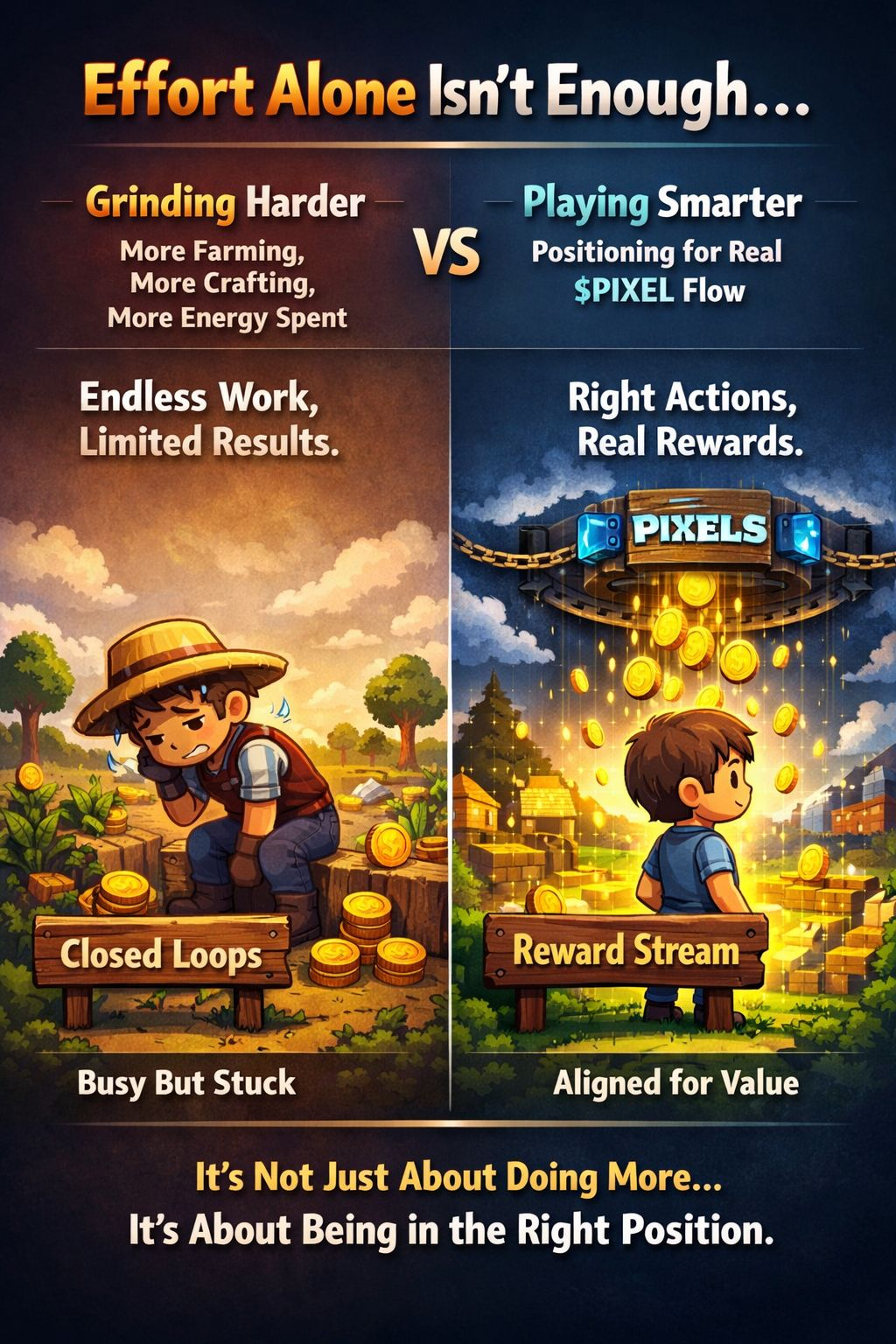
I used to think @Pixels worked in a simple way. The more time I spent playing, the more I should earn. More farming, more crafting, more energy used, meant more $PIXEL coming back.
That assumption felt natural because most games reward effort directly.
But Pixels does not really work like that.
After spending more time observing how rewards actually show up, I realized something important. My output was not directly generating value. Instead, I was being placed inside a system that decides when value is released and who is positioned to receive it.
That shift in understanding changes everything.
There were sessions where I pushed harder than usual. Longer farming, more tasks, more focus. Yet the rewards were not significantly different from lighter sessions. At first I thought I was missing something or playing inefficiently. But the pattern kept repeating.
That is when it became clear that the limitation was not on my effort. The limitation was in how the system releases value.
$PIXEL is designed to avoid the problems that come with pure grind based economies. If rewards scaled endlessly with effort, players would optimize everything, flood the system, and break the balance. Many games before have failed because of that.
Instead, #pixel controls value flow at the ecosystem level. It looks at total activity, circulation, spending patterns, and overall balance across all players. Then it releases rewards in a controlled way through that structure.
This means your individual effort is not the main factor. Your position within the flow of the system matters more.
A lot of players stay busy inside loops that feel productive but do not actually connect to where value is released. Energy gets spent, tasks get completed, but the path to real reward is indirect or limited.
Understanding this changes how you approach the game.
Instead of trying to simply do more, you start paying attention to what actually connects you to the flow of PIXEL. Which actions sit closer to reward distribution. Which systems feel like they lead outward instead of just recycling activity internally.
The grind is still there, but it is not what creates the reward. It only keeps you close enough to receive it when it flows.
Most people only realize this after spending too much time optimizing effort in the wrong direction.
At that point, the real game is not about working harder. It is about understanding where value actually enters the system and staying aligned with it.