
I Started Noticing This Pattern Again
There’s something off about how people interact with Web3 games.
Not the numbers. Those always look fine in the beginning.
The behavior.
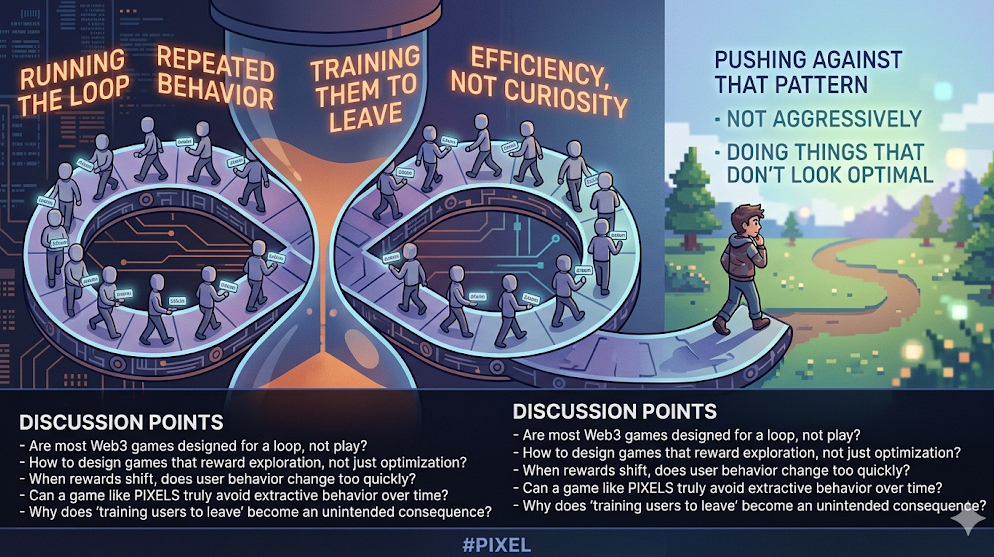
You log in, do what’s needed, and log out. Come back only when there’s something to claim. Everything is timed, calculated, almost mechanical.
At some point, you’re not playing anymore.
You’re just running a loop.
The System Teaches You That
This isn’t really the player’s fault.
Most games are designed this way.
They reward efficiency, not curiosity. The faster you complete things, the better. The less you “waste time,” the more you gain.
So players adapt.
They stop exploring. Stop experimenting. Stop caring about anything outside the loop.
And once that loop weakens, they leave.
I’ve Seen This Break Before
In 2023, there were games where activity looked strong on the surface.
High user counts. Consistent engagement.
But if you actually watched how people played, it was empty.
Same actions. Same routes. Same behavior repeated over and over.
Then rewards shifted slightly.
And everything dropped.
Not slowly. Almost instantly.
Because no one was really there for the game.
PIXELS Feels Like It’s Pushing Against That Pattern
Not aggressively. It’s subtle.
But it’s there.
You’re not constantly pushed to optimize every move. You can still play efficiently if you want, but the system doesn’t force you into it.
That changes how people behave.
You start seeing players doing things that don’t look optimal. Staying longer than needed. Moving without a clear objective.
That’s not common in this space.
But Here’s Where I’m Not Fully Convinced
Just because players aren’t optimizing now doesn’t mean they won’t later.
If incentives shift, behavior usually follows.
People adapt quickly when there’s something to gain.
So the real question is still open.
Does this design actually hold when optimization becomes more rewarding?
Or does it slowly drift back into the same pattern?
This Is Where Most Games Fail
They attract users.
But they train them in the wrong way.
Once players learn to treat the system like a loop, it’s hard to reverse that behavior.
Even if you improve the experience later, the mindset is already set.
Why This Matters More Than It Looks
If PIXELS can avoid fully training players into that extractive behavior, even partially, it has a stronger foundation.
Not perfect. Not guaranteed.
But stronger.
Because players who aren’t locked into pure optimization are more likely to stay when things change.
Final Thought
Most Web3 games don’t lose users because they’re bad.
They lose them because they teach users to leave.
That’s the real issue.
PIXELS hasn’t solved it yet.
But it feels like it’s at least aware of the problem.
And in this space, that already puts it ahead of most.
