
Let’s try to understand what the real story is.
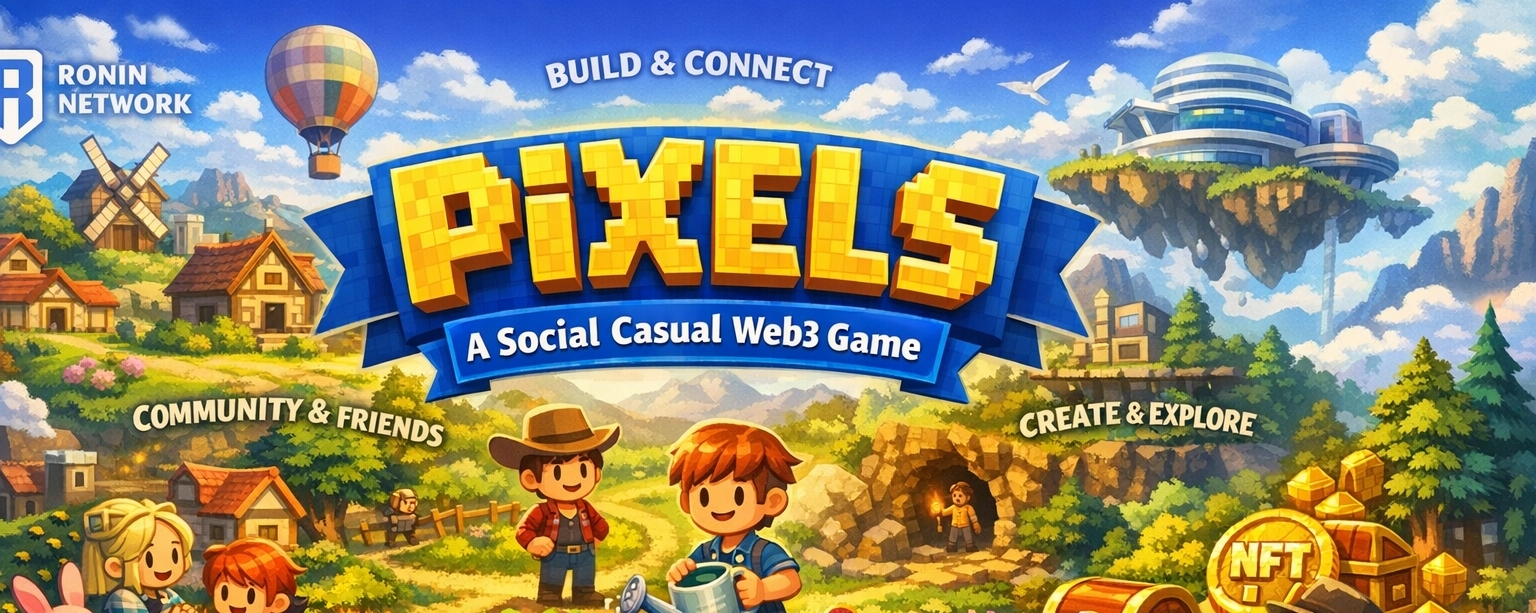
When I see a project describe itself as a “social casual web3 game,” I do not immediately take that at face value. I pause a little. Those words sound simple, but they carry a lot. In crypto, “social” is often used too loosely, “casual” can sometimes hide thin design, and “web3” can end up meaning more about assets than the actual experience. So with Pixels, the real question for me is not whether the label sounds good. It is whether the project actually lives up to it. Pixels presents itself as a world built around farming, exploration, creation, friends, and digital ownership, while also aiming to become something bigger than a single game. That already tells me it wants to be understood as more than a farming title with a token attached.
What stands out first is the word “social.” I do not think Pixels uses that word just to suggest that people can play side by side. The project seems to treat social connection as part of the game’s foundation. On its official site, Pixels talks about playing with friends, building community, shaping land together, and creating shared experiences. That matters because a social game is not just a game with chat. A game starts to feel truly social when other people become part of the reason you return. It is not only about rewards anymore. It is about familiar routines, shared spaces, small collaborations, and the feeling that your time inside the world overlaps with other people’s time in a meaningful way. That kind of design can change the tone of an entire ecosystem.
The word “casual” also feels more important here than it might seem at first glance. Casual does not have to mean shallow. In Pixels, it seems closer to something gentle, repeatable, and easy to step back into. The focus on farming, collecting, land, animals, and steady progress suggests a style of play that fits into daily life instead of demanding intensity all the time. I think that choice says a lot about who the project is for. It is not trying to build pressure into every moment. It is trying to make the world feel livable. And that connects to one of the more serious ideas behind the project: if the game itself is not enjoyable, no reward system will save it for long. That is why the casual identity matters. It points to a design philosophy where people stay because the experience itself feels natural to return to.
Pixels also feels different because it is not presenting itself as only a game. The platform ambition is sitting there in the background. The official direction suggests that Pixels wants to become a place where digital collectibles and game experiences can connect more naturally, not just inside one gameplay loop but across a broader ecosystem. That changes how I read its design. Farming, exploration, and creation stop looking like disconnected features. They begin to look like the early language of a wider system. Farming gives structure and routine. Exploration gives movement and curiosity. Creation gives attachment and expression. Put together, they form a world that players can settle into rather than simply use.
That is also why Ronin matters. Ronin is not just a technical detail in the background. It gives Pixels a setting that already makes sense for gaming and on-chain activity. A project that wants digital ownership, tradable assets, and a wider game-facing ecosystem needs infrastructure that feels comfortable with those things. In that sense, being on Ronin supports the identity Pixels is trying to build. It makes the project feel less like it is borrowing blockchain language from outside and more like it is being built in an environment that already understands gaming behavior.
The same goes for digital ownership. In web3, that phrase is often repeated so much that it starts to lose weight. But in Pixels, it seems tied to a more practical idea. The project is not only saying that users can hold things on-chain. It is pointing toward a design where progress, land, and participation are meant to feel more durable and more meaningful than they would inside a closed game system. That does not mean every promise around ownership becomes automatically powerful. But here, it feels less like decoration and more like part of the project’s logic.
So when Pixels calls itself a social casual web3 game, I do not hear a tagline as much as a test. It is trying to prove that a game can feel easy to live in, social enough to matter, and on-chain enough to make participation feel real. That identity matters because if Pixels gets it right, it is not only defining what kind of game it is. It is quietly making a case for what kind of web3 game might actually be worth staying in.
