

There was a point when “play-to-earn” sounded like one of crypto’s best ideas.
In theory, it made sense. People already spend hours inside games. So why not let them own items, earn tokens, and maybe get rewarded for the time they put in? It sounded fair. Even exciting.
But in reality, a lot of play-to-earn ended up feeling less like gaming and more like extraction.
That’s really what happened. The game part became secondary. The economy became the main event. People stopped asking, “is this actually fun?” and started asking, “how much can I make before this token dies?” Once that shift happens, things usually go downhill pretty fast.
And to be completely honest, that has been the real issue with crypto gaming from the start.
Most of these projects do not fail because the market “wasn’t ready.” They fail because the games themselves are weak, the reward loops are too obvious, and the player base ends up behaving like a workforce instead of a community. If the only reason people show up is to farm and sell, then eventually the whole thing starts collapsing under the weight of its own incentives. Rewards inflate, token emissions pile up, and dumping becomes more rational than actually playing.
At that point, it stops being play-to-earn and starts becoming play-to-extract.
That is what makes Pixels interesting.
Not because it completely solves that problem. I don’t think anyone can say that yet. But at least it seems like one of the few projects that actually understands what the problem is.
Pixels, built on Ronin, is framed as a social casual game first. Farming, exploration, resource loops, community activity. It has that lighter, more accessible kind of feel that makes more sense for a Web3 audience than a lot of the heavy, overdesigned crypto games we saw before. And that already gives it an advantage. A casual farming game is just naturally a better fit for retention than some tokenized grind simulator pretending to be a real game.
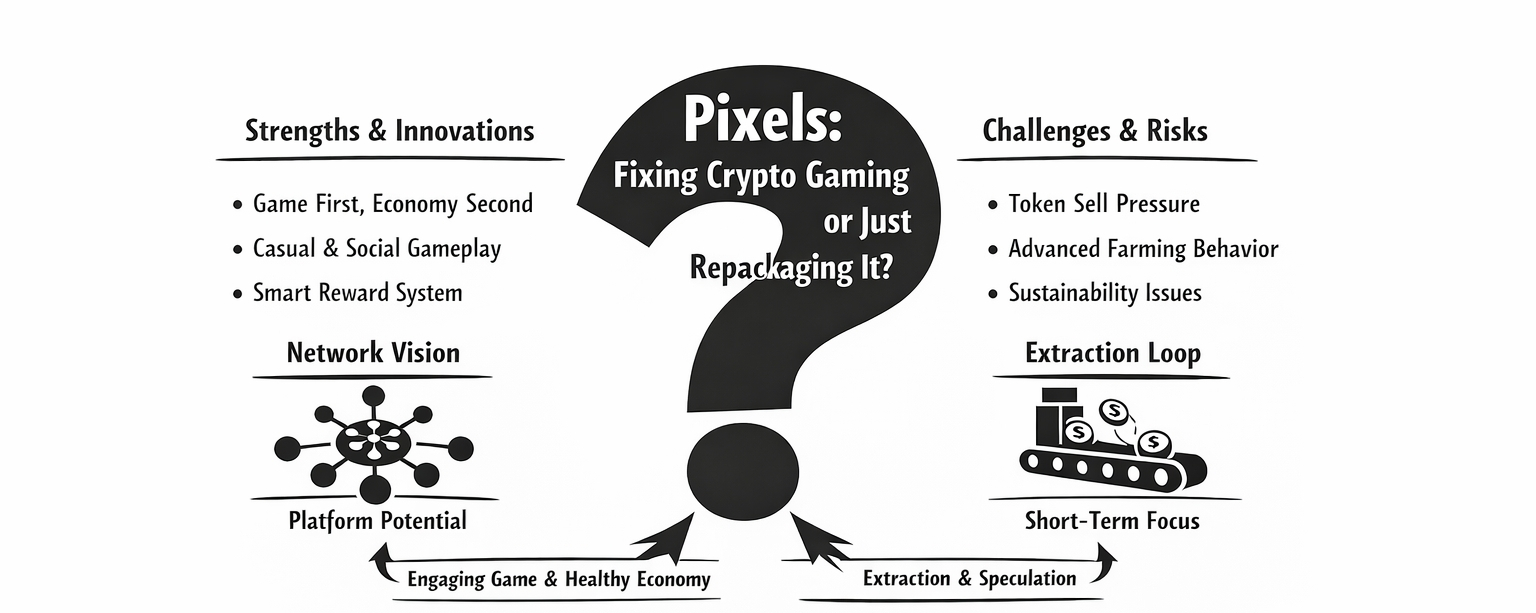
The first thing Pixels seems to get right is the idea of game first, economy second.
That sounds obvious, but in crypto it really hasn’t been. Too many projects built the token first, then tried to wrap a game around it later. Pixels at least appears to be trying to reverse that order. The thinking is simple: if people actually enjoy being in the world, then the economy has a chance to support the experience instead of replacing it.
That is a real strength.
But it also comes with a catch.
Because once a token becomes central to the project, the pressure changes. Even if the developers want to focus on gameplay, the community starts watching the economy. Players start judging updates through earnings potential. Every design choice gets interpreted through token value, reward efficiency, and market impact. So even if the team wants to keep the game at the center, the structure of crypto keeps dragging attention back toward extraction.
That tension does not go away just because the game looks friendlier.
Then there is the reward model, which is probably one of the more thoughtful parts of the Pixels story.
Instead of just throwing rewards at anyone who clicks the same loop enough times, Pixels has talked about using player data to figure out what kinds of activity actually help the ecosystem. That is a much smarter idea than the old model where everyone farms the same rewards and immediately sells them. In theory, a more data-driven approach could help reduce wasted emissions and reward the behaviors that make the game healthier over time.
And honestly, that makes sense.
But it also opens up another problem.
Crypto players are very good at gaming systems. Maybe too good. If rewards are based on “good behavior,” then people will eventually learn how to imitate whatever the system wants. So the model might be more sophisticated, but it is still a model being attacked by highly motivated users. It sounds good on paper, but the minute rewards are attached to measurable behavior, people start optimizing around the measurement itself.
That is the danger. Better targeting does not eliminate farming behavior. It just makes the farming more advanced.
The other part of Pixels that stands out is that it does not seem to want to remain just one game.
That is probably the bigger ambition here. Pixels looks like it wants to become some kind of broader network or platform layer, not just a successful farming MMO. The idea seems to be that if it can build enough attention, enough player data, enough distribution, then it can become a publishing and ecosystem engine rather than a single-game economy.
That is a much stronger long-term vision than “here is our token, here is our game, please keep farming.”
If that works, it matters. Because a single-game token is fragile. A network story is harder to break. If the token has utility across more than one environment, if the audience can move across games, if distribution itself becomes the real asset, then Pixels starts looking like more than another crypto game trying to survive one reward cycle at a time.
Still, this is where I get a little skeptical.
Becoming a network is easy to say. Actually becoming one is much harder. You need real staying power. You need other developers to buy into the ecosystem. You need reasons for people to keep using the token beyond speculation or short-term farming. And you need all of that to hold together while the usual token pressure keeps pushing in the other direction.
That brings us to $PIXEL, which is probably where the biggest questions still sit.
Because no matter how smart the design is, game tokens almost always run into the same wall: people want to earn them faster than they want to hold them.
That has always been the weakness. If players receive rewards and the most rational move is to sell, then sell pressure becomes constant. If new demand does not keep up, the token starts slipping. Then the whole emotional logic of the game changes. Players become frustrated, farmers become more aggressive, and the economy starts feeling defensive.
Pixels clearly knows this is a problem. It has already made changes around its economy that suggest the team understands inflation and unsustainable reward loops better than many earlier projects did. That awareness matters. It is better than pretending emissions are harmless.
But awareness is not the same as a solution.
The real issue is that token sustainability in crypto games is not just a design problem. It is also a behavior problem. Once players are trained to care about rewards, they rarely go back to acting like normal players. Even if Pixels succeeds in attracting genuine users who enjoy the game for what it is, the token layer will always attract a second class of participant whose goal is efficiency, not enjoyment.
And that is where the whole category still feels unresolved.
Pixels might be doing a better job than most. It probably is. It has a cleaner concept, a more natural genre fit, and a more realistic understanding of why past play-to-earn systems failed. That alone makes it more serious than a lot of projects that came before it.
But I still think the core question is open.
Is Pixels actually fixing crypto gaming’s biggest problem?
Or is it just wrapping the same extraction logic inside a more polished, better-designed, more self-aware system?
I don’t think the answer is obvious yet.
My feeling is that Pixels is conceptually stronger than most of its peers. It seems more grounded. More aware of the trap. More thoughtful about incentives. And that matters. A lot.
At the same time, execution risk is still very real. The game has to stay genuinely engaging. The economy has to avoid becoming another optimized farming machine. The token has to hold some reason to exist beyond being sold. And the bigger network vision has to become something tangible, not just a nice story attached to a successful early game.
So yes, Pixels is interesting.
But interesting is not the same as proven.
It may end up being one of the first crypto games that genuinely learns from the mistakes of play-to-earn. Or it may just be a smarter version of the same model, delayed rather than solved.
Time will tell.
