
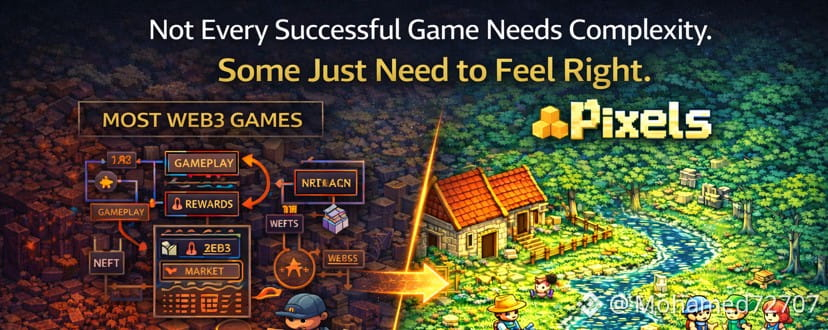
When people analyze games, they usually focus on features.
Graphics, mechanics, token systems, rewards, scalability. Everything is measured in terms of what the game offers on paper.
But there’s something harder to measure, and often more important.
How the game feels.
In traditional gaming, this factor is understood intuitively. Players don’t always explain why they like a game, they just know they want to come back to it. In Web3, this layer is often ignored.
Many projects prioritize systems over experience.
They build complex economies, detailed reward structures, and layered mechanics. But in doing so, they sometimes lose the most important part
Comfort Pixels leans in the opposite direction.
It doesn’t try to overwhelm the player. The gameplay is simple, clear, and easy to return to. Farming, exploring, interacting… everything flows without forcing the player into a rigid structure.
You don’t need to plan your session.
You just enter the game and start.
That creates a different type of engagement.
Instead of intensity, you get consistency.
Players don’t burn out quickly because the experience doesn’t demand too much from them. It respects their pace, allowing them to engage without pressure.
Another layer that contributes to this feeling is the shared world.
Pixels doesn’t isolate players into separate experiences. The environment feels continuous, populated, and active. Even small interactions, seeing other players, moving through the same space, add to the sense that the world is alive.
That presence builds subtle attachment.
You’re not just progressing through tasks.
You’re existing داخل a space that continues beyond you.
From a technical standpoint, the experience is also smoother than many Web3 games.
Running on Ronin helps reduce friction, making interactions faster and more seamless. This supports the overall feeling of ease, which is critical in maintaining immersion.
Because once friction increases, that “feels right” factor starts to break.
But the most important thing Pixels gets right is not technical or visual.
It’s emotional.
It understands that players don’t just stay because of rewards or mechanics. They stay because the experience fits into their routine without resistance.
From a broader perspective, this highlights a shift that Web3 gaming needs.
Less focus on adding features.
More focus on refining experience.
Because in the end, players don’t measure games by what they offer.
They measure them by how they feel.
And that’s something Pixels seems to understand better than most.
