
I almost skipped this part of the analysis entirely. Infrastructure feels like the boring section gas fees, block times, validator counts. I had assumed I understood what Ronin brought to @Pixels and moved on. Then I started actually tracking what happens to player behavior when the chain underneath a game changes, and something I had been treating as background became the most interesting part of the story.
The thing I keep coming back to is this: the market is pricing $PIXEL as a game token. But structurally, holding PIXEL is a bet on infrastructure. And that infrastructure is undergoing the most significant upgrade in its history right now, while almost nobody in the token conversation is talking about it.
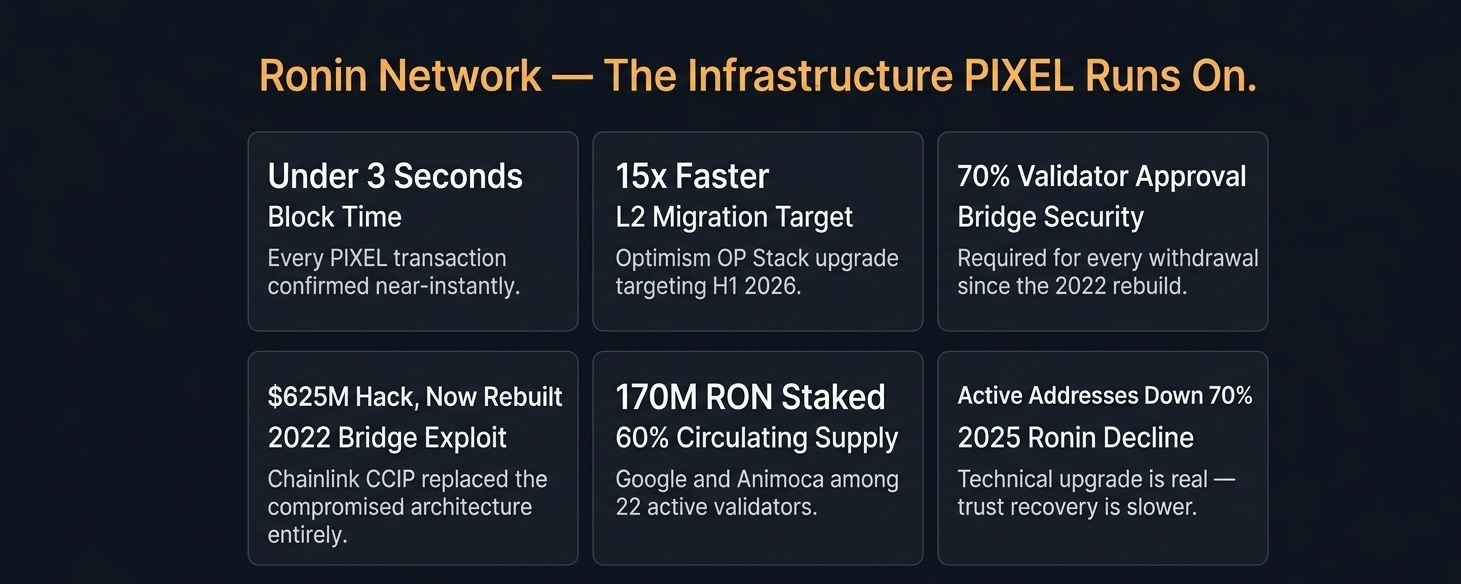
Ronin was built out of desperation, honestly. When Axie Infinity exploded in 2021, Ethereum was charging fees that made in-game transactions economically ridiculous. Sky Mavis built a dedicated sidechain because nothing else existed that could handle it. What came out of that was a network delivering sub-3-second block times and near-zero fees, purpose-built for gaming rather than bolted onto a general-purpose chain. For Pixels, where a player might farm, craft, trade, and interact dozens of times in a single session, that infrastructure difference is not marginal. It is what makes the game feel like a game rather than a sequence of wallet confirmations.
What I did not fully appreciate until recently is how different the current Ronin is from the one that launched four years ago. The bridge that was exploited for $625 million in March 2022 by the Lazarus Group one of the largest crypto hacks ever recorded has been replaced by a fundamentally different architecture. Ronin migrated its bridge to Chainlink's Cross-Chain Interoperability Protocol in April 2025. Withdrawals now require approval from at least 70 percent of validators, with daily limits and anomaly detection running continuously. Google and Animoca Brands are among the current validators. That is a categorically different security posture than the nine-validator setup compromised in 2022 when attackers took control of five nodes in a single operation. The hack still follows Ronin into every conversation. The rebuild that followed it mostly does not.
The part that genuinely surprised me though is the L2 migration. Sky Mavis announced in late 2025 that Ronin is transitioning from a standalone sidechain to a full Ethereum Layer 2 using Optimism's OP Stack, targeting the first half of 2026. Their own statement around it was unusually direct "Four years ago, we built Ronin because Axie Infinity needed a faster, more efficient network. Ethereum is BACK." The new chain promises up to 15 times faster transactions while inheriting Ethereum's consensus security directly. A new Proof of Distribution model will redirect rewards from passive validators toward active builders and developers. That is not an incremental upgrade. That is a structural rethink of what Ronin is and who it is built for.
For Pixels this matters at a level the token price does not yet reflect. Every in-game action runs through Ronin. Every NFT mint, every guild transaction, every VIP membership purchase, every PIXEL withdrawal is on-chain activity that depends on the network being fast enough, cheap enough, and secure enough to feel invisible to the player. When infrastructure friction disappears, player behavior changes in ways that are hard to model but real. The 84 percent inflation reduction through Chapter 2.5 was a tokenomics decision. The L2 migration is an infrastructure decision operating at a deeper level, changing the cost and speed of every interaction PIXEL is involved in before the economic layer even gets touched.
More than 170 million RON tokens are staked across 22 validators and around 20,000 delegators, representing roughly 60 percent of the circulating supply. I sat with the Google validator detail for a while. Enterprise validators have institutional reputations at stake in ways that anonymous crypto validators simply do not. That changes the incentive structure around security maintenance in ways that are difficult to quantify but not trivial to dismiss.
Now I have to argue against my own reading, because the infrastructure thesis flatters Pixels more than the complete picture justifies.
The first issue is that the $625 million hack is not just historical context it is an active reputational drag. Nansen data shows active addresses on Ronin fell 70 percent in 2025. The technical rebuild is real and meaningful. But trust rebuilds more slowly than architecture does. A faster, more secure Ronin does not automatically translate into a repriced PIXEL, and there is no clear evidence yet that the L2 migration is accelerating trust recovery in measurable user behavior. Credibility after a catastrophic failure compounds slowly, and the timeline for that is not the same as the timeline for a technical upgrade.
The second problem cuts closer to the core thesis. Infrastructure quality and token demand are not the same thing. A smoother Ronin reduces friction for players, but reduced friction does not automatically create PIXEL demand. The Coins layer handles most daily economic activity in Pixels without touching the on-chain token. Players can have an improved experience farming and crafting through off-chain mechanics while PIXEL sits largely untouched. The infrastructure upgrade benefits the game. Whether it structurally increases demand for the token is a question the current design does not cleanly answer, and I have not seen anyone address it directly.
The signals I am watching are narrow and specific. Whether the L2 migration completes on schedule in the first half of 2026 and whether Ronin's active address count shows any recovery after the 70 percent decline. Whether the Proof of Distribution model brings new studios to the ecosystem with real on-chain volume rather than just reshuffling rewards among existing participants. And whether Pixels' PIXEL-specific on-chain transactions the ones that actually require the token rather than the Coins layer grow in proportion to the infrastructure improvement or stay flat while the off-chain economy quietly absorbs the benefit. The chain is being rebuilt from the ground up. Whether the token sitting on top of it gets repriced alongside that rebuild is the question I genuinely cannot answer yet.#pixel