
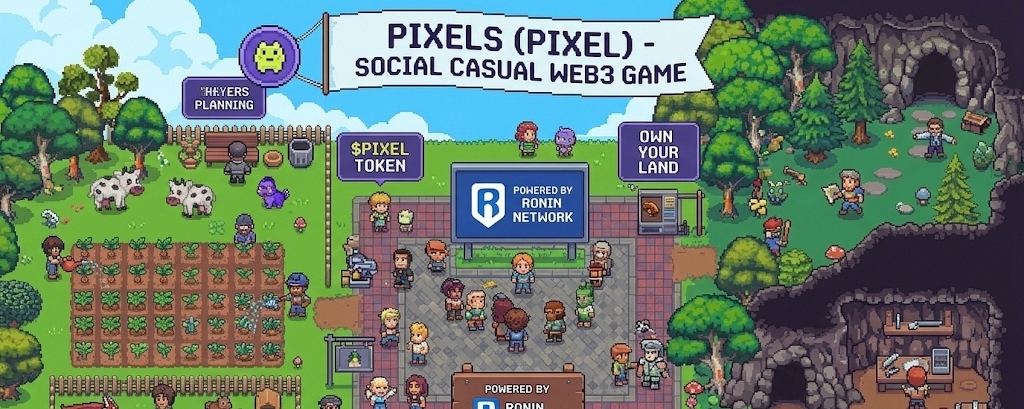

I remember the exact moment it shifted for me, though nothing visibly changed. I was harvesting, moving through the same familiar loop, expecting progress to feel steady, predictable. Instead, everything felt… delayed. Not blocked, not denied—just slightly out of sync, like I had arrived a few minutes after something important had already happened.
That’s the strange thing about Pixels. It never tells you you’re late. It lets you believe you’re right on time.
At the surface, it’s disarmingly simple. You farm, you explore, you create. The world opens itself without resistance, and for a while, that openness feels genuine. You move through systems that seem designed for you, as if nothing existed before your arrival. But the longer you stay, the more you begin to notice the quiet asymmetry. Some players don’t just move faster—they move differently. Their actions ripple outward. Mine barely echo.
That’s when it began to settle in: this world wasn’t just built to be played. It was built to be shaped—and that shaping had already begun long before I understood what I was part of.
Resources here are not just things you gather. They are moments someone else captured before you even realized they were valuable. Every tool, every optimized cycle, every piece of progress carries a timestamp hidden beneath it. Early participants didn’t just get ahead—they embedded themselves into the system’s foundation. By the time I arrived, I wasn’t building alongside them. I was building on top of them.
And the system remembers that.
What feels like natural progression is actually a path already influenced by those who came first. The mechanics don’t just guide you—they quietly reflect someone else’s prior decisions. Access isn’t denied, but it isn’t equal either. Some pathways are smoother because someone else cleared them early. Others feel slow because you’re carving them too late.
It’s not unfair. It’s just already in motion.
Over time, you start to see the invisible structure holding everything together. There are layers of players, though no one explicitly names them. Those who arrived early have become something more than participants. They don’t just play within the system—they exist at a level where the system flows through them. Their resources feed into the wider ecosystem. Their efficiency becomes the baseline others try to reach. Without ever announcing it, they’ve become part of the infrastructure itself.
Then there are players like me, who arrived somewhere in the middle. Aware enough to recognize the patterns, but not early enough to have shaped them. We adapt, we optimize, we look for edges where the system hasn’t fully hardened yet. Progress is still possible, but it comes with a quiet realization: every step forward is priced differently now. Not just in time, but in awareness, in precision, in the ability to navigate something that has already matured.
And then there are those who will arrive after us. They’ll feel what I felt at the beginning—that sense of openness, of equal footing. They won’t immediately see the depth beneath their actions. But eventually, they’ll reach that same moment, where effort and outcome stop aligning cleanly, and the realization will land: the system has already moved again.
That’s the part that stays with me. Not that it’s difficult to catch up, but that the definition of “catching up” keeps shifting. What was once accessible through time alone slowly transforms into something that demands more—better positioning, smarter decisions, sometimes alignment with those who already hold influence. The door never closes, but it gets heavier each time it swings.
And yet, Pixels never loses its surface warmth. It still feels like a user-first world. It draws you in through simplicity, through loops that are satisfying before they are strategic. That’s what makes it work. You don’t enter thinking about systems or structures. You enter because it feels good to play, to create, to explore. The depth reveals itself later, almost quietly, like something you weren’t supposed to notice this early.
The underlying network supports that fluidity. Everything responds quickly, almost effortlessly, encouraging you to keep going, to do more, to refine your approach. And that’s where the compounding begins—not in a dramatic way, but in small, repeated actions that stack over time. For those who started early, that stacking has been happening far longer than most of us can comprehend.
There are moments when you see it clearly—spaces where activity concentrates, where movement feels more deliberate, more efficient. You begin to recognize roles forming naturally. Some players supply, others depend. Some dictate flow without ever needing to say a word. It’s not hierarchy in the traditional sense. It’s something quieter, more embedded.
Ownership exists here, but it doesn’t always look like possession. It looks like timing. Like being present before something becomes obvious. Like having the ability to move without hesitation because you’ve already been through the cycle enough times to understand where it leads. Tokens, assets, rewards—they’re just the visible outcomes of something deeper: the accumulation of advantage over time.
And the system doesn’t reset. It evolves.
Every new feature, every expansion, every added layer doesn’t level the field—it extends it. The same players who understood the system early are the ones best positioned to understand what comes next. They don’t just benefit from the past; they adapt faster to the future. Their advantage isn’t static. It compounds, reshapes, and reasserts itself in ways that are hard to replicate.
For the rest of us, each new layer is a chance—but also a reminder. The system doesn’t wait for anyone to fully understand it. It keeps moving, keeps building on itself, rewarding those already in motion.
I still log in. Still plant, still explore, still create. But I don’t see it the same way anymore. Every action feels connected to something larger, something that existed before I arrived and will continue long after I’ve figured it out.
I thought I was playing a game.
But somewhere along the way, I realized I had stepped into a living system—one that had already decided more than it ever needed to say.