
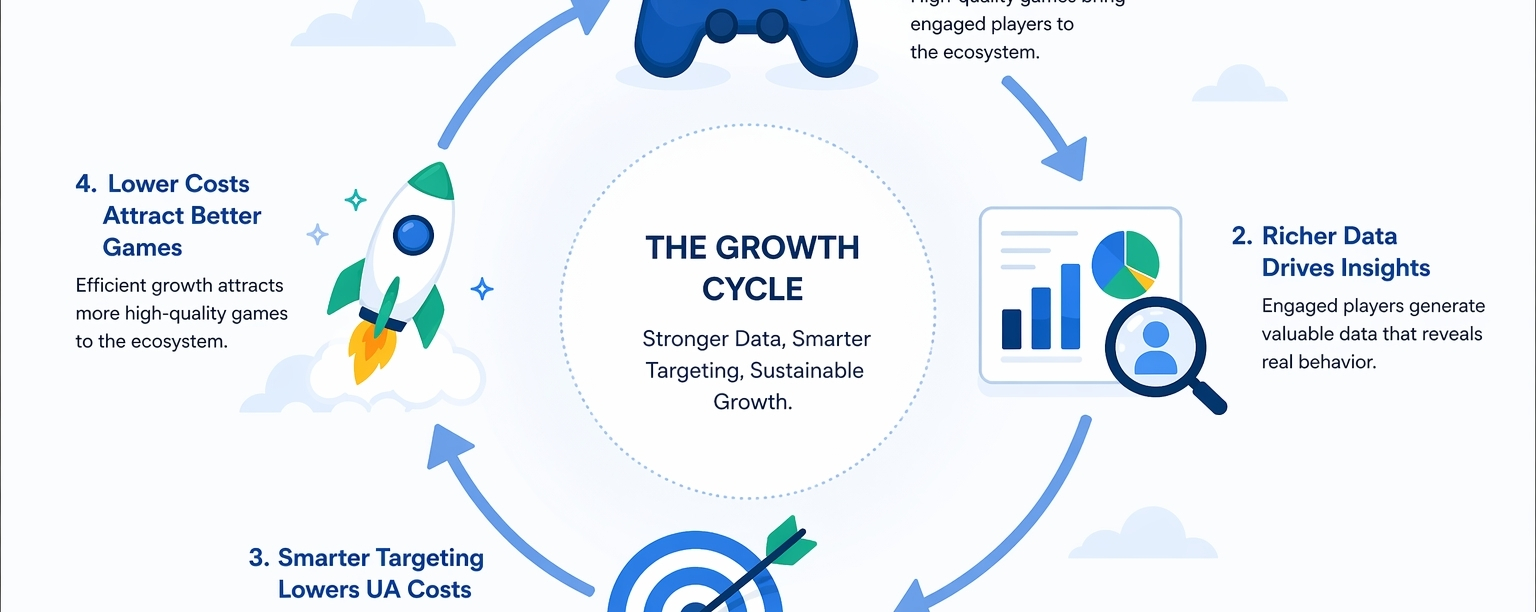
In many digital ecosystems, growth looks like a straight line: more users, more games, more revenue. But in reality, strong systems do not grow in a straight line. They grow in cycles. And the real power comes when each cycle makes the next one stronger.
The system we designed inside Pixels is built exactly on that idea. It is not just about adding more users or attracting more games; it is about building a loop where every part feeds the next part and makes the whole ecosystem healthier over time.
At the center of this idea is a simple but powerful connection between data insights, publishing strategy, and player incentives.
Each of these parts works alone, but when they connect, they create something much bigger than what any single part could achieve on its own.
The goal is not short-term growth. It is long-term stability where the system starts to grow by itself without needing constant external push.
Attracting Better Games Creates Stronger Data
Everything starts with games.
When higher-quality games enter the ecosystem, they naturally bring more engaged players. These are not random users; they are players who actually interact with systems, spend time in gameplay, and respond to incentives in meaningful ways.
This kind of engagement creates data, but not just normal data. It creates rich behavioral data.
Rich data means we can see how players think, how they act, what keeps them active, and what causes them to leave.
This is extremely important because most systems fail not because they lack users, but because they do not understand users.
When better games join the ecosystem, the quality of data improves automatically, and that becomes the foundation for everything else.
Without good data, every decision becomes guesswork. With good data, every decision becomes precise.
Rich Data Improves Targeting and Reduces UA Cost
Once the ecosystem starts collecting strong behavioral data, the next step is understanding it.
This is where data insights become powerful.
Instead of blindly spending money to bring in users, we start identifying exactly who is likely to stay, who is likely to engage, and who actually adds value to the system.
This is where machine learning and targeting models become important.
We are no longer guessing; we are predicting.
We can now show the right game to the right type of player at the right time.
This precision has a direct impact on user acquisition cost.
When targeting becomes more accurate, fewer resources are wasted on users who will not stay.
This naturally reduces UA costs.
But more importantly, it increases the quality of every user that enters the system.
So now, instead of paying more to get more users, we are paying less to get better users.
That shift is very important because it changes the entire economic structure of growth.
Lower UA Costs Attract Better Games
This is where the cycle becomes visible.
When game developers see that they can acquire users at lower cost with higher quality, they naturally become more interested in joining the ecosystem.
For developers, UA cost is one of the biggest risks. If they spend too much to acquire players who do not stay, their game becomes unprofitable very quickly.
But if the ecosystem offers a way to reach players more efficiently, then it becomes much more attractive.
So lower UA cost becomes a signal.
It tells developers that this ecosystem is not just a traffic source; it is a smart distribution network.
As more high-quality games enter the system, the cycle repeats again but now at a higher level.
Each new wave of games brings better players, which creates better data, which improves targeting, which lowers UA cost even further.
The Continuous Loop of Improvement
What makes this system powerful is that it does not reset after each cycle.
Instead, each cycle builds on the previous one.
Think of it like layers.
The first layer brings initial games and players.
The second layer improves data quality.
The third layer improves targeting precision.
The fourth layer reduces acquisition cost.
The fifth layer attracts even stronger games.
And then everything starts again, but now from a stronger position.
This is why we call it a self-sustaining loop.
It does not depend on one-time growth events.
It depends on continuous reinforcement between all parts of the system.
Player Incentives as the Hidden Engine.
One part that quietly powers this entire cycle is player incentives.
Players are not just users in this system; they are active participants in shaping the data.
Every action they take contributes to understanding behavior patterns.
But incentives ensure that players are motivated to participate in meaningful ways instead of random or empty activity.
Good incentives guide behavior toward value creation.
When players are rewarded for actions that actually improve the ecosystem, the data becomes even more reliable.
This is very important because bad incentives create noise, but good incentives create signal.
And in a system like this, signal is everything.
Why This System Becomes Self-Sustaining
Most growth systems eventually slow down because they rely on constant spending or external marketing pressure.
But in this model, growth is internal.
Each improvement creates conditions for the next improvement.
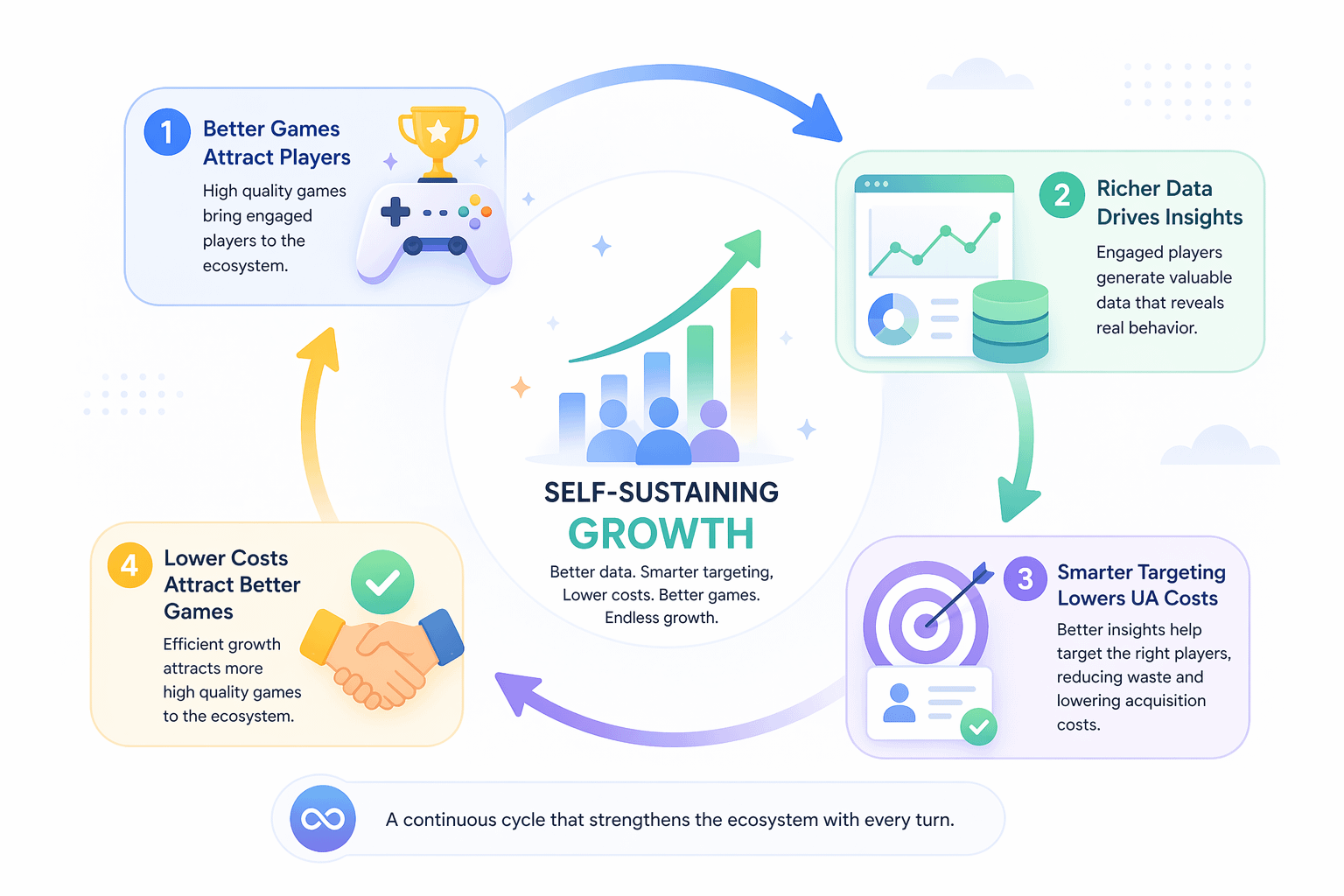
Better games improve data.
Better data improves targeting.
Better targeting reduces cost.
Lower cost attracts better games.
This loop does not need to be restarted manually.
It continues as long as the ecosystem remains active.
That is what makes it self-sustaining.
It is not dependent on hype or temporary trends.
It is dependent on structure.
The Long-Term Effect on Ecosystem Health
Over time, this kind of system does more than just grow numbers; it improves the quality of the entire ecosystem.
Players become more engaged because they are part of a system that understands them better.
Developers stay longer because acquisition is efficient and predictable.
The platform becomes more stable because decisions are based on real data instead of assumptions.
Profitability also improves because waste is reduced at every stage.
But the most important effect is trust.
When users and developers see that the system consistently rewards value and reduces inefficiency, they begin to trust it more.
And trust is the hardest thing to build in any ecosystem.
Final Thought
This growth cycle is not about aggressive expansion. It is about intelligent expansion.
It is about creating a system where every participant improves the system just by participating.
Games improve data.
Data improves targeting.
Targeting reduces cost.
Lower cost brings better games.
And the loop continues.
In the end, the real strength of this model is not in one part of the system but in how all parts are connected.
When everything starts feeding everything else, growth stops being something you chase and becomes something that happens naturally.