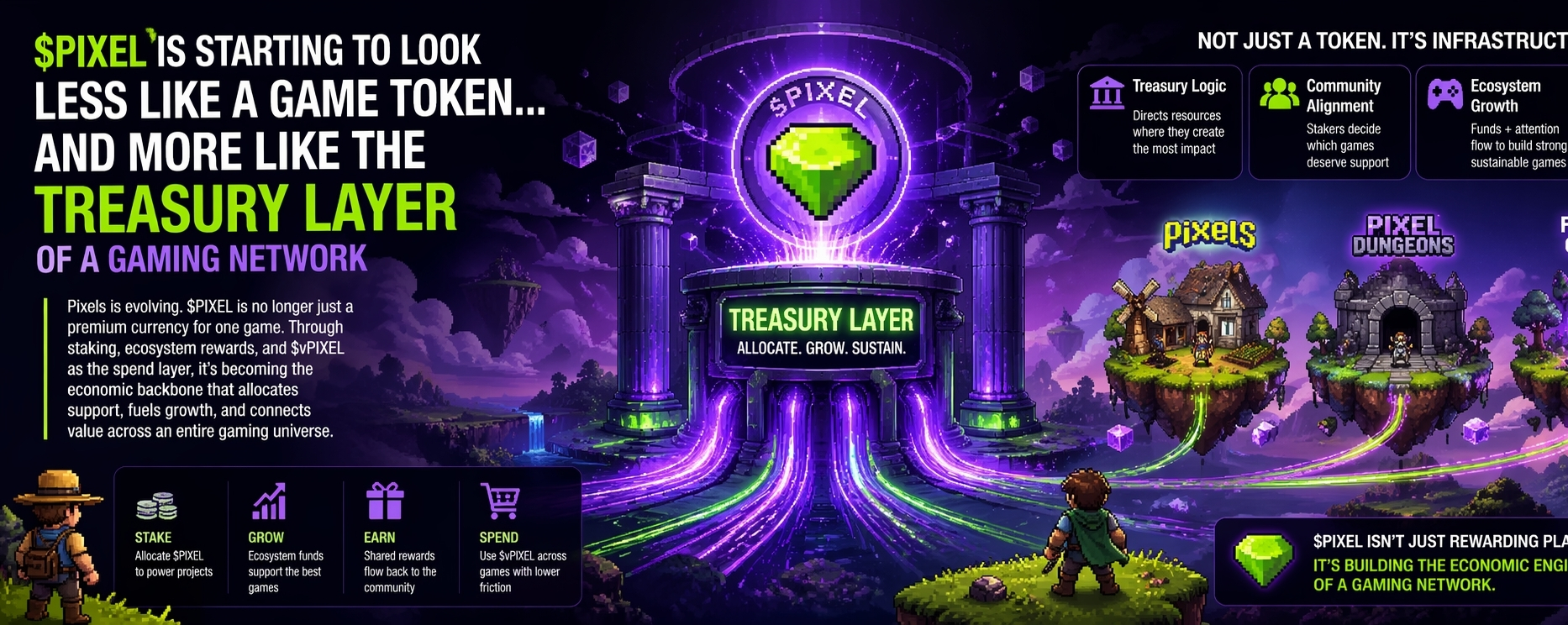

The more I look at Pixels, the harder it gets to call @Pixels a normal game token.
That label still exists, sure. But it feels too small now. Too old. Like using a village map to explain a city that kept growing while nobody was watching.
In the early Pixels docs, pixel was framed as a premium in-game currency. Not the thing you needed for basic progression. Not the everyday fuel of farming. It was more for acceleration, cosmetics, recipes, pets, status, and convenience. The docs even compared it to premium currencies in traditional games and made a point that it should not simply boost future earnings. Even then, Pixels was already trying to keep the token tied to enjoyment, status, and ecosystem-benefiting behavior instead of turning it into a blunt extraction tool.
That old design matters more than people think.
Because it tells me the team never really wanted pixel to live and die as a farm-and-dump reward token. The original blueprint already separated soft gameplay currency from premium ecosystem currency. So when people say the token is “changing,” I think the better word is expanding. The seed was there from day one. What is changing now is the scale of the role.
And this is where it gets interesting... really interesting.
The newer staking system changes the meaning of pixel in a way that I think the market still underestimates. Officially, Pixels now lets users stake $PIXEL into different game projects, with the idea that staking supports development and expansion while giving access to future project-linked benefits. That sounds simple on the surface. But it is not simple at all. The moment a token begins helping determine where support flows, it stops acting like a mere game currency and starts acting like an allocation mechanism. That is treasury behavior.
And treasury behavior changes how a token should be understood.
A normal game token mostly does three things. It gets earned. It gets spent. It gets sold. Fast cycle. Short memory. But a treasury layer does something deeper. It decides where resources gather. It decides what grows. It becomes less like a coin in someone’s hand and more like water pressure inside the pipes. You do not always see it. But it decides which rooms light up and which ones stay dry.
That is the frame I think fits Pixel now.
Pixels’ own recent language pushes in that direction too. The project has publicly described staking as part of a decentralized publishing model powered by staking, where games themselves replace traditional validators. That wording is not casual. It tells us Pixels is no longer thinking in the narrow language of one-game token utility. It is thinking in the language of network coordination, capital routing, and ecosystem-level incentives.
Once I saw that, the whole architecture started to look different.
Because if games are effectively competing for stake, and stake influences who gets more support, then Pixel is no longer just rewarding players inside a single world. It is helping decide which worlds inside the ecosystem deserve more economic gravity. That is bigger than utility. Bigger than emissions. Bigger even than staking in the old crypto sense. It starts to resemble a market-driven publishing layer, where community capital signals which games are worth pushing harder.
And then comes vPIXEL, which sharpens the whole story.
The official Staking FAQ says $vPIXEL is a coming spend-only reward token. It also gives a very revealing example: if a player wants to withdraw to spend in Pixel Dungeons, they will be able to use $vPIXEL and bypass the Farmer Fee. That one sentence says a lot. It suggests Pixels is separating the ecosystem into layers. One layer is more strategic. One layer is more fluid. One layer seems built for coordination and alignment. The other seems built for movement and spending.
That is why I do not think the real story is just “cross-game utility.”
That phrase is true... but it is still too shallow.
The deeper story is that pixel may be moving toward the role of a reserve-like coordination asset, while vPIXEL starts to function as a spend-oriented circulation layer inside the wider ecosystem. In plain words, one anchors the system. The other helps value move through it. One feels like the treasury spine. The other feels like the bloodstream.
And this shift is not coming out of nowhere either.
The old Pixels platform docs already showed much broader ambition than one farming game. The project explicitly described support for multiple tokens in stores, external project stores, burn mechanisms for outside tokens, and cross-project economics. In other words, Pixels was already imagining a world where value, identity, and incentives move across projects instead of staying trapped in one closed loop. What we are seeing now with staking and vPIXEL feels less like a random pivot and more like the economic operating system finally catching up to the original platform vision.
This is also where the thesis connects to a much bigger market trend in Web3 gaming.
A lot of game tokens failed because they were built like open faucets. Emissions came first. durable demand came later... or never. Players learned the pattern. Farm. Exit. Repeat. What Pixels seems to be doing instead is far more disciplined. It is trying to turn the token from a simple payout object into a coordination asset that can influence growth, loyalty, retention, and ecosystem spending across more than one title. That does not magically remove risk. But it is a much more mature direction than the old play-to-earn playbook.
And honestly, that is the philosophical part that stays with me.
A disposable token lives in the moment. It gets claimed, dumped, and forgotten. A treasury layer lives differently. It remembers where support went. It shapes what comes next. It quietly carries the logic of a network on its back.
That is what Pixel is beginning to feel like.
Not just the premium token of Pixels. Not just a rewards asset. Not just something to stake for yield.
Something heavier. More structural. More foundational.
If this model works, the market may eventually stop valuing Pixel as “the currency of one farming game” and start valuing it as the economic coordination layer of a broader gaming ecosystem. That is a much bigger claim. Harder to prove. Harder to execute. But also much more interesting. And to me... much more relevant to where Web3 gaming actually needs to go next.