
I didn’t think much of it at first.
Pixels looked simple enough — a casual Web3 farming game with land, quests, crafting, and a friendly social world. The kind of project people describe in one sentence and move on from.
Farm, explore, earn, repeat.
Nothing unusual.
But the longer I watched it, the less it looked like a game in the normal sense.
Something felt slightly off.
Not wrong. Just deeper than it first appeared.
Because Pixels doesn’t only give players things to do.
It gives them patterns to fall into.
And once enough people fall into the same patterns, something more valuable than gameplay starts forming.
Habit.
That’s where it starts behaving differently.
On the surface, Pixels is easy to understand. You gather resources, grow crops, complete tasks, improve your setup, meet other players, maybe earn rewards along the way.
But simple loops are often misunderstood.
People think simple means shallow.
Usually, simple means efficient.
A loop that feels light and harmless can be one of the strongest behavioral systems ever designed. Because if friction is low enough, people return without resistance.
They log in casually.
Then again tomorrow.
Then again next week.
Then one day they’re no longer “trying a game.”
They’ve built a routine.
It doesn’t announce this. It just happens.
That’s the hidden power of systems like Pixels.
Most people think the output is crops, coins, XP, land upgrades.
Maybe not.
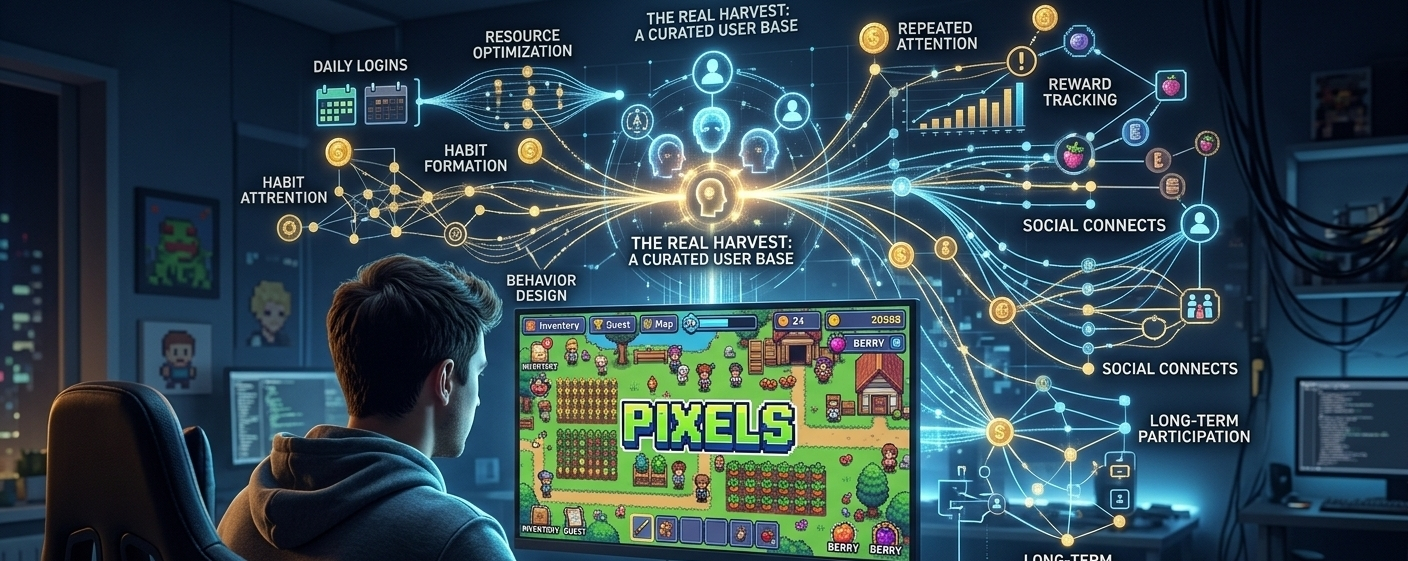
The real output may not be resources… but repeated attention.
And attention, once structured, becomes valuable.
This is where psychology quietly enters.
A visible progress bar makes effort feel meaningful.
A daily reward creates continuity.
Scarcity creates urgency.
Ownership creates attachment.
A social world creates comparison.
None of these mechanics are new on their own. But when combined carefully, they create momentum.
And momentum changes behavior faster than persuasion ever can.
Most people won’t notice this at first.
They’ll say they’re playing because it’s fun.
And many genuinely are.
But over time, another layer appears.
Some players start optimizing routes.
Some track rewards.
Some compare output.
Some calculate time versus return.
Some stay because their friends are there.
Some stay because leaving feels like losing progress.
Now the game is no longer just entertainment.
It has become a sorting system.
Separating tourists from builders.
Separating curiosity from commitment.
Separating short attention spans from long-term participants.
That’s valuable.
Because every platform wants users.
But systems become powerful when they identify the right type of users.
Pixels may look like a farming game.
But it may also function as a filter for patience, consistency, and incentive sensitivity.
That matters more than people think.
Because once a system learns who responds to what, it can evolve around them.
Rewards become sharper.
Economies become stronger.
Communities become stickier.
Behavior becomes predictable.
And predictable behavior is one of the most valuable assets any digital world can have.
Then comes the token layer.
Most people talk about tokens only in terms of price.
That misses the real point.
A token is also emotional architecture.
It gives effort memory.
It gives participation weight.
It gives users a reason to care about tomorrow.
Without that, many actions disappear the moment they’re completed.
With it, actions can feel connected to a larger future.
That changes how people behave.
They become more patient.
More attentive.
More invested.
Sometimes financially.
Sometimes psychologically.
Usually both.
This is also why transparency becomes complicated.
Because players often feel something happening before they can explain it.
They sense they care more than expected.
They log in more than intended.
They think about optimization when offline.
They feel attached to a world that once looked casual.
But because each individual mechanic seems harmless, the total effect is hard to describe.
That’s how strong systems work.
Not through one dramatic feature.
Through many small nudges stacking quietly over time.
Pixels may be a game.
It may be an ecosystem.
It may be a token economy.
It may be a social network disguised as farmland.
Probably all of them at once.
And that’s why it deserves more attention than surface descriptions give it.
Because the most interesting digital systems no longer sell products.
They design behaviors.
They turn routine into identity.
They turn presence into value.
They turn ordinary actions into long-term attachment.
In the end, Pixels may not be growing crops at all.
It may be growing a certain kind of user.
And in this market, that harvest is worth more than anything on the land.
