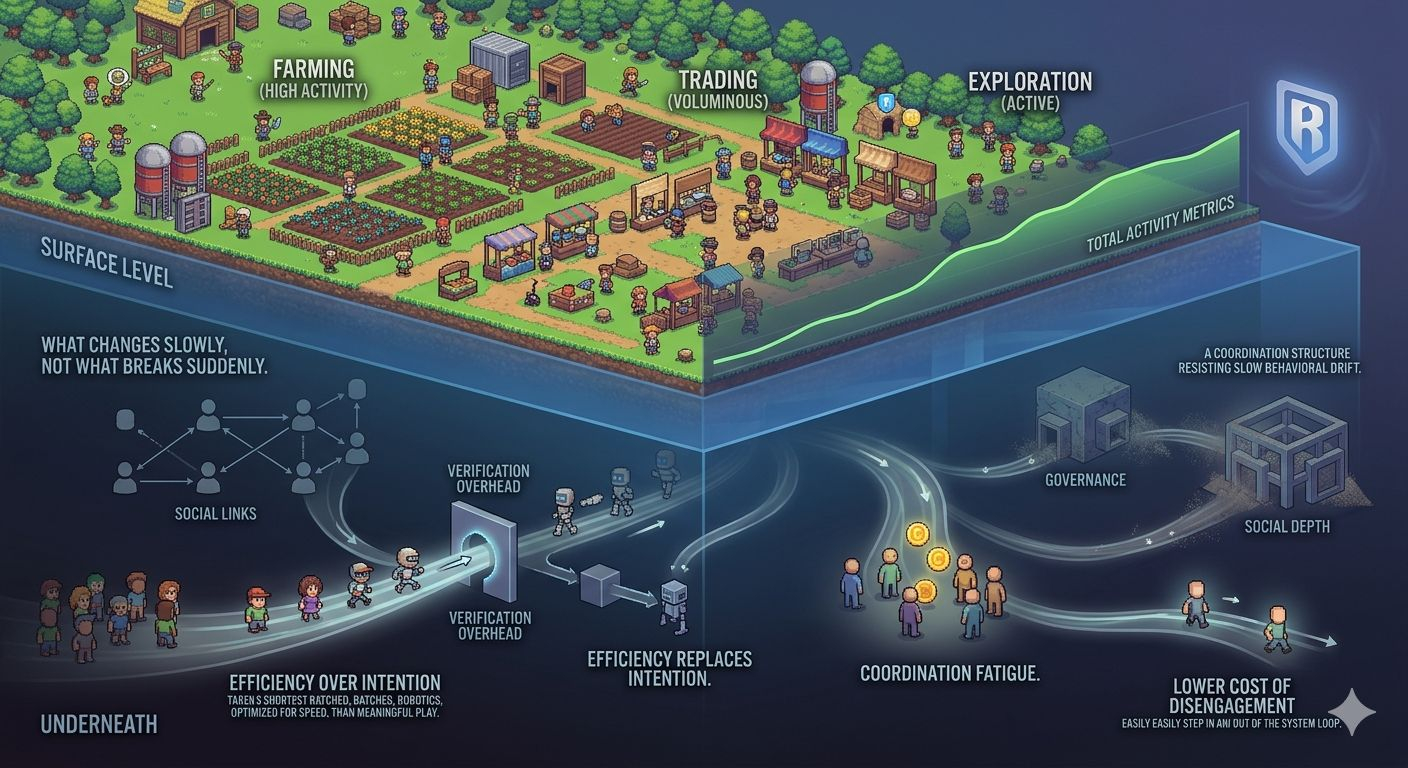
Most systems don’t collapse in dramatic moments. They continue to run, to process, to appear stable. The decay is quieter than that. It shows up in small shifts—how participants behave, what they prioritize, what they stop questioning. Nothing breaks, but something slowly loses alignment.
“When I am watching, I am paying attention to what changes slowly, not what breaks suddenly.”
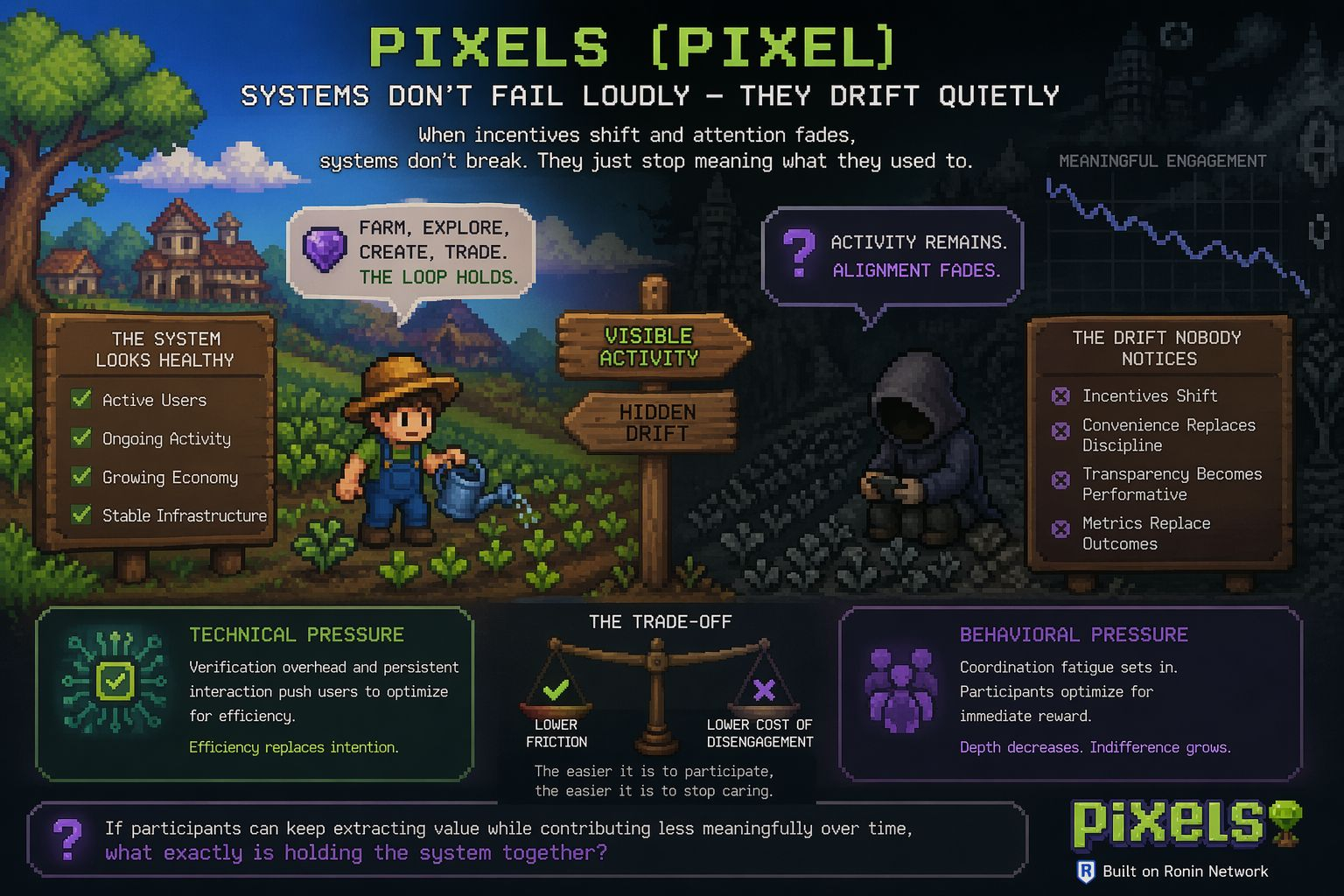
Over time, incentives begin to tilt. Not enough to trigger alarms, but enough to redirect effort. What was once done carefully becomes done efficiently. What was once verified becomes assumed. Transparency remains visible, but its function starts to fade—it becomes something to display, not something to rely on.
This is where most infrastructure reveals its real nature. Not in stress tests or outages, but in how it behaves under quiet, continuous pressure.
I’ve been thinking about this while observing Pixels (PIXEL) operating on Ronin Network. On the surface, it looks like a stable, active system. Participants farm, trade, explore. The loop holds. But beneath that, it’s a coordination structure trying to resist slow behavioral drift.
One pressure point is technical, but it translates directly into behavior. The system depends on persistent interaction—actions need to be recorded, assets tracked, ownership maintained across sessions. This creates verification overhead. Not heavy enough to stop activity, but present enough that participants start optimizing around it. They batch actions, they minimize friction, they look for the shortest path through the system. Over time, this doesn’t break the infrastructure—it reshapes how it’s used. Efficiency starts to replace intention.
The second pressure is quieter and more human. Coordination fatigue sets in. When participation is continuous but loosely structured, people begin to disengage from anything that requires effort beyond immediate reward. Governance, social coordination, even exploration—all of it becomes secondary. Activity remains high, but depth decreases. The system looks alive, but it’s running on thinner engagement.
The trade-off becomes clear. Lower friction keeps the system accessible, but it also lowers the cost of disengagement. The easier it is to participate, the easier it is to participate without caring.
At some point, the system stops asking for attention and starts accepting indifference.
What stays with me is this: systems don’t drift because they are attacked—they drift because they are used.
And the uncomfortable question is hard to avoid: if participants can keep extracting value while contributing less meaningfully over time, what exactly is holding the system together?
I keep watching the same signals—activity, interaction, persistence. They’re still there. Nothing is failing. Nothing is breaking.
But I’m not sure they mean what they used to