
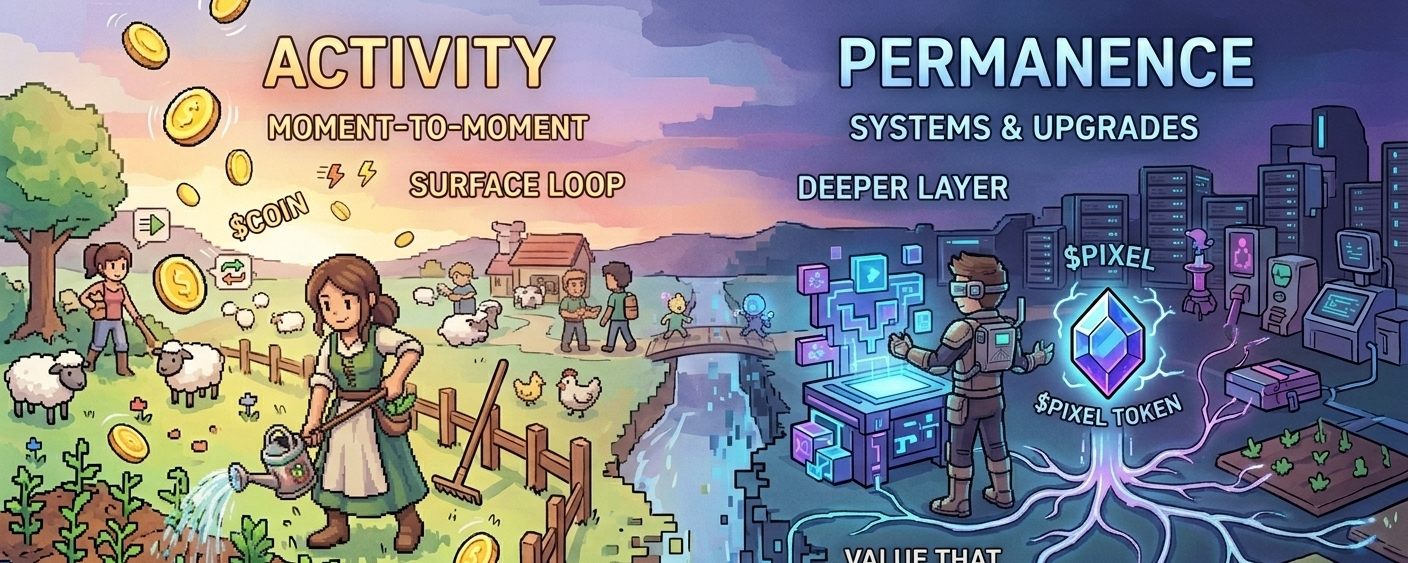

@Pixels doesn’t loudly announce its economy and that’s exactly what makes it interesting.
On the surface, everything feels simple. You farm, craft, trade, and earn Coins. It’s smooth, familiar, and self-contained. You can play for hours without ever thinking about $PIXEL at all. Nothing forces it into your attention.
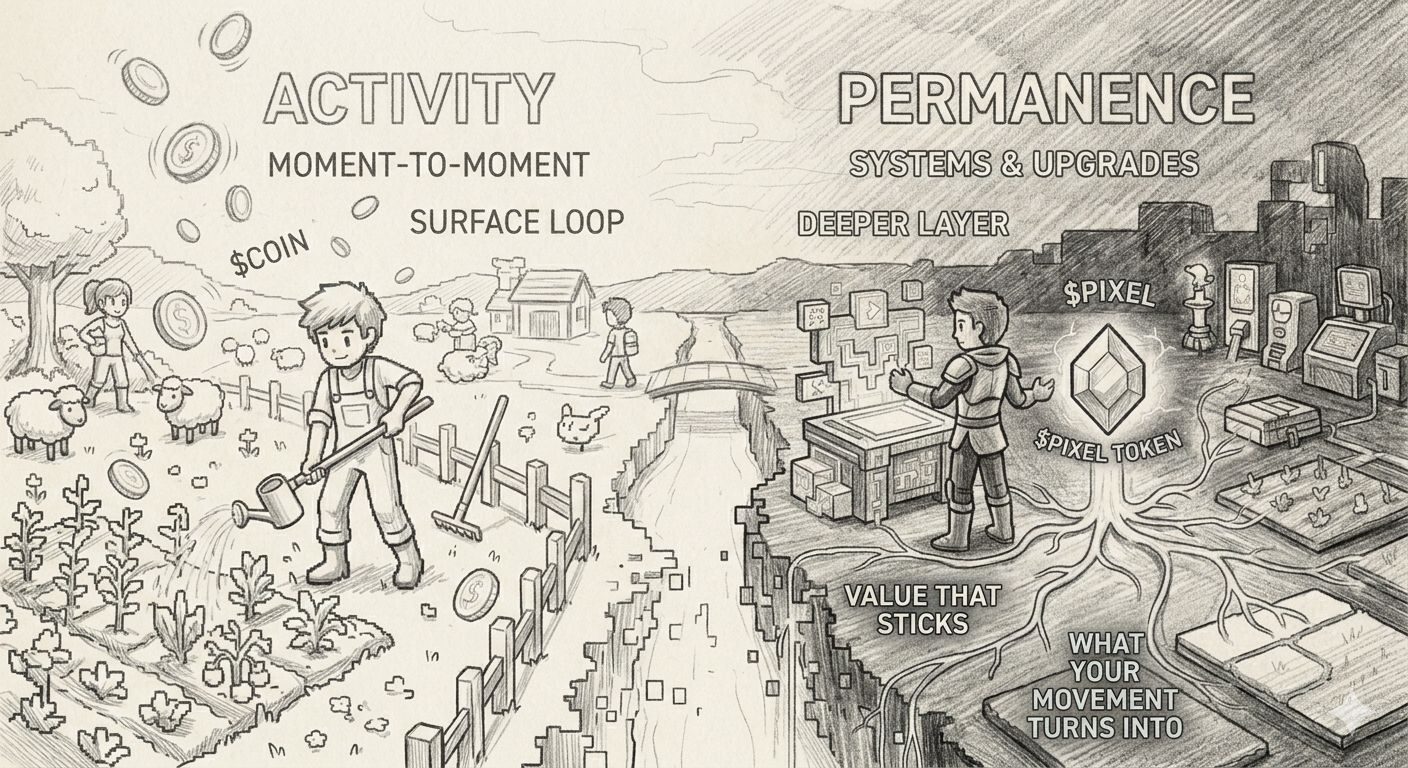
But the longer you stay, the more you notice a split.
Coins handle the visible, everyday loop—fast rewards, constant activity, short memory. $PIXEL shows up much less often, but in places that feel heavier: upgrades, crafting systems, land, and mechanics that persist beyond a single interaction.
That’s where the design starts to shift.
It’s not about “pay to progress.” It’s more about what actually sticks. Coins keep you moving. $PIXEL quietly decides what your movement turns into over time.
Two players can spend the same hours inside Pixels and end up in very different positions—depending on whether they stayed in the surface loop or occasionally interacted with the deeper layer.
The interesting part is that the game doesn’t push this distinction aggressively. You can ignore it for a long time. The system only reveals the split gradually, through repetition.
And that creates a subtle tension: most of the gameplay feels equal, but not all progress behaves equally.
If Pixels grows into a larger ecosystem, $PIXEL could become less of a “token layer” and more of a connective thread between systems. If not, it risks staying partially disconnected from the main player experience.
Either way, the design choice is clear:
one layer is about activity… the other is about permanence.