
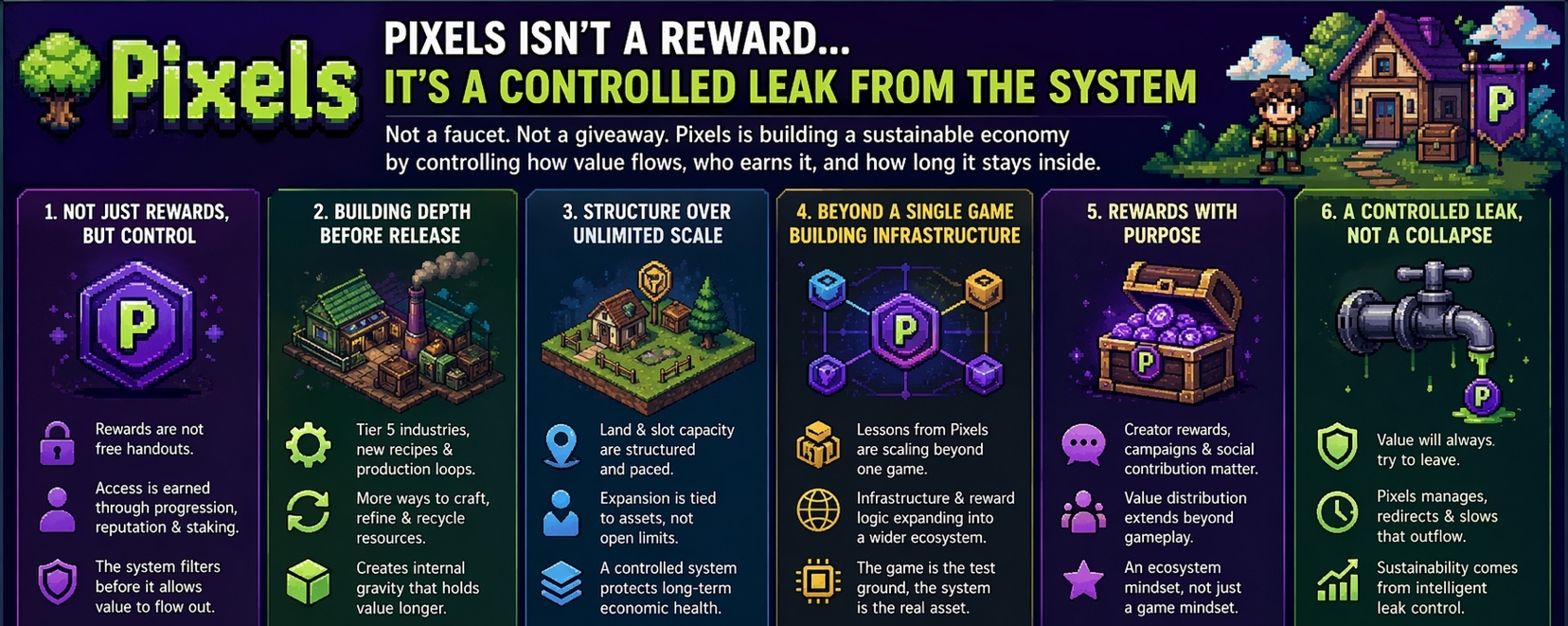
Pixels is one of those projects that looks simple if you only glance at it once, and honestly, that is usually where people get trapped.
I’ve seen that movie too many times. Nice surface, clean loop, token attached, some early traction, then the whole thing starts grinding itself into dust because nobody built enough underneath it to carry the weight.
That’s why I don’t really look at Pixels as just another reward-driven setup anymore.
At this point, I’m looking at it more like an economy that knows rewards can kill it if they are handled badly. That sounds harsh, but crypto has earned that kind of language. Most projects don’t die because nobody cared. They die because they let value leave too easily, too early, and too often. They confuse activity with strength. They confuse noise with demand. Then they spend the next year recycling the same story while the structure underneath keeps thinning out.
Pixels feels more aware of that than most.
What I notice first is the friction. Not random friction. Intentional friction. The kind that tells me the team understands that open access sounds good in theory, but in practice it usually turns into extraction. Fast. Dirty. Predictable. I’ve watched enough of these systems fall apart to know that once the easiest path is “show up, farm, leave,” the clock is already ticking.
Pixels doesn’t feel like it wants to be that kind of project.
That matters to me more than any surface-level promise. Because the easy version of crypto gaming has already been tested to death. We know where it ends. A burst of attention, a pile of content, some excited posting, then the real economy kicks in and everybody starts leaning on the exit at the same time. Same pattern. Different branding.
But here’s the thing. Pixels doesn’t look like it is pretending that problem away. It looks like it has spent enough time inside the grind to understand what actually breaks first.
Usually it’s the flow of value.
Not the art. Not the story. Not the user count on a good day. It’s the flow. Who gets access. How fast they can pull value out. Whether the system has any real internal depth before that value disappears into the market and becomes someone else’s bag to manage.
That’s where Pixels starts to get more interesting for me.
The project feels like it is trying to slow that whole process down. Not by stopping rewards. That never works. People come for incentives. That’s just reality. But by making the economy thicker before rewards become too liquid, too loose, too easy to dump into the usual cycle of noise and fatigue. I think that’s the right instinct. Maybe one of the only instincts in this sector that still matters.
You can see it in the way the world has been expanding.
More production layers. More crafting depth. More internal loops. More ways for effort to move through the system before it turns into pure outward pressure. That may sound small to people who just want a chart and a headline, but I don’t think it is small at all. A shallow economy bleeds fast. A deeper one at least has a chance to hold together for longer than a few market moods.
And that’s really what I’m looking for now. Not perfection. Just resistance. Something with enough internal weight that it doesn’t immediately collapse into extraction the moment users get impatient.
Pixels seems to understand that a project like this cannot survive on a clean little reward loop forever. It needs internal gravity. It needs reasons for value to stay in motion inside the system instead of rushing toward the nearest exit. Without that, everything becomes temporary. User behavior becomes transactional. Participation becomes mechanical. The whole thing starts feeling like a shift job nobody believes in.
I’ve seen plenty of projects end up there.
Pixels doesn’t feel healthy because it offers rewards. That part is ordinary. It feels more serious because it seems to distrust its own reward flow, and honestly, I think that’s a good sign. A necessary sign. Maybe the best sign you can get in this category. If the team knows rewards are dangerous, there’s at least a chance they build with some discipline instead of just dressing up emissions and calling it community growth.
The real test, though, is whether all this added depth actually changes user behavior.
That’s where I still hold back.
Because adding more systems is easy to praise from a distance. More layers, more mechanics, more moving parts. Fine. But if those systems don’t create real attachment, real circulation, real reasons to stay, then it’s just more structure sitting on top of the same old leak. I’ve watched that happen too. Projects get more complicated, not more durable. They build around the problem without solving it. The grind just gets dressed in better language.
Still, I can’t ignore what Pixels is trying to do.
It feels less like a project chasing the old play-to-earn fantasy and more like one trying to survive after watching that fantasy break in public. That’s a different energy. More cautious. More weathered. Less interested in pretending rewards alone can carry a whole ecosystem. I trust that tone more than the usual polished optimism because the usual polished optimism has destroyed a lot of capital.
And I do think Pixels is moving toward something more project-driven than token-driven, which is important. The token still matters, obviously. In crypto it always does. But I’m more interested in whether the world itself can hold pressure. Whether the systems are strong enough to keep users participating without turning every cycle into another round of extraction and disappointment.
That’s the part nobody can fake for long.
A lot of projects look alive when the market gives them energy. Very few still look coherent when the mood gets heavy, when attention starts thinning, when users become colder, more selective, more tired. That’s when the real shape shows. That’s when you see whether the economy has actual bones or whether it was just another temporary arrangement built on incentives and good timing.
Pixels, at least to me, looks like a project trying to grow bones.
Not hype. Not spectacle. Bones.
And maybe that’s why I keep paying attention to it. Not because I think it has solved the category. It hasn’t. Nobody has. But it does look like it understands the disease better than most of the others did. It looks like a project that knows rewards are not the product. The structure around them is the product. The containment matters. The pacing matters. The friction matters.
That kind of thinking doesn’t guarantee anything. I know better than that by now.
It just gives the project a shot at being more than another loop people use until the noise fades and the grind starts feeling heavier than the upside.
I’m still watching for the point where this either hardens into something durable or slips into the same recycling pattern the market has already seen a hundred times.
And that moment usually arrives quieter than people expect.