
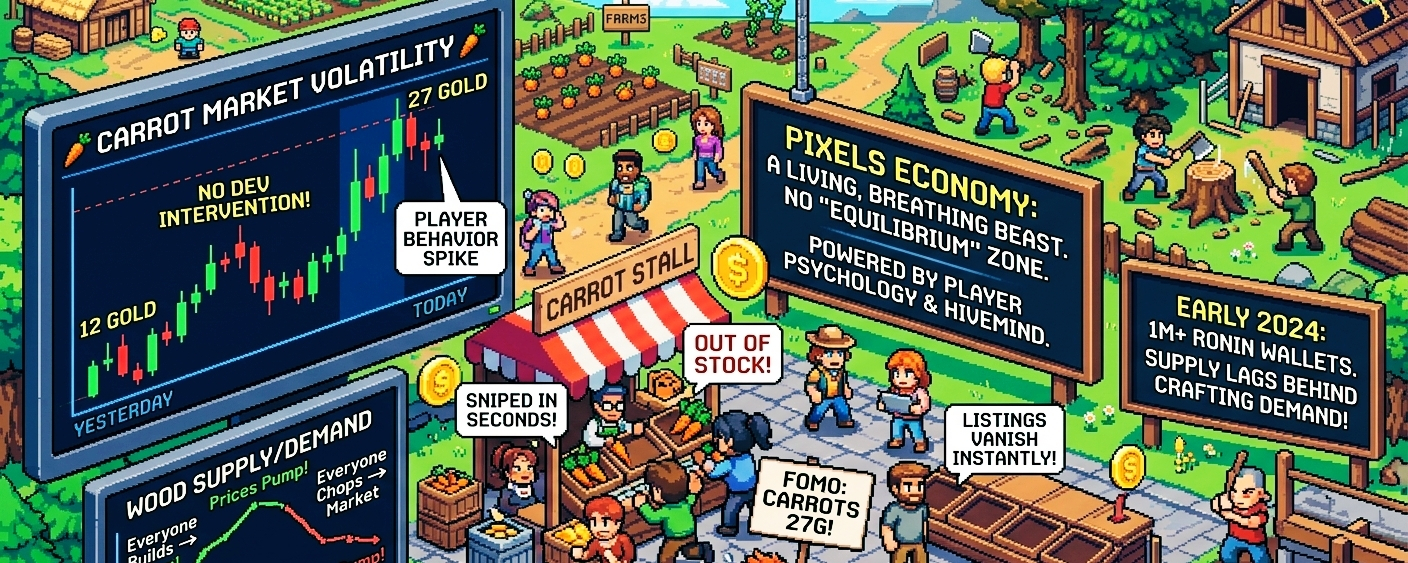
Just yesterday, I logged into Pixels for a quick inventory check. Out of nowhere, the carrots I’d been holding since the afternoon were selling at a wildly higher price. No game updates, no events, no announcements—just the market moving in a way I totally didn't see coming. My brain immediately went into default "Web2 mode": The devs must have tweaked a drop rate, or there's a new quest eating up supply.
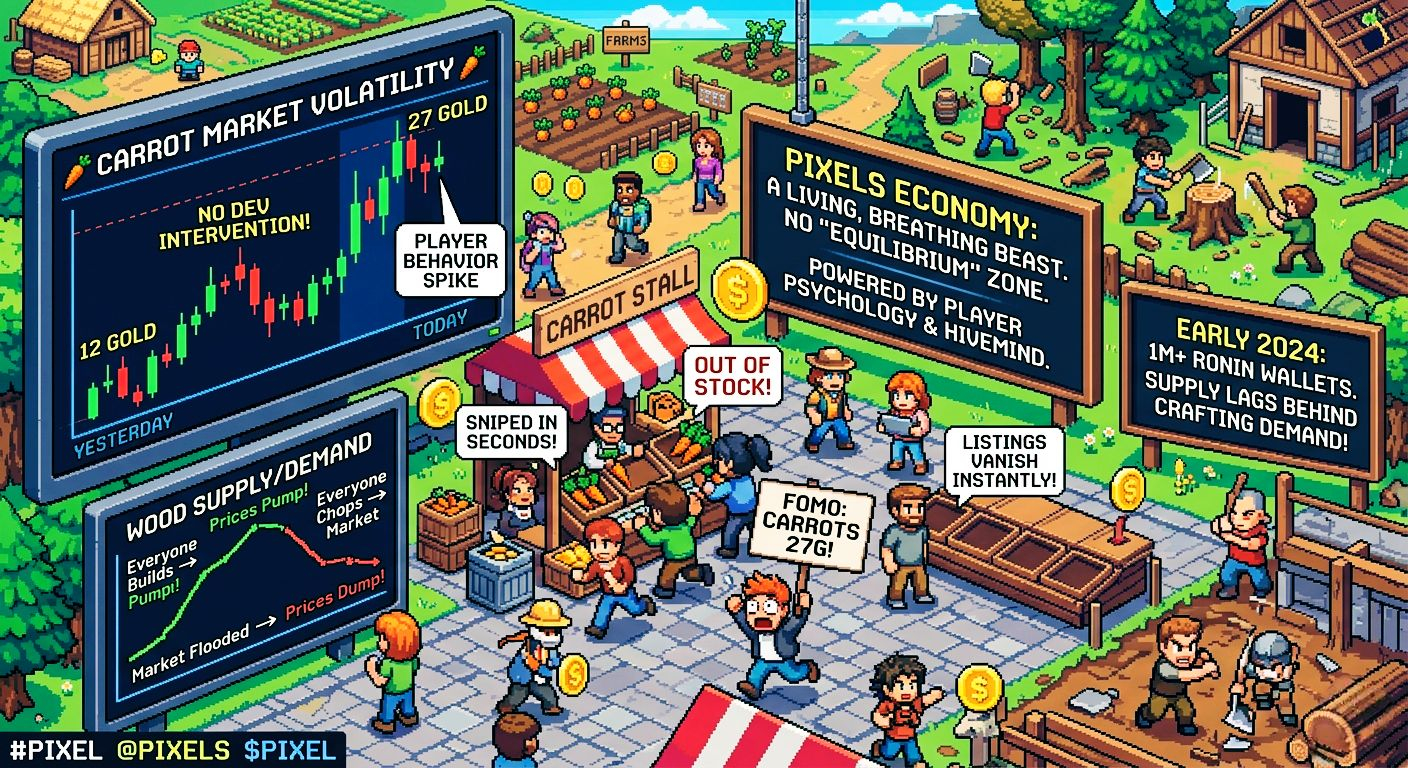
But when I actually sat down and watched the marketplace, things got weird. In the span of just 2 or 3 hours, carrot prices spiked from around 12 gold to nearly 27 gold. Listings vanished, and anything newly posted got sniped in seconds. There was zero system intervention here—just pure, rapid shifts in player behavior. That exact moment made me rethink everything I thought I knew about this game's economy.
I used to believe game economies always had a "safe zone"—a baseline equilibrium that devs eventually force prices back to. I even tried playing around that theory in Pixels, trying to farm and sell on a steady, predictable rhythm. Spoiler alert: I failed miserably. A few hours of being misaligned with the market, and my edge was completely wiped out.
There are days when I think I'm playing it safe, only to watch my profits bleed out without understanding why. Honestly? I’m starting to think the "equilibrium" I’ve been looking for never existed. Everything in this market is dragged around by player psychology, not hardcoded logic.
In Pixels, players hold the wheel. There’s no invisible safety net keeping prices "reasonable." A perfect example is early 2024 when Pixels blew up on Ronin. We hit over 1 million active wallets in a month, and the demand for crafting resources skyrocketed. But here’s the catch: supply can't magically scale up. It relies entirely on players shifting their farming habits, and that lag creates massive volatility. Demand spikes, prices moon. Then players FOMO into farming that specific resource, supply floods the market a day later, and prices crash right back down.
I've seen the exact same cycle with wood. Everyone decides to build at once -> prices pump -> everyone switches to chopping wood -> the market gets flooded -> prices dump on the exact same day.
The longer I play, the more obvious it gets: there is no "correct" price to return to. Prices don't go back to normal; they are endlessly yanked around by the collective hivemind. It happens in real-time. No batch updates, no smoothing mechanics. If the crowd panic-sells, prices tank instantly. If they hoard, prices soar. If you aren't paying attention, you're always going to be one step behind. I used to think game supply and demand was just a simulation, but Pixels actually feels closer to the real-world stock market because there’s no dev layer acting as a buffer.
Diving deeper into the loop, I realized the team isn't trying to build a perfectly balanced utopia. They’ve practically thrown the idea of "equilibrium" out the window. Pixels is just a constant flow where every single player action alters the state of the board.
Sure, this makes the game wildly unpredictable, but it also makes it feel incredibly real. Every time you plant or sell, you're reacting to real people. The downside? The volatility is brutal. If you're just a casual player, it’s super easy to feel out of control and constantly out of sync with the meta. And because it's purely player-driven, whales or large guilds can easily trigger short-term chaos. The system doesn't step in to fix it; the chaos is just a natural part of the game.
Maybe I’m deep down the rabbit hole here, but Pixels is making me rethink a massive assumption we have in crypto: the obsession with designing and maintaining a "perfectly balanced" state. If human behavior is always shifting, maybe "equilibrium" is just a myth—a fleeting second where supply and demand accidentally cross paths.
For me, Pixels isn't just a farming simulator anymore. It’s a live experiment of what happens when you take the training wheels off an economy. And honestly, that lack of a fixed balance might be exactly what makes this ecosystem feel so alive.