
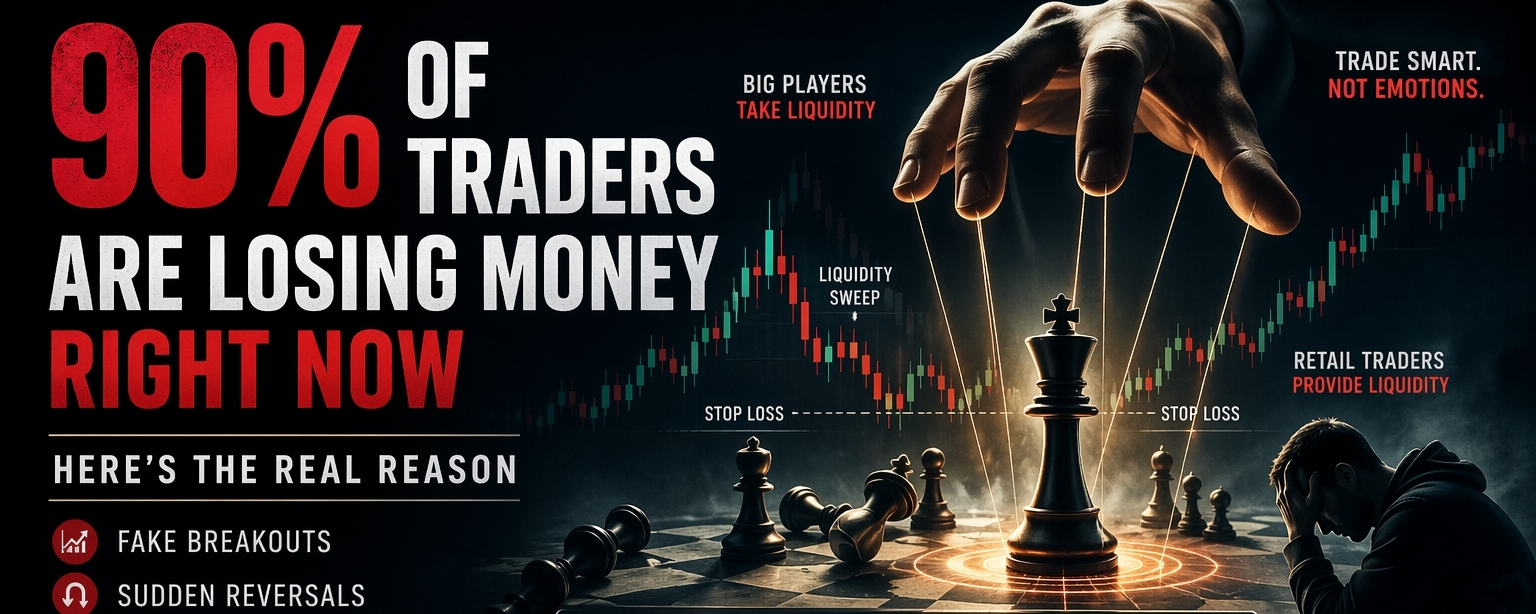
The current crypto market is not behaving in a traditionally bullish or bearish manner. Instead, it is operating in a highly reactive and liquidity-driven environment where most retail traders are consistently being trapped.
If you have been experiencing repeated stop-loss hits or inconsistent results, it is not necessarily due to poor strategy alone — it is largely due to the nature of the current market structure.
At present, price action is designed in a way that creates emotional decisions:
When price moves upward, traders tend to enter long positions driven by fear of missing out (FOMO).
When price drops, the same traders quickly reverse and take short positions out of panic.
In both scenarios, liquidity is created — and ultimately taken by larger market participants.
This behavior reflects a classic liquidity cycle. Institutional or high-capital traders do not chase price movements; instead, they position themselves where retail liquidity accumulates — typically around obvious breakouts, support/resistance zones, and stop-loss clusters.
Current Market Characteristics:
Based on recent observations, the following patterns are dominating the market:
Frequent false breakouts with no continuation
Sharp intraday reversals after entry confirmation
Repeated stop-loss hunts (liquidity sweeps)
Lack of sustained directional momentum
This explains why a large percentage of traders are currently facing losses despite being active in the market.
What Actually Works in This Environment:
In such conditions, a reactive or impulsive approach does not yield consistent results. A structured and selective strategy becomes essential.
Rather than entering every visible opportunity, the focus should be on high-probability setups defined by:
Confirmed trend direction across higher timeframes
Clear market structure (Higher High–Higher Low or Lower High–Lower Low formations)
Liquidity sweeps before entry (to avoid being trapped)
Alignment of volume and momentum indicators
This approach significantly reduces unnecessary exposure and improves trade quality over quantity.
Real Trade Performance (Recent):
A practical example of this approach can be seen in recent trades:
SOLUSDT: Stop Loss triggered (-$6.00)
DOGEUSDT: Target 2 achieved (+$15.00)
BTCUSDT: Target 2 achieved (+$18.40)
XRPUSDT: Target 1 achieved (+$11.20)
POLUSDT: Target 3 achieved twice
(+$84.60 total)
Net Result: +$123.20 Profit
Account Growth: $200 → $323
The key observation here is not that every trade was profitable — but that controlled risk combined with strong reward trades resulted in overall profitability.
Risk Management Perspective:
Consistency in trading does not come from predicting every move correctly. It comes from managing risk effectively:
Limiting downside per trade
Securing partial profits early (making positions risk-free)
Allowing high-performing trades to run
Avoiding overtrading and signal spamming
This creates a mathematical edge over time rather than relying on individual outcomes.
Conclusion:
The current market environment rewards patience, discipline, and precision — not aggression or overactivity.
Losses are not always a result of poor decision-making; often, they are a consequence of trading in unfavorable conditions without adapting strategy.
A sustainable trading approach is built on:
Selectivity over frequency
Risk control over high leverage exposure
Long-term consistency over short-term gains
Traders who adapt to these principles are more likely to survive and grow in volatile conditions.
Follow for structured trade setups, real performance tracking, and disciplined risk management insights.
#CryptoTrading #Binance #FuturesTrading #TradingStrategy #RiskManagement