It looks relaxed on the surface. Farming, wandering around, building things, meeting other players. It has that soft, open-world rhythm that makes people stay longer than they planned. But once you sit with it for a bit, it becomes clear the game is also carrying around a harder question in the background. How do you reward players without breaking the game itself?
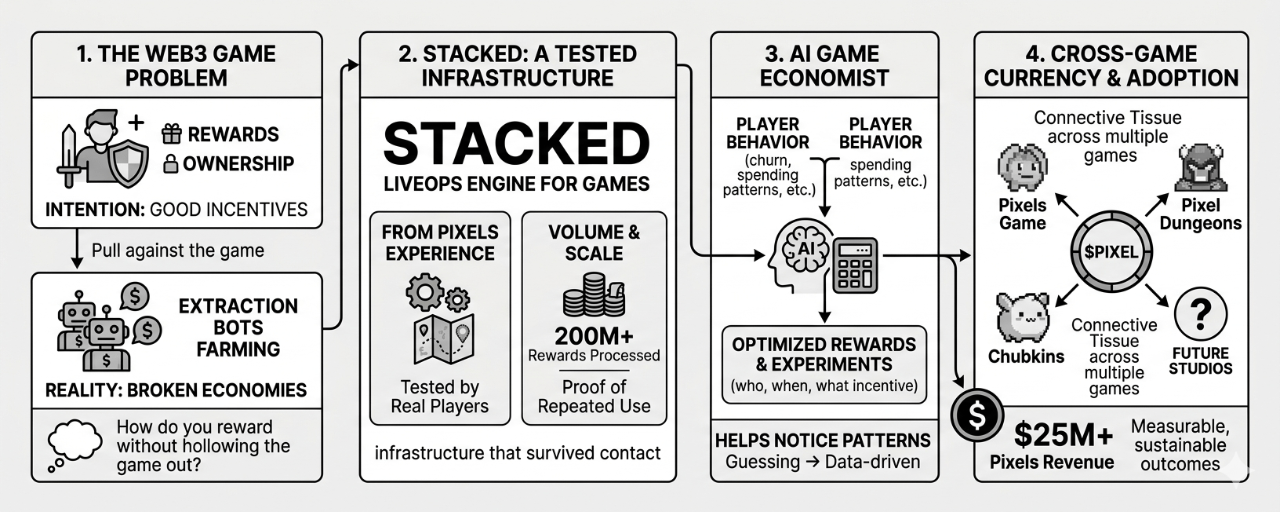
That question matters more in web3 games than people sometimes admit. A lot of these systems start with a simple idea. Give players rewards, let ownership matter, create more reasons to come back. On paper, that sounds fine. Sometimes even exciting. But you can usually tell pretty early when the reward layer is starting to pull against the game instead of supporting it. The wrong people show up. Bots get comfortable. Economies get stripped down to extraction. The game starts feeling less like a world and more like a loop people are trying to exploit before it closes.
That seems to be the context behind Stacked.
The simplest way to say it is probably this: Stacked is a rewarded LiveOps engine for games, with an AI game economist sitting on top. The point is not just to hand out rewards. It is to decide who should get them, when they should get them, and then see whether those moments actually improve retention, spending, and long-term value. That sounds technical when you say it too fast, but the idea underneath is pretty human. Timing matters. Relevance matters. Not every player should see the same offer, the same prompt, or the same incentive at the same time.
That is where things get interesting, because Stacked does not really read like another rewards product trying to attach itself to games from the outside. It feels more like something that came out of a specific problem the @Pixels team had already lived through. And that difference matters. They were not guessing about what goes wrong in play-to-earn systems. They had already seen what happens when rewards attract the wrong kind of behavior, when economies get farmed, and when systems that look clever at launch fall apart under real usage.
So the tone around Stacked makes more sense when you look at it that way. It is less “here is a shiny new mechanic” and more “here is the infrastructure that survived contact with real players.”
That part is probably worth slowing down on. A lot of game tooling sounds good in theory because theory is easy. The hard part is production. The hard part is scale, repetition, weird player behavior, fraud, edge cases, and all the things people do when even small amounts of money are involved. Once real-money rewards enter the picture, the question changes from “can this be built?” to “can this keep working when players push on every weak point?” That is a very different standard.
Stacked seems to be pointing to that standard pretty directly. It already powers systems inside Pixels, Pixel Dungeons, and Chubkins. So this is not being introduced as a concept deck or an abstract platform story. It is already live inside an ecosystem that has processed more than 200 million rewards. After a while, that number matters less as a headline and more as a sign that the system has gone through repeated use. Volume has a way of exposing whether something is fragile.
The revenue piece matters for the same reason. If Stacked-powered systems contributed to more than $25 million in Pixels revenue, then at minimum it suggests the reward layer is not just decorative. It is tied to business outcomes in a measurable way. And honestly, that is probably the part many studios care about most, even if they do not say it first. They do not need another rewards idea. They need to know whether a rewards system changes player behavior in ways that are actually useful and sustainable.
That is also where the AI game economist idea becomes more practical than it first sounds. Left alone, reward systems can become noisy fast. Too many campaigns. Too many incentives. Too much guessing. An economist layer, if it is working the way it is supposed to, is less about sounding futuristic and more about helping teams notice patterns in player behavior that are easy to miss. Who is likely to churn. Who might spend if nudged differently. Which experiments are worth running. Which ones only create temporary spikes and leave no lasting effect. Those are not glamorous questions, but they are real ones.
Then there is the role of $PIXEL inside all of this.
That part seems important because it shifts the token away from being tied to only one game. The framing here is more like a cross-game rewards and loyalty currency running through an ecosystem. Not just an item attached to Pixels as a standalone title, but something that can move across different game environments as part of a broader rewards layer. Whether that grows into something larger will depend on adoption, obviously. But the intention is clear enough. They are trying to make the token function more like connective tissue than a single-game asset.
And that may be the clearest way to understand the whole thing. Stacked is not really being presented as a feature. It is more like a system for deciding how rewards should work across games without repeating the same old mistakes. Built by a team that has already been through the messier version of this. Already used in production. Opened up now to other studios, but coming from a place that feels tested rather than imagined.
With Pixels, you can still start from the farming and exploration and the softer side of the game. That part is real. But underneath it, there is also this quieter effort to solve a harder problem about incentives, economies, and what makes players stay for reasons that do not hollow the game out. That is probably the part worth watching for a while.
#pixel

Článok
Pixels is one of those games where the appeal makes sense pretty quickly.
Zrieknutie sa zodpovednosti: Obsahuje názory tretích strán. Toto nepovažujte za finančné poradenstvo. Môže zahŕňať sponzorovaný obsah. Pozrite si zmluvné podmienky.