
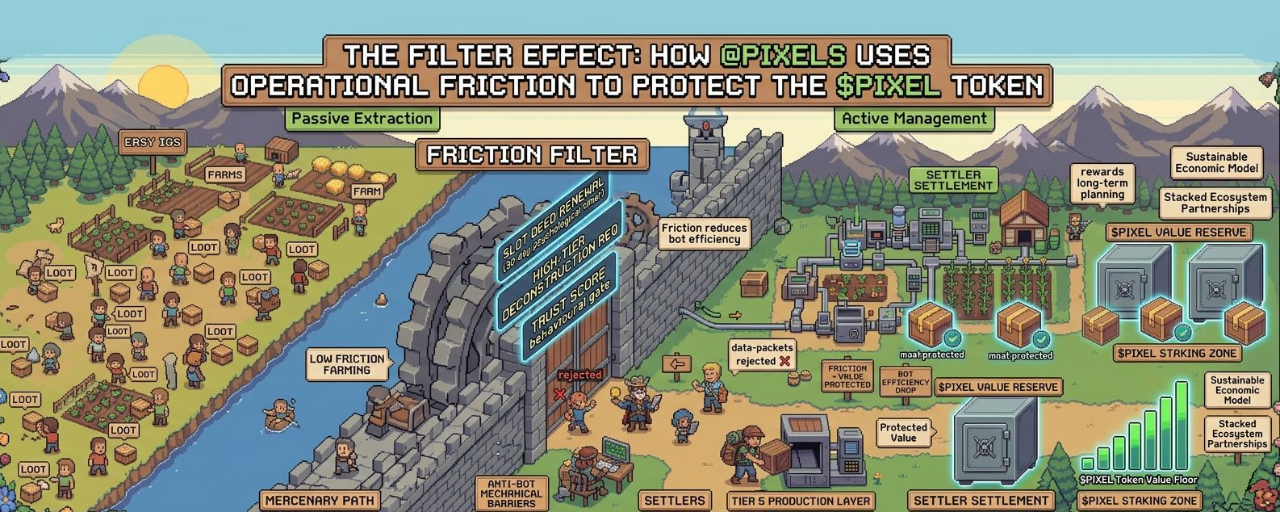
In the early, heady days of the Play-to-Earn (P2E) movement, the industry-wide mantra was "seamless onboarding." Projects raced to make it as easy as possible for anyone, anywhere, to jump in and start earning tokens. We now have the benefit of hindsight to see that this approach was often a recipe for economic disaster. When the barrier to extraction is zero, the value of the token almost always follows it to the floor.
@Pixels has taken a radically different, more sophisticated path. By implementing a series of "Operational Frictions," they have created a filter that protects the $PIXEL token from the hyper-inflationary death spirals that claimed so many of its predecessors.
The 30-Day Psychological Timer
The Slot Deed system is perhaps the most visible and debated form of friction in the current ecosystem. By requiring players to actively renew their access every 30 days, @Pixels creates a definitive "use it or lose it" scenario. This is a masterstroke in preventing "passive extraction."
In older GameFi models, a "whale" could simply buy a prime piece of digital land and sit on it indefinitely, collecting rewards while contributing nothing to the game’s actual activity or liquidity. In the Pixels Tier 5 (T5) era, that is no longer possible. You must be an active manager. You must be present. This specific friction ensures that the "digital real estate" of the game remains in the hands of active producers rather than dormant speculators. It keeps the economy moving and ensures that rewards are tied to ongoing effort rather than past capital.
Trust Scores as a Behavioral Barrier
Friction isn't always about time or manual labor; sometimes it’s about reputation and behavioral data. The "Trust Score" is a "soft-friction" mechanism that is remarkably effective. It doesn’t physically stop you from clicking buttons, but it significantly limits your ability to "off-ramp" value if the system deems your behavior suspicious, automated, or purely extractive.
This forces a fundamental shift in player psychology. To maximize your returns, you are forced to act like a member of a community rather than an anonymous, predatory miner. You are incentivized to engage with the social layers, participate in quests, and maintain a "clean" footprint. It is a brilliant use of friction to mold a healthier, more human player base.
Why the "Hard" Path is Sustainable
While casual players often complain when new layers of complexity are added, a look at the Top-3 global leaderboard analysis tells a different story. These "economic hurdles" are the structural supports that keep $PIXEL sustainable.
Anti-Bot Efficiency: Bots thrive on simplicity. When a game requires complex, multi-step decision-making and frequent renewals, the "return on investment" for bot operators drops significantly.
The Cost of Production: By increasing the effort required to produce goods or earn tokens, the game creates a natural floor for the value of those assets. High friction equals high "proof of work."
Rewarding the Strategist: Friction rewards the players who think 30 days ahead. It favors long-term planning over short-term greed, which is exactly the kind of behavior that builds a lasting economy.
Conclusion: The Professionalization of Play
We are witnessing the end of the "casual earning" era and the beginning of "professionalized production." @Pixels is leading this charge by proving that a healthy Web3 economy requires gates, requirements, and effort.
As the "Stacked" ecosystem grows and more partnerships are integrated into the Ronin Network, expect even more of these filters to appear. They aren't bugs in the system, and they aren't meant to "annoy" the player base for no reason. They are the essential guardrails that allow the PIXEL token to hold its value even in a volatile market. In the world of Web3 gaming, if it isn't a little bit hard, it probably isn't worth doing.