

I used to think quest boards failed because they were too simple.
Same missions, same rewards, same loop repeating until players got bored. It felt like a content problem. Add more variety, rotate tasks faster, maybe layer in streaks and it would hold longer.
But that’s not what actually breaks.
What breaks is that a quest board assumes every player should be pushed in the same direction.
And that assumption doesn’t survive scale.
Because once enough players enter a system, they stop behaving like “players” and start behaving like different economic roles. Some optimize for speed. Some for extraction. Some for completion. Some for status. Some don’t care about the game at all only the reward attached to it.
A quest board can’t see that.
It treats all of them the same.
That’s the limitation Pixels is trying to remove.
Stacked doesn’t fix the quest board.
It removes the idea that everyone should get the same task in the first place.
That’s the uncomfortable shift.
Stacked doesn’t give you missions.
It decides if you should have one.
And once that layer exists, the entire system changes direction.
A normal quest board sits inside the game loop. You log in, you see tasks, you complete them, you get paid. The system reacts to you.
Stacked flips that.
Before you even see a mission, the system has already evaluated you.
What kind of behavior do you show?
Do you come back after rewards drop?
Do you only appear when payouts spike?
Do you convert into long-term participation or just extract and leave?
That evaluation decides what you see.
So the flow is no longer:
task → action → reward
It becomes:
behavior → evaluation → task → calibrated reward
That’s not a feature upgrade.
That’s a control layer.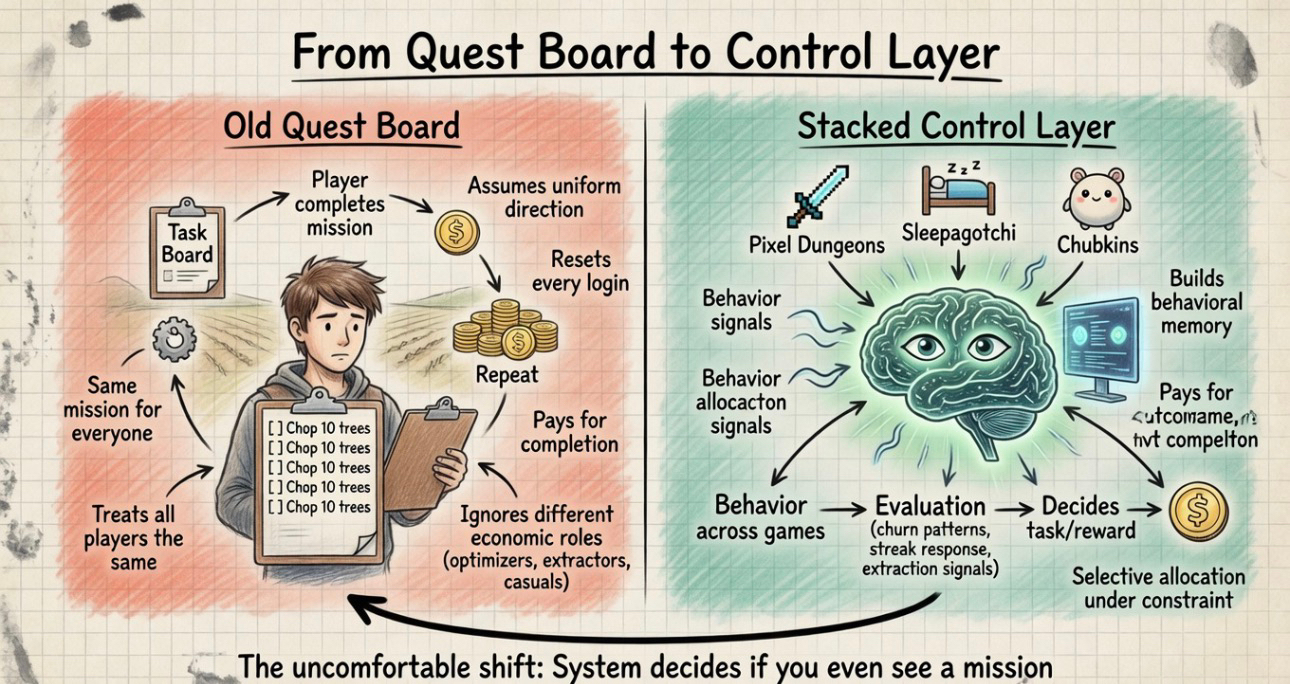
And it only works because of how Pixels is structured now not as a single loop, but as a connected set of games.
Pixel Dungeons, Sleepagotchi, Chubkins these aren’t just additional titles. They’re different environments producing different behavior signals. One player might grind efficiently in one game, explore casually in another, and disappear completely in a third.
Stacked sits above all of that.
It doesn’t just see what you did in one loop.
It sees how you behave across loops.
That’s where the system starts building memory.
Not session memory.
Behavioral memory.
And that’s something a quest board can never do.
A quest board resets every time you log in.
Stacked accumulates.
That accumulation is what allows targeting to actually mean something.
Players aren’t grouped by level or progress anymore. They’re grouped by how they behave under incentives.
Players who respond to streak pressure.
Players who farm aggressively when rewards spike.
Players who disappear the moment payouts compress.
Players who stay even when rewards are low.
These groups aren’t labels.
They are inputs into how the system allocates budget.
And this is where the real mechanism shows up.
Because once you move to this model, rewards stop being emissions.
They become capital.
Every reward is a spend decision.
And the system is constantly asking:
Is this behavior worth funding?
Does it create retention?
Does it create real in-game demand?
Does it lead to actual spending or just temporary activity?
If the answer is no, rewards shrink or disappear.
If the answer is yes, rewards increase.
That’s the difference a quest board can’t handle.
A quest board pays for completion.
Stacked pays for outcome.
And once players realised that, the system becomes something else entirely.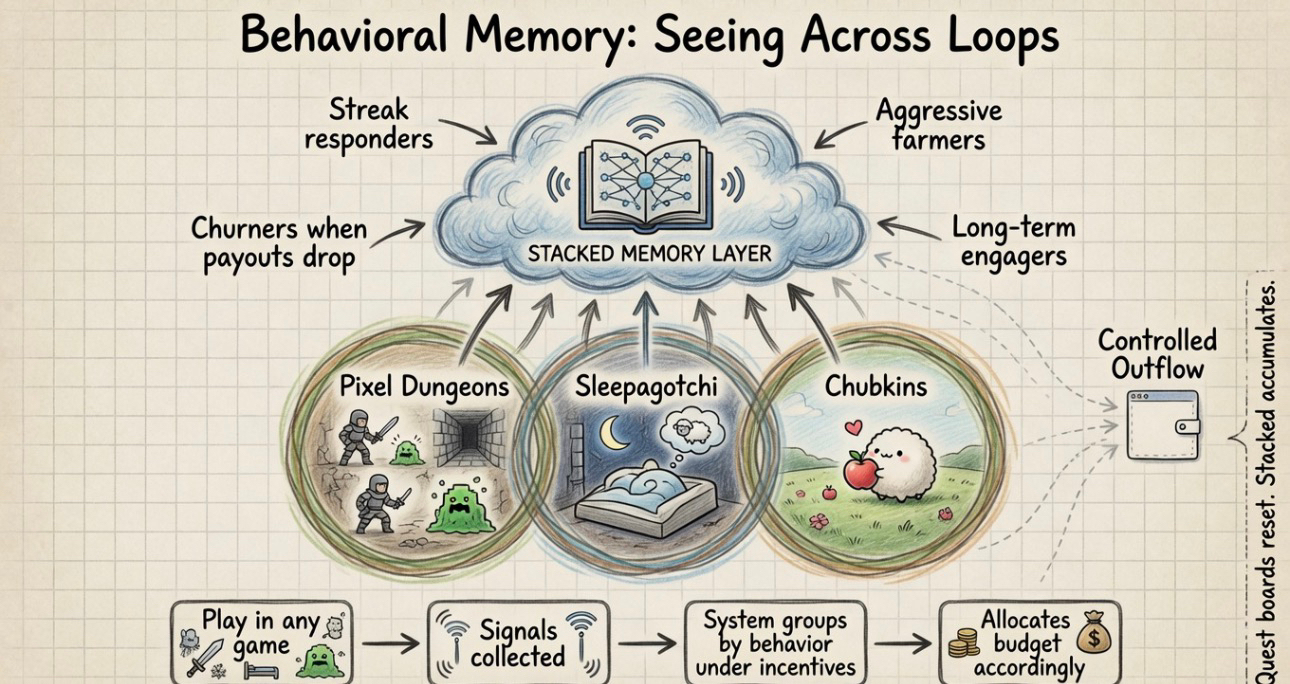
They stop blindly completing tasks.
They start trying to understand what the system values.
Some will adapt in the direction the system wants.
Others will try to break it.
Because the moment rewards become dynamic, the system itself becomes the game.
Players will look for patterns:
Which actions are overpaid right now?
Which loops are being subsidized?
Where is the easiest extraction path?
If Stacked misreads behavior at this stage, it doesn’t just make a small mistake.
It funds the wrong behavior at scale.
And that’s the real risk.
You can end up with a system that looks healthy on the surface high activity, strong engagement metrics but underneath, it’s rewarding extractors more efficiently than actual players.
That’s harder to detect than a broken quest board.
Because it doesn’t collapse immediately.
It slowly rots.
That’s why the controlled rollout matters more than anything else here.
Starting with internal titles isn’t caution.
It’s containment.
Pixels already understands the loops inside these games. They know where players churn, where rewards leak, where behavior becomes extractive instead of productive.
So when Stacked is applied, every shift is meaningful.
If rewards spike in the wrong place, they can see it.
If a cohort starts exploiting a pattern, they can isolate it.
If the system overpays for low-value behavior, they can correct it before it spreads.
You can’t do that in a full ecosystem launch.
You’d scale the mistakes along with the system.
And this is also why the reward mix matters more than people think.
A single-token system forces every behavior into the same output.
That’s where most Web3 games broke.
Because the same token had to act as:
reward
incentive
speculation layer
alignment mechanism
Everything collapsed into one stream.
Stacked breaks that.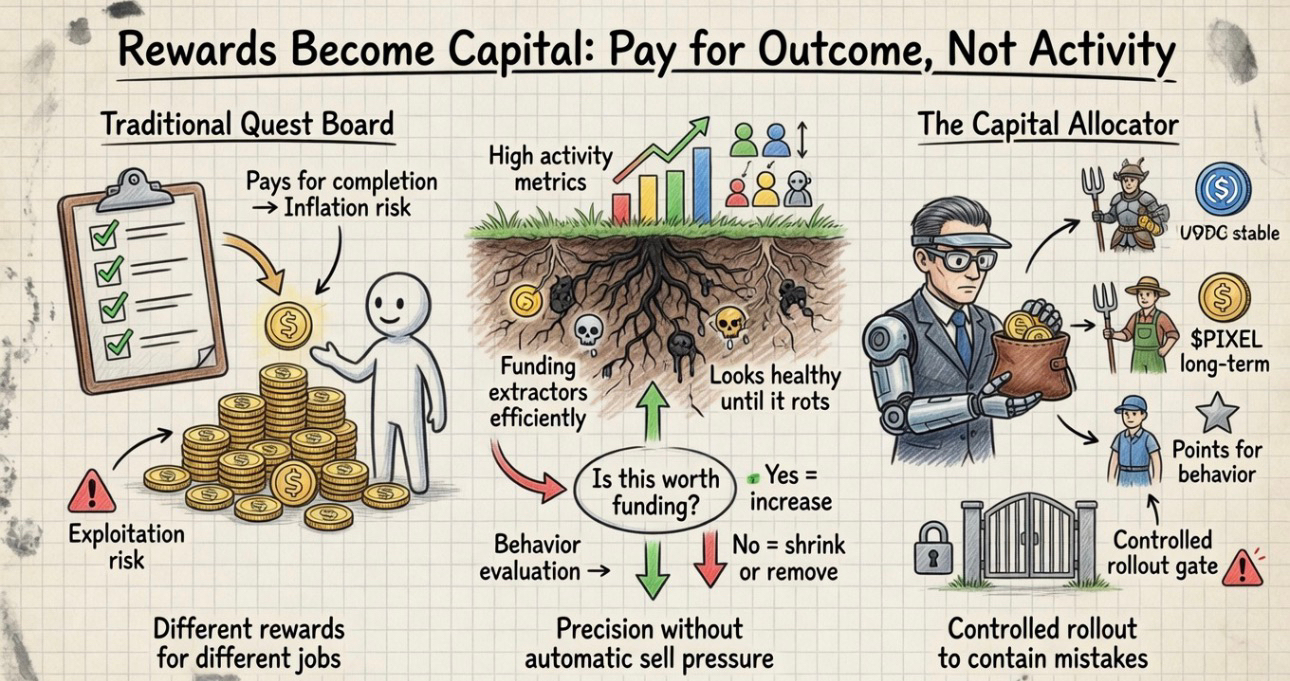
Different rewards can do different jobs.
A stable reward like USDC signals immediate, predictable value.
A native token like $PIXEL can be tied to longer-term ecosystem participation.
Points can be used to guide behavior without immediate economic pressure.
Each reward type carries a different meaning.
More importantly, a different cost to the system.
That gives Stacked precision.
It can reward behavior without automatically turning every payout into sell pressure.
It can test loops without risking the entire economy.
It can scale incentives without collapsing into inflation.
But again, this only works if the system coordinating those rewards is coherent.
Because once you introduce multiple rewards across multiple games, fragmentation becomes the default outcome.
Players chase the easiest reward.
Studios optimize for short-term spikes.
The ecosystem splits into disconnected loops.
Stacked is trying to prevent that by acting as a central allocator.
Not just distributing rewards, but deciding:
which reward
for which player
for which behavior
at which moment
That’s not content design.
That’s economic coordination.
And it’s why Pixels shouldn’t be read as a single game anymore.
It’s becoming a system that learns how behavior responds to incentives across different environments and uses that learning to adjust itself.
That’s a much harder problem than building quests.
Because now you’re not designing missions.
You’re designing the rules that decide which behavior deserves to exist in the economy.
And once that layer is in place, you don’t go back to quest boards.
Not because they’re outdated.
But because they were never designed to handle behavior at this scale.
Stacked is.
The real question is whether it can keep learning faster than players can exploit it.
Because the moment that balance flips, the system doesn’t just fail.
It goes back to the same place every quest board ends up.
Paying for activity.
Instead of paying for value.