
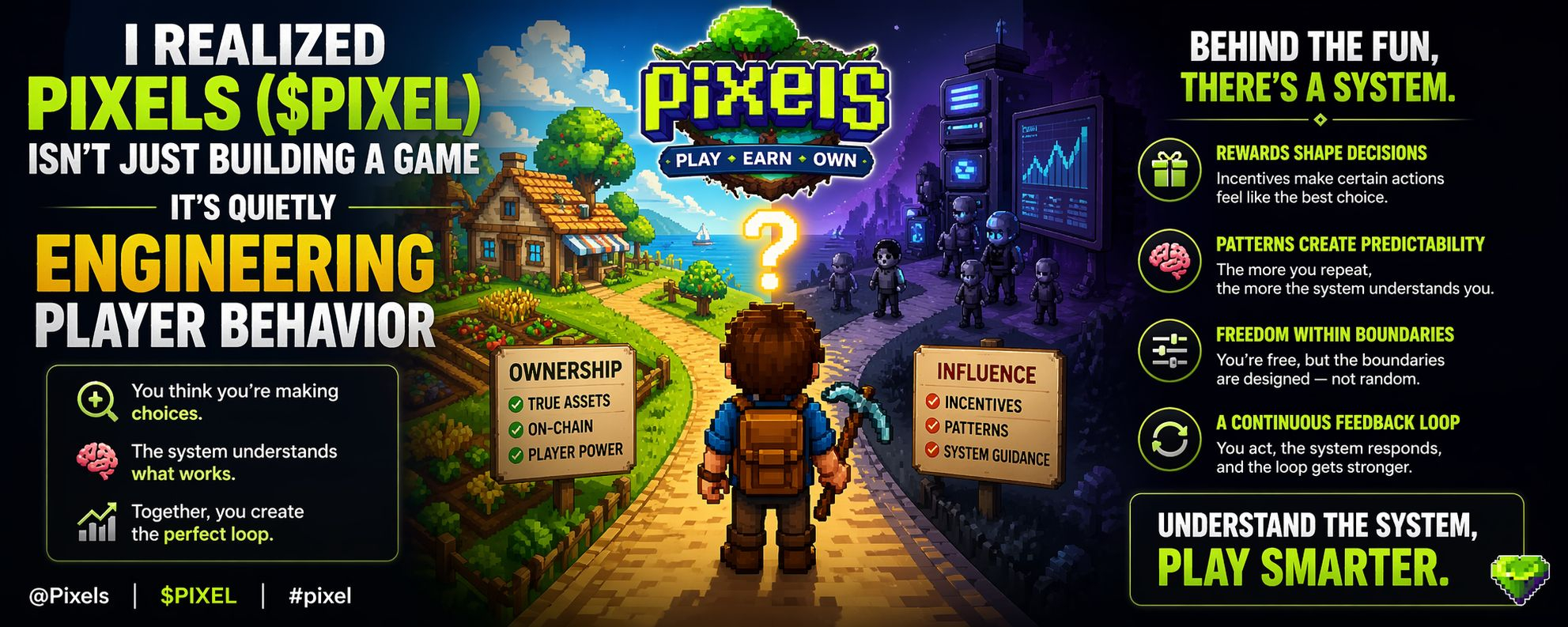
When I first started playing Pixels, I approached it with a simple mindset. I thought I was entering a Web3 game where my progress would depend on how well I could optimize my strategy, manage my time, and understand the economy. At the beginning, everything felt exactly like that. I was learning, improving, and gradually becoming more efficient. But over time, I began to notice something that didn’t feel obvious at first. My decisions were becoming more structured, my actions more repetitive, and my approach more predictable. That’s when I realized I wasn’t just improving at the game I was adapting to the system behind it.
What made this realization stronger was how natural the process felt. I wasn’t being forced into specific actions, and there were no clear restrictions telling me what I could or couldn’t do. Instead, the system guided me through incentives. Certain behaviors consistently gave better results, and without realizing it, I started prioritizing those behaviors over everything else. I chose efficiency over curiosity, consistency over experimentation, and safe outcomes over uncertain ones. It didn’t feel like I was losing freedom, but in reality, the range of choices that felt “worth it” was becoming narrower.
I don’t see this as a flaw. In fact, I think it’s one of the most complex parts of Pixels’ design. Creating a system that shapes player behavior without making it feel forced is extremely difficult. Too much control would make the game feel restrictive, while too little would make it chaotic. Pixels manages to sit in between, where everything feels smooth and natural on the surface, but underneath, there is a very calculated structure guiding how players interact with the game. That balance is not accidental it’s carefully built.
The more I thought about it, the more I realized that my role inside the game is not as simple as I initially believed. I’m not just a player making independent decisions to maximize rewards. I’m part of a feedback loop where my actions are influenced by the system, and in return, the system evolves based on collective player behavior. It’s a dynamic interaction, not a one-sided experience. And the more consistent I become, the more predictable I am to the system itself.
This is where the concept of control becomes more interesting. I still have freedom, but that freedom exists within boundaries that were designed long before I entered the game. Those boundaries are subtle, which is why they are effective. Over time, they start to feel natural, and I stop questioning them. I simply follow what works. But what works is not random it’s engineered. And once I understood that, I started looking at my decisions differently.
I still play Pixels, and I still focus on optimizing my outcomes, but now I pay attention to the reasons behind my actions. I question why certain strategies feel better, why I repeat the same patterns, and whether those patterns are truly my own or shaped by the system itself. That awareness doesn’t take away from the experience — it adds depth to it.
In the end, Pixels is not just a game where I earn rewards for my actions. It’s a system that quietly shapes how I think while I’m inside it. And once I realized that, I understood that the real value isn’t just in playing the game better — it’s in understanding the system that’s guiding me while I play.