
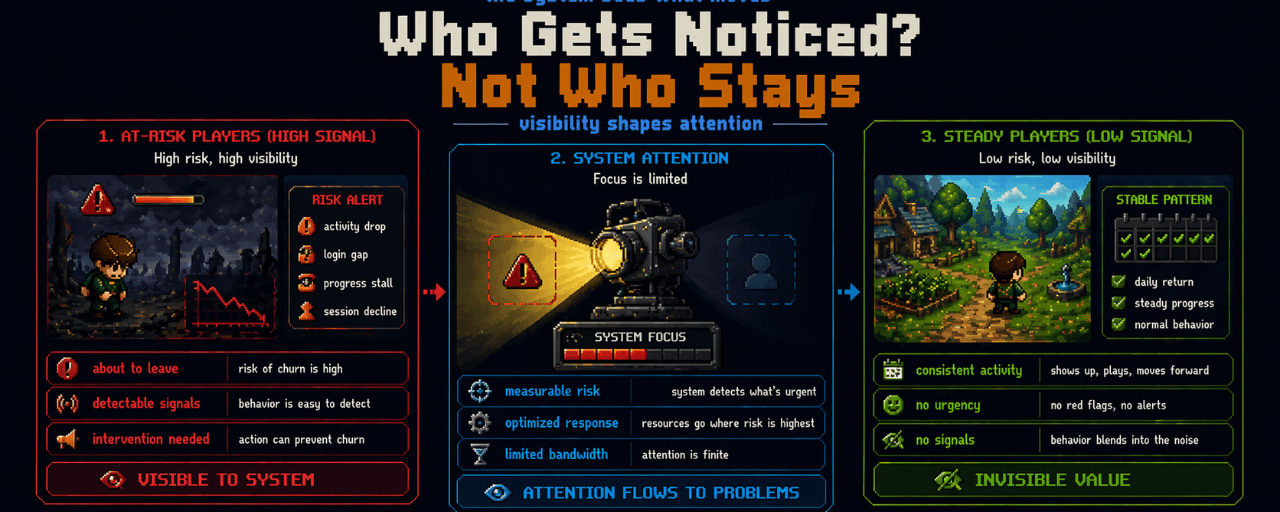
I keep thinking about a type of player in Pixels that doesn’t really show up in most discussions. Not the one about to churn. Not the one triggering alerts. Just the one who quietly comes back the next day.
No drama, no drop, no obvious reason to intervene.
And I’m starting to wonder if that’s exactly why they’re easy to miss.
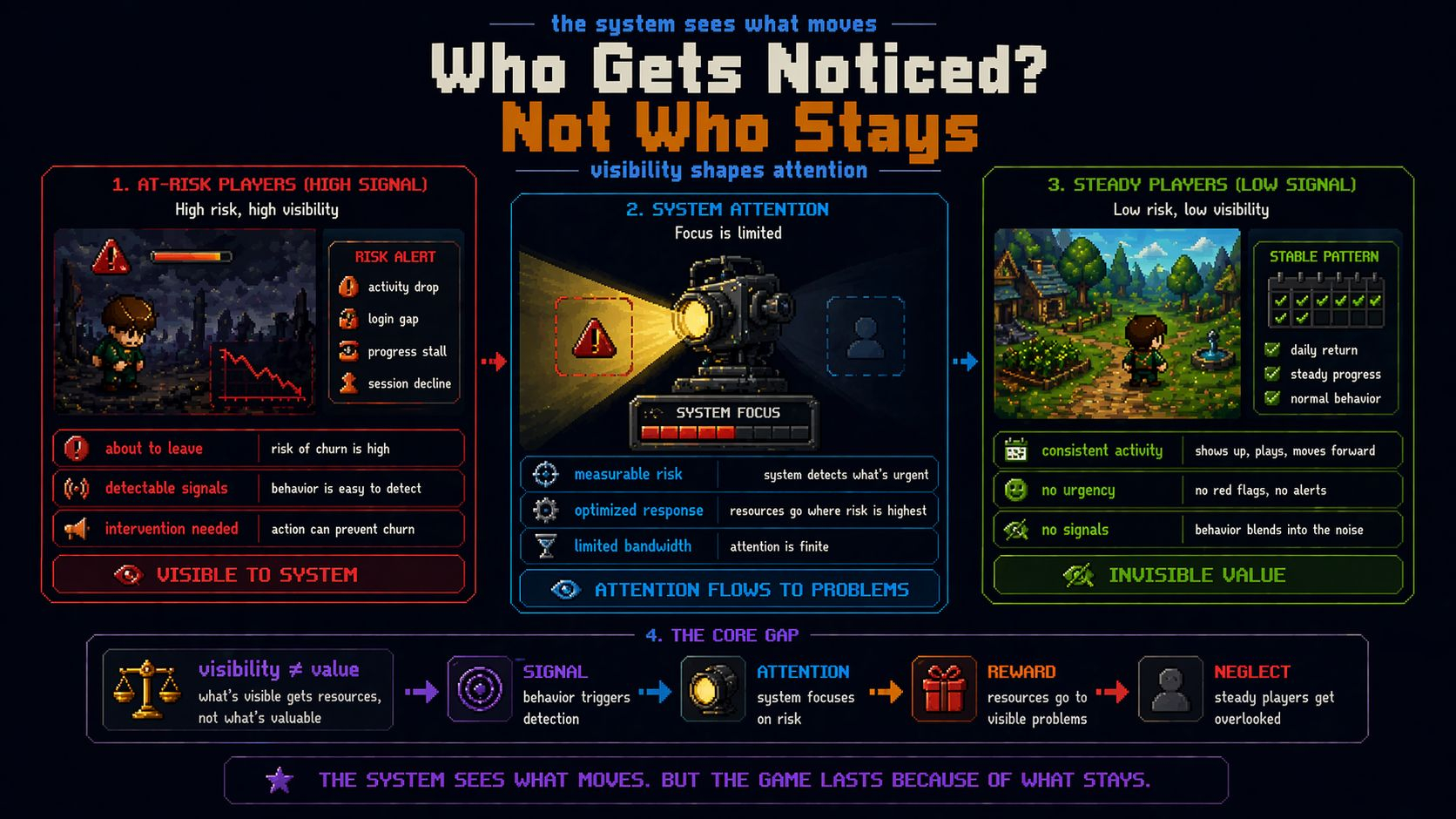
Because once you introduce something like Stacked, a system built to detect risk and act on it, attention naturally flows toward the players who might leave. That makes sense. Those users are measurable. Their behavior creates signals. You can see the dip, test a reward, measure the lift. It’s clean, actionable.
The steady player doesn’t give you that.
They don’t produce urgency. They don’t justify experiments. They don’t show up as problems to solve. So even if they’re valuable, they slowly fade into the background of the system.
And that’s the part that feels a bit uncomfortable to sit with.
Not because anything is broken. More because the system might be working too well in one direction. The better it gets at rescuing unstable behavior, the easier it becomes to overlook stable behavior. Not intentionally, just as a side effect of optimization.
It’s a strange trade.
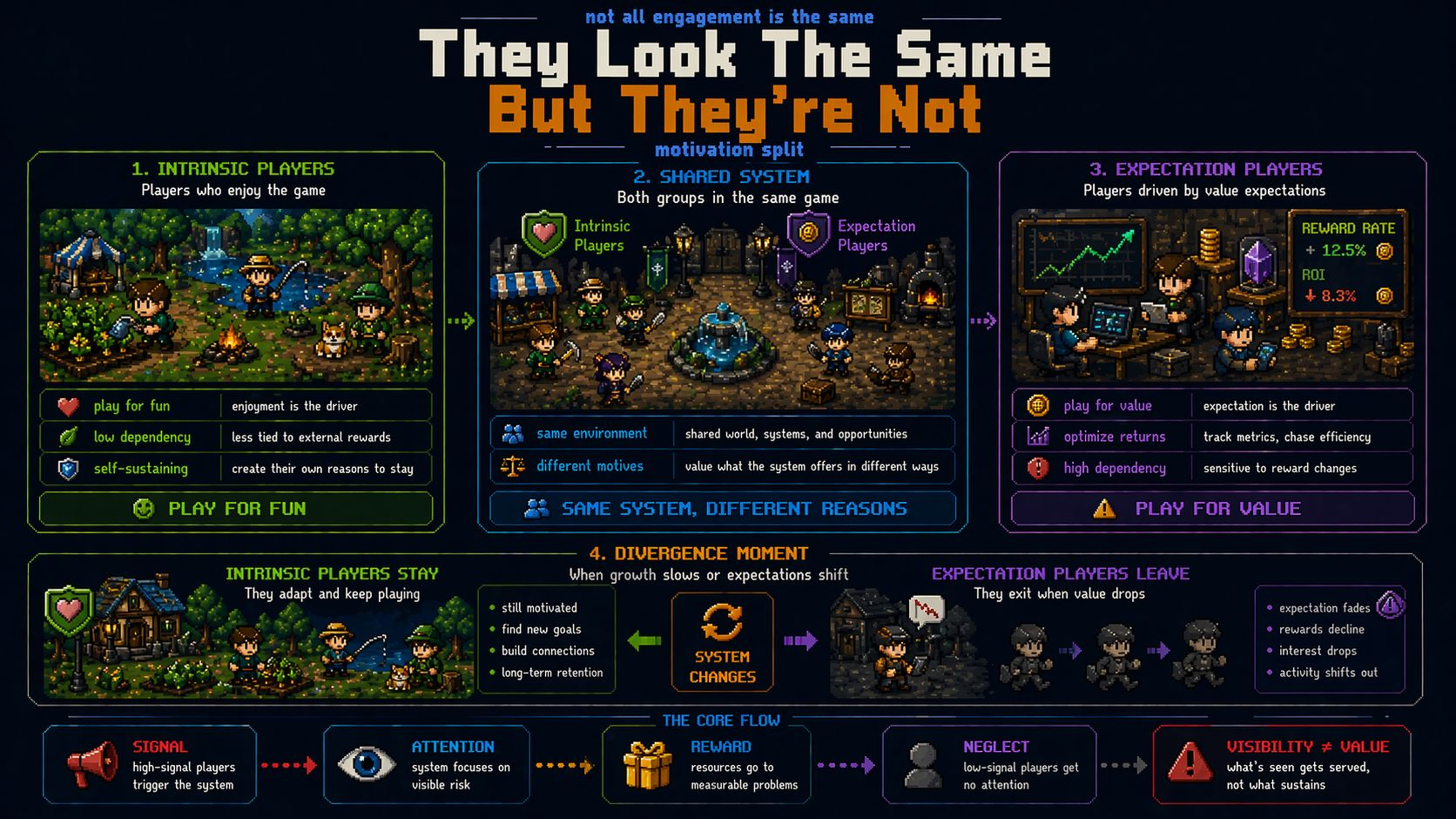
You end up with a system that is very good at reacting, but maybe less aware of what quietly holds everything together. And over time, that imbalance can shift how the game feels. Not in an obvious way, but subtly. The players who stay without asking for attention might start to feel like they’re not really part of the “important” loop.
And that feeling is hard to measure.
I don’t think this is a flaw specific to Pixels. If anything, it’s a sign the system is becoming more serious. Moving away from broad emissions toward targeted decisions. That’s necessary. But it also introduces a new kind of responsibility.
Because once you decide who is worth saving, you’re also deciding who can safely be ignored.
And I’m not sure that second decision gets enough attention.
The strongest version of this system, at least in my head, isn’t just one that rescues well. It’s one that still finds ways to reinforce players who never needed rescuing in the first place. The ones who don’t trigger alarms but still carry long-term value.
That balance feels harder than the tech itself.
And it probably matters more over time.
Because the easiest player to lose isn’t always the one already drifting away. Sometimes it’s the one who stayed long enough to stop being noticed.
I’m still trying to see how Pixels handles that.