
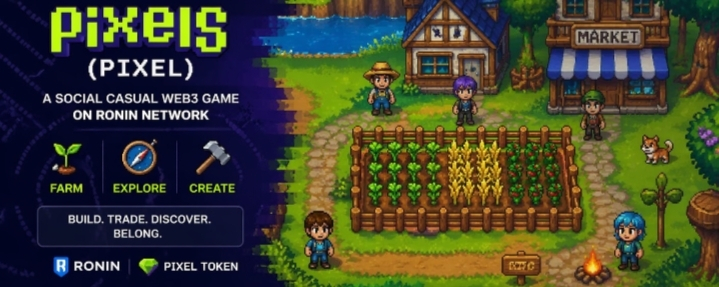
Pixels (PIXEL) is one of those games that doesn’t try too hard to impress you right away—and that’s exactly why it works. At a glance, it looks simple: a pixel-style farming world where you plant crops, gather resources, and walk around an open map. But give it a little time, and it starts to feel less like a game you’re testing and more like a place you’re settling into.
It runs on the Ronin Network, though honestly, you don’t feel that immediately. And that’s probably intentional. A lot of Web3 games put the technology front and center, almost demanding that you care about wallets, tokens, and transactions before you even understand what you’re playing. Pixels takes a softer approach. You just start farming. You clear a bit of land, plant something, wait, harvest, and repeat. It’s familiar in a way that lowers your guard.
Then, slowly, the world begins to open up. You realize there are other players moving around doing their own thing. Some are trading, some are optimizing their farms, others are just exploring. There’s no rush pushing you forward, no aggressive system telling you what to do next. You decide your pace. That freedom makes a difference because it turns routine into something personal instead of something assigned.
The farming loop is the anchor, but it’s not the whole story. As you keep playing, you start unlocking more ways to interact with the world—crafting, quests, social elements, small discoveries scattered across the map. None of it feels overwhelming. It builds gradually, almost like the game is quietly saying, “take your time, you’ll get there.” That tone is rare, especially in games tied to blockchain, where everything often feels urgent or reward-driven.
There is a token behind it all—PIXEL—and it plays a role in the ecosystem, from rewards to governance and utility. But what stands out is how it doesn’t constantly interrupt your experience. You’re not thinking about the token every minute. You’re thinking about your crops, your progress, maybe even how your little piece of land looks compared to someone else’s. The economy exists, but it doesn’t overshadow the gameplay.
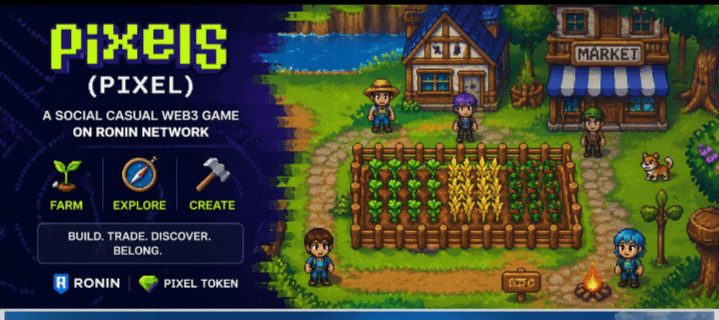
That balance didn’t happen by accident. Earlier versions of the game leaned more heavily on multiple currencies and reward mechanics, but the shift toward simplifying things around PIXEL shows a kind of maturity. It feels like the developers realized something important: if players are too focused on extracting value, they stop enjoying the world itself. And once that happens, the game loses its soul.
The choice of Ronin as the foundation supports this direction. It’s built for games, which mostly means things just work faster and with fewer interruptions. You don’t feel friction every time you interact with the system. That might sound like a small detail, but it’s actually huge. The less you’re reminded of the underlying tech, the easier it is to stay immersed.
What really sticks, though, is the atmosphere. Pixels doesn’t pressure you to “win.” There’s no single path you’re expected to follow. You can focus on farming efficiently, or you can wander around and explore. You can interact with others or keep to yourself. You can treat it seriously or just drop in for a few minutes each day. It adapts to you instead of forcing you into a specific playstyle.
And over time, that creates something subtle but meaningful. You start forming habits. Maybe you check your farm in the morning. Maybe you spend a bit of time improving your setup before logging off. It becomes part of your routine in a quiet, almost unnoticeable way. Not because you’re chasing something urgent, but because you want to see your space grow.
That’s where Pixels feels different from a lot of Web3 projects. It doesn’t rely entirely on hype or promises. It leans on something much simpler: consistency. A steady loop, a shared world, and enough flexibility for players to find their own reasons to stay.
It’s still evolving, and you can feel that. Some systems will change, the economy will adjust, and new features will come in. That’s just the nature of a live game, especially one experimenting with blockchain. But the foundation feels solid—not because it’s complex, but because it’s approachable.
At the end of the day, Pixels isn’t trying to overwhelm you with innovation. It’s trying to keep you coming back. Not out of pressure, but out of quiet attachment. And in a space where many projects chase attention, that kind of staying power might matter more than anything else.