

Pixels started as something I casually played, like any other game. I would log in, farm, complete my tasks, earn $PIXEL, and move on. There was no pressure, no deep thinking. It was just a loop. But slowly, over time, something started shifting. I wasn’t acting as quickly as before. I would pause before using my resources, not because I was confused, but because I started to feel that timing mattered. I began to sense that using the same resource at different moments could lead to completely different outcomes. And that feeling stayed with me.
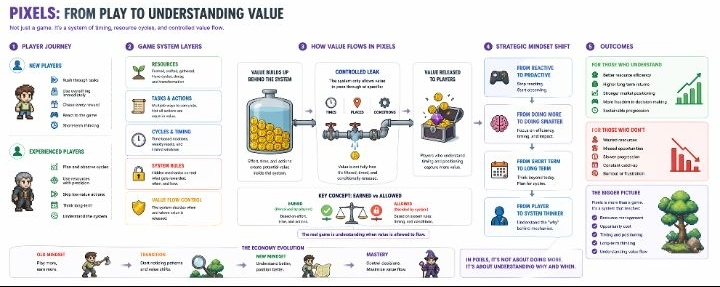
When I hit deeper levels, like Tier 5, it became clearer: Pixels wasn’t just about progressing; it was about controlling the game. The resources weren’t just waiting to be used—they were cycling through, decaying, transforming, and only making sense when used at the right moment. At first, I thought this just made the game more complicated, but then I observed how players acted. New players rushed through tasks, completing everything, using everything, chasing every reward. But the experienced players didn’t. They slowed down. They thought before they acted. They even skipped actions that seemed beneficial at first glance.
That’s when I realized: Pixels doesn’t just reward effort; it rewards understanding. The system doesn’t directly tell you to optimize or calculate. It doesn’t push you to be strategic. But if you stick around long enough, you start to notice the patterns—the value shifts depending on timing, some actions make long-term efficiency worse, and resources behave differently depending on cycles.
Experienced players adapt. They test different strategies, compare outcomes, and adjust their approach. Some treat Pixels as a system of inputs and outputs, trying to understand what works best over time. The game starts to feel less like an activity and more like managing a process. It’s no longer just about moving through levels or completing tasks. It’s about making the right decisions at the right time.
That’s where things get tricky. Because on one hand, this is what makes Pixels meaningful. It gives weight to your decisions. Scarcity, resource loops, and timing create real depth. You can’t just repeat actions mindlessly—the system pushes back in subtle ways. But on the other hand, it changes the feeling of the experience. You’re not playing freely anymore. You’re thinking before every move. Sometimes, you even stop yourself from playing because the timing doesn’t feel right. That’s not what most games do.
It reminds me of real life—like when someone starts organizing their day seriously. At first, everything’s flexible. But once you start noticing patterns, you plan. You choose what to do, what to delay, what to avoid. Not because you have to, but because it feels smarter. Pixels creates that same mindset. You’re still inside a game world, but your thinking shifts toward understanding systems—how value flows, how resources cycle, and how decisions affect future outcomes. Even mechanics like deconstruction and resource decay start influencing how you play.
The veterans are already fully immersed in this layer. They think ahead, plan around limitations, and adjust their actions accordingly. Meanwhile, the new players are still in the discovery phase, reacting to the game without overthinking it. It feels like two different experiences happening at once. And maybe that’s by design. Maybe Pixels is meant to move players from simple interaction to deeper awareness—from just doing things to understanding why those things matter.
But this brings me back to one question: If a game starts rewarding careful thinking over constant action—if it pushes players to slow down, plan, and make smarter decisions instead of just doing more—is it still a game? Or is it something else entirely? Something closer to a system that’s quietly teaching us how to manage value over time?
And then, there’s this idea about the system itself. Pixels doesn’t just reward players for doing things—it controls what gets rewarded and when. I noticed that coins in the game don’t act the way I expected. They don’t just move freely, they’re attached to certain moments, chains, and boards. It’s like the system is deciding when and where value can flow, and only letting certain things escape at certain times. It doesn’t feel random, it feels controlled.
This realization completely shifted my perspective. Maybe what I’m interacting with isn’t a reward layer at all. Maybe it’s a controlled leak, where value builds up behind the system and only certain parts of it are allowed to pass through, at specific times, to specific players. The idea of “earned” versus “allowed” started to feel different. When I see a reward, is it something I earned, or is it just something the system decided to release at that moment?
And then, the idea of timing and positioning became even more significant. Players aren’t just grinding for rewards—they’re positioning themselves within the system, waiting for the system to allow them to extract value. It’s not just about playing hard, it’s about understanding the flow of value, understanding where the system is willing to release it, and being in the right place at the right time. That’s a whole different level of gameplay, and it’s one that new players don’t always realize is happening.
The economy in Pixels is changing. It’s moving from a simple “play more, earn more” to a more nuanced “understand better, position better.” New players are still figuring this out, but the experienced ones are starting to get an edge. They understand the system. They see the patterns. They know when to act and when to hold back. And over time, the difference in progress becomes noticeable.
In the end, it’s not just about grinding anymore. It’s about understanding where value comes from and how it moves through the system. And as Pixels continues to evolve, that understanding will become even more important. Because the more I play, the more I realize: it’s not just about doing things—it’s about understanding why those things matter and where they fit within the bigger picture of Pixels’ economy
