Honestly... I didn't expect to feel this specific kind of attention reading through how Pixels actually structures the yield mechanics of owned land.
Not skepticism. not alarm. something closer to the feeling you get when a design decision that reads like a straightforward ownership benefit turns out to be one of the most subtle and interesting economic architectures in the game.
because there's a pattern in how blockchain games describe land ownership that this space accepts without examining what actually drives the return. the standard framing positions land as a productive asset you own. the deed is on-chain. the yield is yours. the value comes from holding the NFT and accessing the resources tied to it. ownership is the source of income.
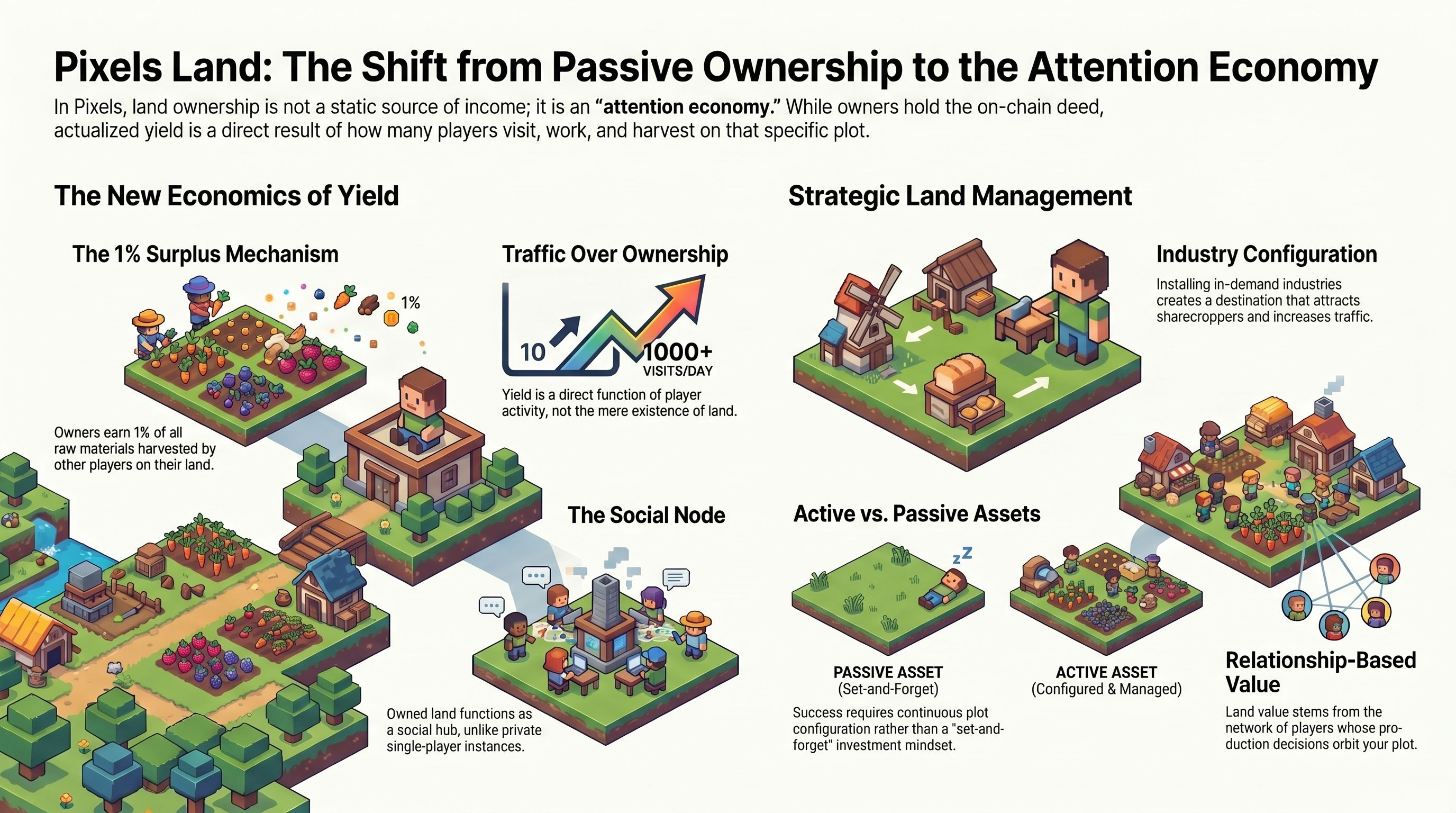
but Pixels built the land economy on a different principle. land owners receive a 1% surplus of all raw materials farmed and harvested on their land. not from farming it themselves. from other players working it. the yield does not come from the asset sitting in your wallet. it comes from the activity of every player who visits, works an industry, harvests a node, or builds a production relationship on that specific plot.
because the product they are describing is real. the Pixels whitepaper is explicit about this. land owners have the richest tapestry of interactions in the game. they can manage resources themselves, benefit from the production of sharecroppers working their land, and participate in other land economies simultaneously. well-managed lands with high activity increase in value. the traffic model is not a side feature. it is the core yield mechanism.
so yeah... the ownership is real.
but ownership has never been the hard part of the Pixels land economy.
the hard part is attracting and retaining the players who make the land generate yield in the first place. and this is where Pixels is doing something that deserves to be examined much more carefully than the typical land NFT conversation allows.
because here's what I keep coming back to. a land plot sitting idle in a wallet with no active industries and no visiting players earns its owner nothing beyond the staking power boost. the on-chain asset is real. the potential yield is real. but the actualized yield is a direct function of whether other players find that land worth visiting and working. which means the land economy in Pixels is not really an asset economy. it is an attention economy. the landowners who win are not necessarily the ones with the most land. they are the ones who have configured their land to be most useful to the players who might visit it.
then comes the industry question. because of course.
and here's where it gets genuinely compelling. industries are what make a land plot worth visiting. a land owner who installs the right industries for what the current crafting economy demands is not just improving their own farming efficiency. they are creating a destination that sharecroppers will seek out because working those specific industries advances their own skills and production goals. the land owner who understands which industries are most in demand this season is building traffic to their plot. and traffic is what converts the NFT from a speculative holding into an active yield-generating asset.
that dynamic completely reframes what land ownership means in Pixels. the question is not which plot has the best inherent resources. it is which plot has been configured in a way that makes other players want to show up and work it. two land owners with identical NFT traits can have completely different economic outcomes depending on how actively they have positioned their land relative to current player needs.
there's also a dimension nobody talks about enough.
free and rented plots in Pixels are primarily single-player instances. visitors cannot see those farms. owned land is where the social layer of the game actually lives. a land owner with active industries and consistent visitor traffic is not just earning yield. they are operating a node in the social graph of the Pixelverse. the players who work their land regularly become part of their economic circle. those relationships create the kind of repeated interaction that builds community in a way that solo farming never does. the land value is not just the yield it generates. it is the network of players whose production decisions are oriented around it.
still... I'll say this.
the decision to tie land yield to player activity rather than passive ownership reflects a genuine understanding of what makes a virtual economy stay alive over the long term. a system where land earns based on traffic rather than just existence creates a continuous incentive for land owners to keep improving and configuring their plots rather than treating them as a set-and-forget investment. the dynamic is healthy for the ecosystem and healthy for the social fabric of the game.
the question is not whether the traffic model creates value. it clearly does. the question is how many land owners in Pixels are actively managing their plot configurations as an ongoing economic practice versus treating their NFT as a static asset whose yield will take care of itself as long as they hold it.
and in this space, the land owners who treat configuration as a continuous decision are consistently running a different kind of asset than the ones who bought the deed and moved on.
@Pixels #pixel $PIXEL $RAVE $UAI