
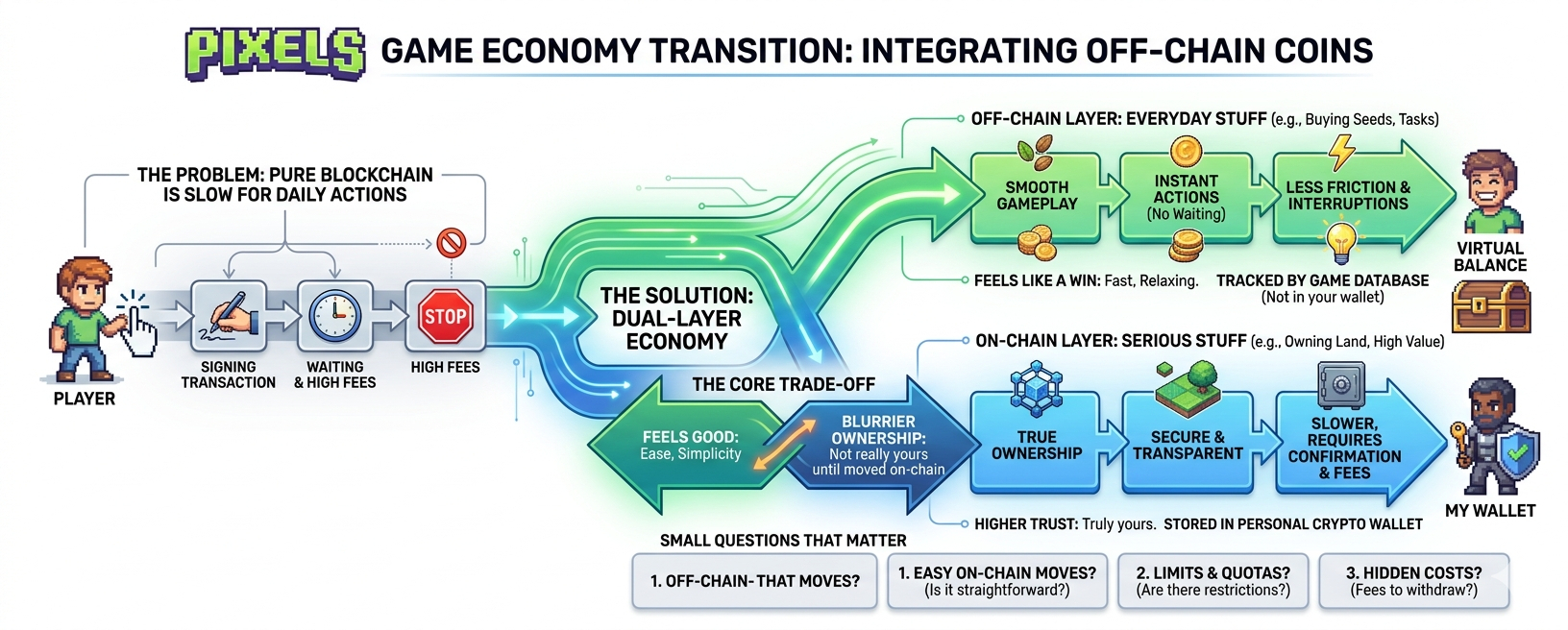
When Pixels added off-chain coins, it didn’t feel like a dramatic change at first. Nothing suddenly broke. The game didn’t look different. If anything, it just felt… easier.
You click, things happen instantly, and you move on. No waiting, no extra confirmations, no small interruptions pulling you out of the flow. From a player’s perspective, that’s a clear win. Games are supposed to feel smooth, not like you’re signing a transaction every few seconds.
And honestly, that’s probably why this change happened.
Blockchains are great at proving ownership, but they’re not great at keeping things fast and simple. Every little action carrying a cost or delay just doesn’t fit how most people want to play. So Pixels did what a lot of games eventually do—they separated the “serious” stuff from the everyday stuff.
The everyday stuff went off-chain.On one level, that makes total sense. You don’t need heavy infrastructure just to buy seeds or complete small actions. It would slow everything down. Moving those interactions off-chain makes the game feel more natural, more like something you can relax into instead of constantly thinking about the tech behind it.
But there’s another side to it that’s easy to ignore when everything feels good.
When your balance is off-chain, it’s not really sitting with you in the same way as something in your wallet. It’s being tracked by the game. It exists because the system says it exists. And while that’s normal for most games, it’s a bit different here because Pixels didn’t start as “most games.”
It started with the idea that what you earn and own is actually yours.
That doesn’t completely disappear with this change, but it does get a little blurrier. Now there are two layers: one where things are fast and flexible, and another where things are slower but truly yours. That balance can work—but only if players understand where they stand in each layer.
And that’s where small questions start to matter.
Can you move your off-chain coins on-chain whenever you want? Is it simple, or are there limits? Are there hidden costs, or is it straightforward? Most players won’t think about this right away—and that’s fair. When a game is fun, you don’t stop to analyze its structure.
But those details shape the experience more than they seem to.
To be clear, this doesn’t feel like a careless decision. If anything, it feels like Pixels trying to fix a real problem. Without changes like this, a lot of Web3 games end up feeling slow, expensive, or just inconvenient to play.
This just happens to be the trade-off they chose.
And like most trade-offs, it’s not purely good or bad. It depends on how it’s handled—and how aware players are of what’s actually going on behind the scenes.
Because when everything works smoothly, it’s easy to forget where things really live.