
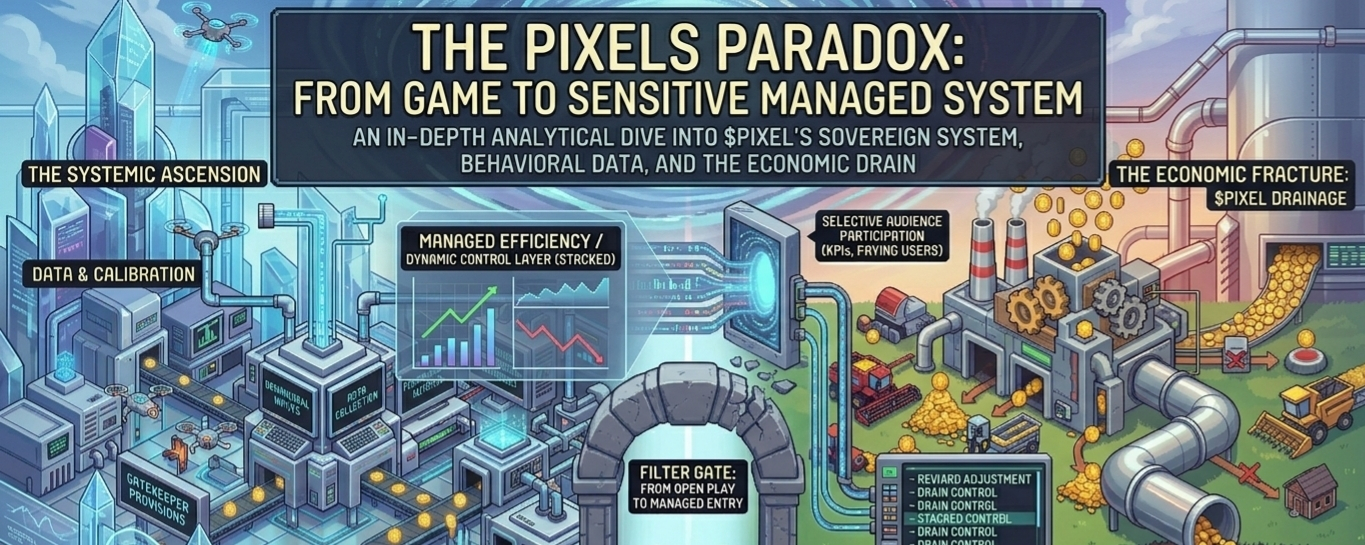

we’ve watched the "GameFi" narrative stumble through cycles of unsustainable hype and catastrophic collapses. But something shifted recently. Looking at the evolution of Pixels (PIXEL), it’s becoming clear that we aren't just talking about a digital farm or a social hub anymore. We are witnessing the birth of a System—a managed, high-efficiency behavioral engine.
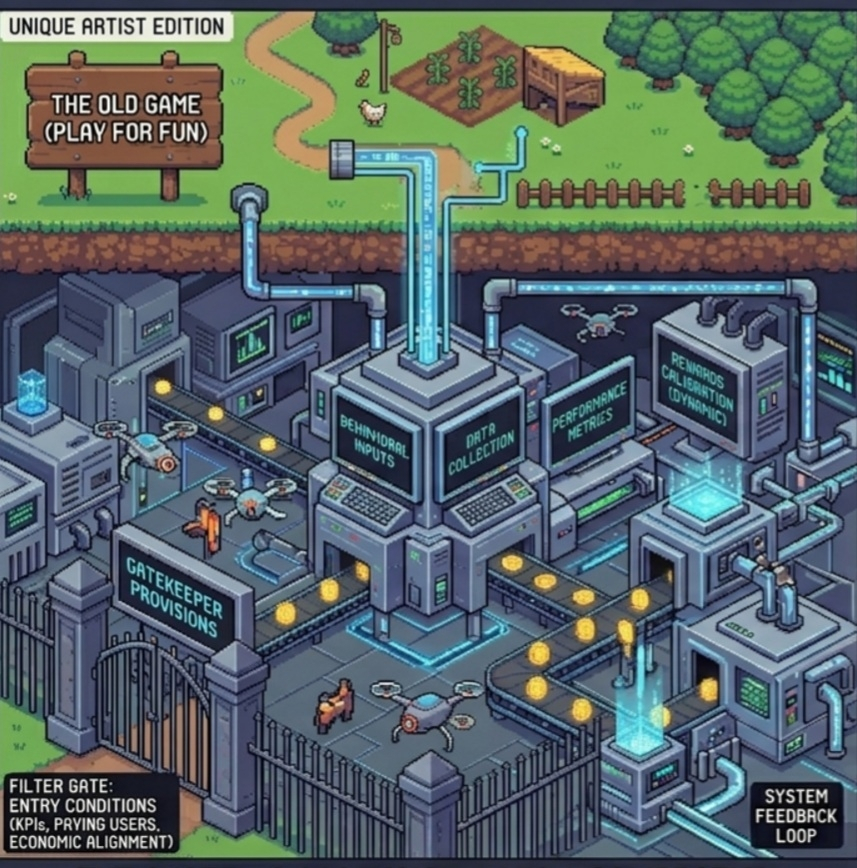
When I look at the transition from "Game" to "System," I see a fundamental rewrite of the player’s role. In the old world, you were a user seeking entertainment. In this new infrastructure, the player is a Behavioral Input. Every click, every hour spent, every strategic choice is a data point fed back into a massive feedback loop. It’s no longer about "playing and winning"; it’s about Calibration. The game isn't static; it adapts to your behavior, shifting the experience under your feet in real-time.
The Mobile Expansion: Infrastructure in Disguise
The push toward mobile isn't just a "port" to reach more people—that’s a surface-level take. From an analyst’s perspective, mobile is the Scalability Layer. It’s about building a network capable of handling millions of concurrent data streams. Pixels is positioning itself as a Gatekeeper. Entry for other games into this ecosystem isn't open-access; it’s filtered based on economic performance, paying-user ratios, and data-sharing agreements. It’s a selective, managed organism.
The Economic Friction Problem: The Reality of PIXEL
Now, let’s get into the "trenches" of the economy, because this is where the philosophy meets the market. There is a massive misconception that high emission (distribution) is the primary enemy. I disagree.
The real problem isn't "how much is distributed," but "where the distribution goes."
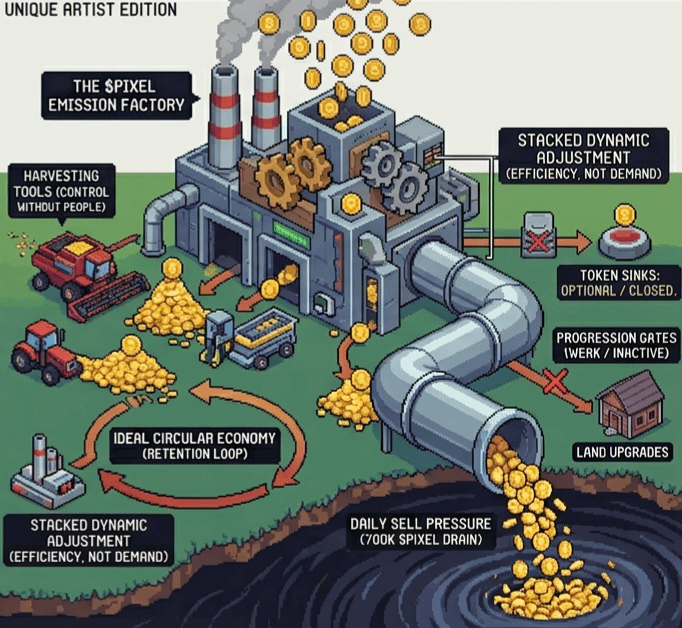
Currently, we are seeing a Unidirectional Drain. If a player earns 150–250 $PIXEL daily and immediately liquidates 70%, we aren't looking at a "circular economy." We are looking at a Drainage Pipe. When 700,000 tokens hit the market daily—roughly 20 million a month—the question shifts from theoretical supply/demand to a brutal reality: Who is the buyer?
The Retention Bottleneck
The failure of the "Closed Loop" hypothesis is evident. We expected new players to buy from old players, creating balance. Instead, the new players simply join the farm and add to the sell pressure. Pixels currently sits in a dangerous Mid-zone:
It has a real, liquid token (unlike Web2 games).
It lacks the Economic Friction (like ETH or SOL staking/fees) to force retention.
If spending isn't a requirement for progression, the reward inherently becomes sell pressure.
The Stacked Layer: Control vs. Value
This brings us to Stacked—the dynamic control layer designed to adjust rewards in real-time. While Stacked is a powerful tool for protection and efficiency, we have to be honest about its limits: Control is not the same as Value Creation. Stacked can turn down the faucet, but it cannot force a player to want the water. If the core gameplay doesn't mandate PIXEL as a "Progression Gate," the individual player will always act rationally: Farm with zero upgrades and sell everything. This is "perfect" for the individual, but suicidal for the collective.
The Philosophical Paradox: Managed Efficiency vs. Freedom
We are left with a heavy question. If a system:
Filters who enters
Dynamically calibrates rewards based on behavior
Uses a control layer to manage the economy
Are we still in an open gaming environment, or have we moved into a Managed Economy?
The benefits are undeniable: massive distribution for developers, robust anti-cheat, and a pre-built audience. But the cost is the loss of Spontaneity. When behavior is directed and incentives are calibrated to the millisecond, the "magic" of a game might be replaced by the "efficiency" of a machine.
Final Thoughts: The Two Paths
We are standing at a crossroads. For PIXEL to move from a "drainage pipe" to a "sovereign economy," it needs to introduce Hard Friction. Usage of the token cannot be optional; it must be a condition for advancement.
Until Pixel creates a reason for the player to hold that is stronger than their urge to sell, the system will remain a high-efficiency machine waiting for a new influx of capital. We aren't just watching a game anymore; we are watching a grand experiment in Mathematical Assurance versus human greed.
The question isn't whether Pixels works. The question is: Who are we in this system—the players, or the fuel?
