
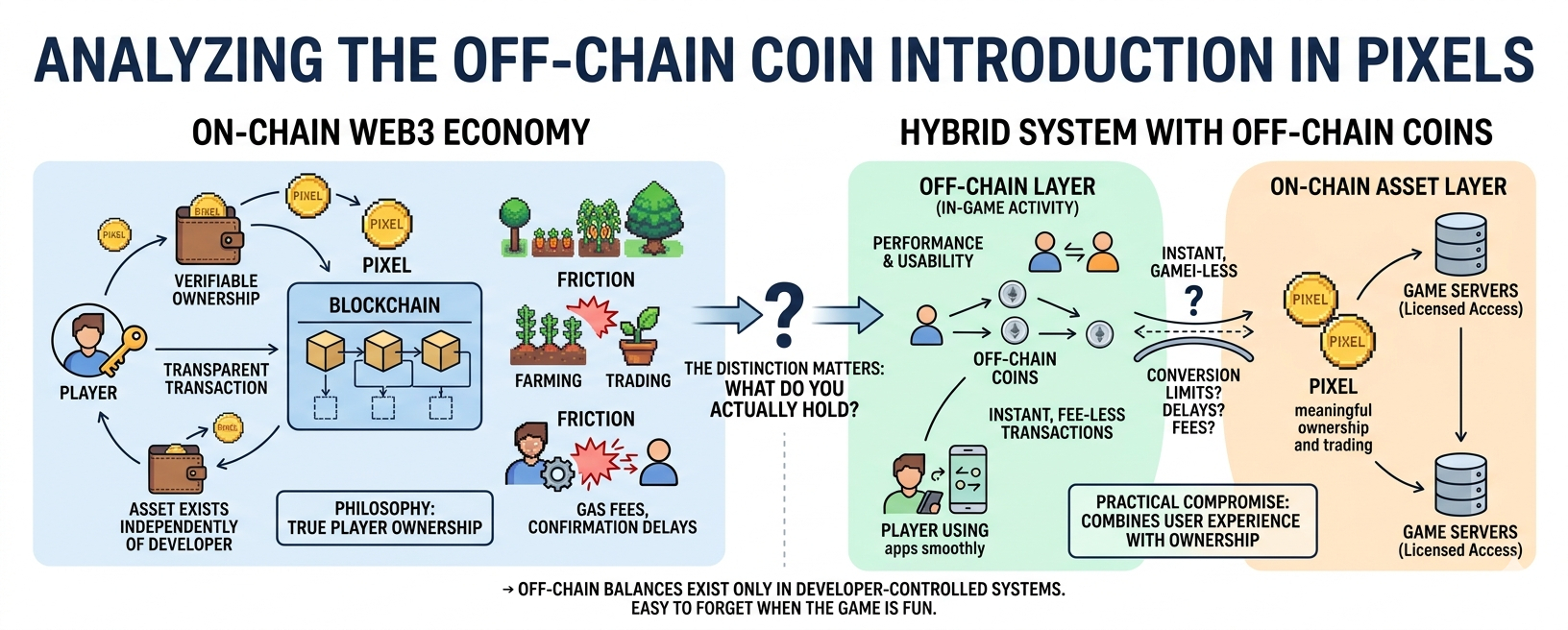
When Pixels introduced off-chain coins into its economy my first reaction was to read the announcement twice just to make sure I understood what was actually changing.
On the surface, adding an off-chain currency to a blockchain game feels a bit contradictory. The core idea behind Web3 gaming has always been that assets live on-chain verifiable, transparent, and truly owned by the player rather than sitting on a company’s server. So when a game built around that principle starts moving part of its economic activity off-chain, the immediate question becomes: why? And more importantly, what does that shift cost in return?
The straightforward answer is performance and cost. On-chain transactions come with gas fees and confirmation delays. In a game designed around constant interaction clicking, farming, trading forcing a wallet confirmation for every small action quickly becomes friction that breaks the experience. Off-chain coins solve that problem by allowing instant, fee-less transactions. It makes the game feel responsive again, closer to a traditional game loop rather than a financial interface. That’s a real issue being solved in a practical way.
But what kept bothering me is the question of ownership. On-chain assets exist independently of the game itself. If your PIXEL is in your wallet, it’s yours in a way that doesn’t rely on Pixels the company continuing to exist or behave a certain way. Off-chain balances, on the other hand, only exist because the game’s servers say they do. That’s a subtle but important difference, even if it often gets downplayed in how these systems are presented.
To be fair, this isn’t something unique to Pixels. It’s how most traditional game economies already work. Gold in World of Warcraft, V-Bucks in Fortnite, coins in mobile games—none of that is truly “owned” by the player. It’s all effectively licensed access under rules controlled by the developer. In that sense, introducing off-chain coins doesn’t invent a new problem; it just brings part of the system closer to how games have always operated. Whether that’s a practical compromise or a philosophical step backward depends on how strongly you believe in the original promise of Web3 ownership.
The way this kind of hybrid design usually gets framed is simple: off-chain for small, frequent transactions, on-chain for meaningful ownership and trading. The idea is to combine speed and usability with true asset ownership where it matters most. On paper, that’s a reasonable balance.
In practice, though, the line between small and meaningful isn’t something players define. It’s defined by the developers. And history shows that when that kind of boundary exists, it can slowly shift over time based on what’s more convenient for the system rather than what’s best for the user.
What I find myself wanting more clarity on is conversion. How easily can off-chain coins move into on-chain assets? Are there limits, delays, fees, or conditions attached to that process? The more open and frictionless that bridge is, the more the off-chain layer feels like a convenience feature. The more restricted it is, the more it starts to look like a separate economy with different rules about what ownership even means.
I don’t think Pixels made this decision lightly. It’s pretty clear the motivation is to make the game smoother and more accessible, especially for casual players who would never tolerate constant on-chain friction. That trade-off makes sense from a product perspective.
Still, it’s important for players to be clear about what they’re actually holding when they accumulate off-chain balances. And to understand how much of their activity is happening in a system that exists entirely because the game says it does.
The distinction matters.
It’s just easy to forget when the game is fun.
