

not dramatically. not with an announcement. just quietly, through a series of design decisions that each look small on their own until you step back and realize the whole shape of the thing has changed underneath you
that’s what’s happening inside Pixels right now and i think most people are still reading it as a farming game update when it’s actually something structurally more interesting than that
let me go back to where this started
the Pixels team didn’t build Stacked because it sounded good in a pitch deck. they built it because they watched what happens when a live game economy meets real adversarial pressure and they needed something that could survive that pressure while the game was still running with real players inside it. bots arriving within days of launch. reward extraction at scale. token leakage that compounds faster than any patch can address. coordinated farming that drains an economy before the team even has data confirming what’s happening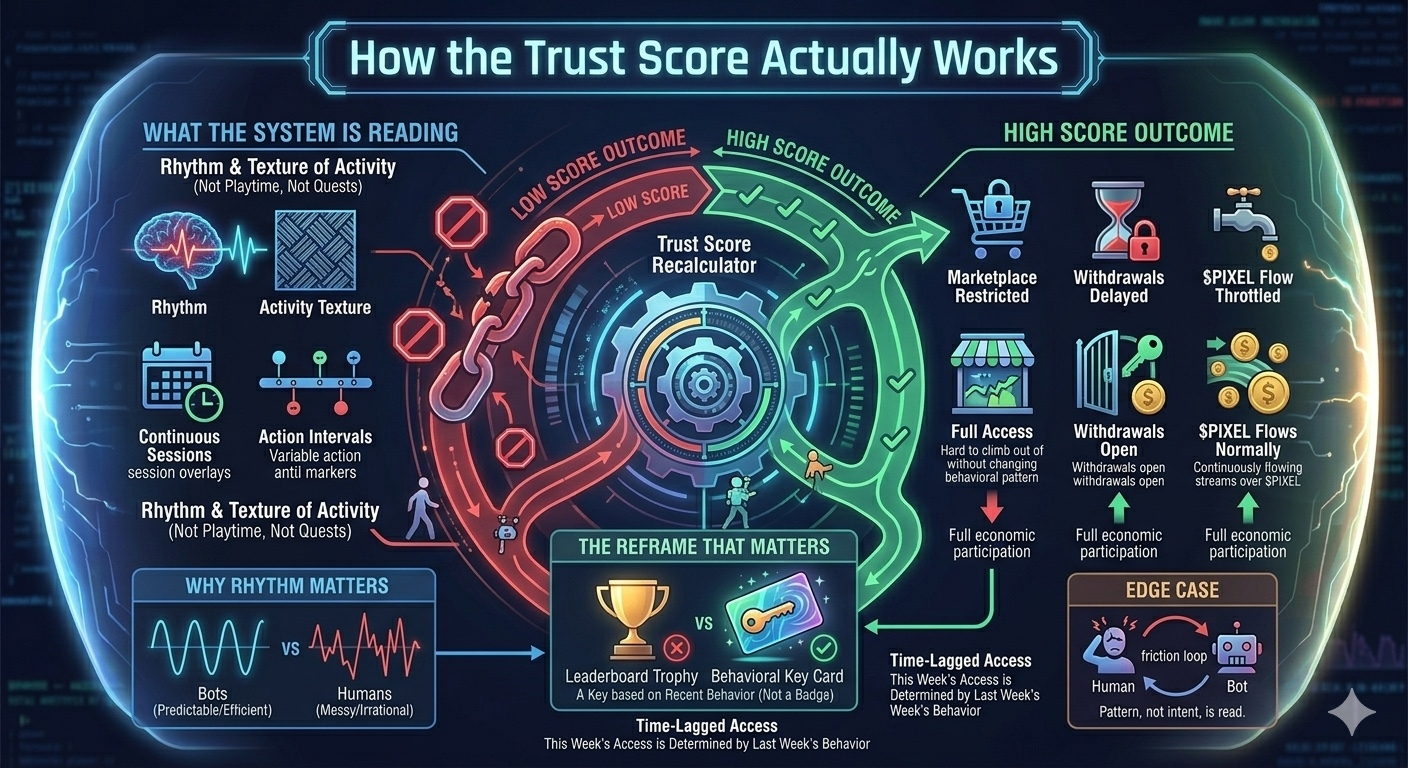
most teams respond to that situation after the damage is visible. the Pixels team responded by building infrastructure that addresses it before the damage starts. that timing difference is everything
Stacked is that infrastructure. and the more you understand how it actually works the more the “rewards app” framing starts to feel inadequate for what it is
start with the trust score because that’s where the architecture gets genuinely interesting
before you access the marketplace, before withdrawals open, before toward you — the system has already been building a behavioral picture of how you move. not your level. not your quest count. not your total playtime. the rhythm and texture of your activity across sessions. when you act, how long between actions, what your engagement pattern looks like when you’re not thinking about being watched
this distinction is load-bearing. bots are optimized for efficiency which means they’re also optimized for predictability. mechanical regularity is what efficiency looks like at the behavioral level. a real human player is messy by comparison. irregular session timing, variable activity bursts, genuine gaps, moments of obvious distraction. the trust score is built specifically to find and reward that messiness
purai obak lagche when you actually sit with this — the system is rewarding you for being unpredictably human. your irregularity is your credential
low trust score means the economic doors stay partially closed. marketplace restrictions, withdrawal delays, throttled $PIXEL access, higher friction across the board. high trust score means the full economic stack opens. it sounds like a simple tier system but the architectural decision underneath is significant
this is a permission layer built on behavioral reputation. and behavioral reputation is dynamic, continuous, and always recalculating based on recent activity. your access rights this week are determined by how you played last week. that’s not a leaderboard. that’s not a reward tier. that’s a fundamentally different relationship between player behavior and economic access than anything most games have shipped
now here’s the layer that doesn’t get enough attention
the trust score is simultaneously running three separate jobs inside one system
it’s a behavior signal — continuously reading and classifying your activity pattern against a model of what human versus mechanical engagement looks like. it’s an anti-bot filter — creating precise friction at the exact points where bot extraction depends on speed and volume, withdrawal delays that break the instant sell loop, marketplace restrictions that stop the farming cycle before completion. and it’s an economic throttle — controlling the rate at which $PIXEL exits the ecosystem at the individual level, preventing coordinated inflation events, managing token velocity without touching the base game mechanics
one system. three jobs running simultaneously. and that overlap creates real complexity
when behavior signal and anti-bot filter and economic throttle all run through the same score, a false positive on any one dimension affects all three outcomes for that player at once. a real player with a legitimate but irregular behavioral pattern — heavy grind for four days, ten day absence, return with intensity — can fall into the same friction loop as a bot. the system reads pattern not intent. that’s the cost of building something that has to survive adversarial usage at scale. it’s not a flaw. it’s a tradeoff. but it’s a real one and real players encounter it
Stacked sits underneath all of this as the actual decision engine and the AI economist layer is what makes it genuinely different from anything else in this space
it’s not distributing rewards randomly or even based on simple quest completion. it’s analyzing cohorts continuously, identifying churn patterns before they compound into visible player loss, designing reward experiments targeted at specific behavioral segments, then executing those experiments inside the same system without any gap between the insight and the action
studios plugged into Stacked can ask questions that most game teams can’t answer with their current tooling. why are high value players dropping between day three and day seven. where is reward budget flowing without producing measurable retention improvement. which specific in-game mechanics correlate with players still active past day thirty. what experiment is worth running next and for which exact cohort. and they get actionable answers immediately — not in the next sprint, not after a data team analysis — inside the same system that will execute the experiment
200M+ rewards processed. $25M+ in Pixels revenue that Stacked-powered systems contributed to directly. this infrastructure has been running under real adversarial conditions at real scale with real economic consequences. not a whitepaper. not a demo 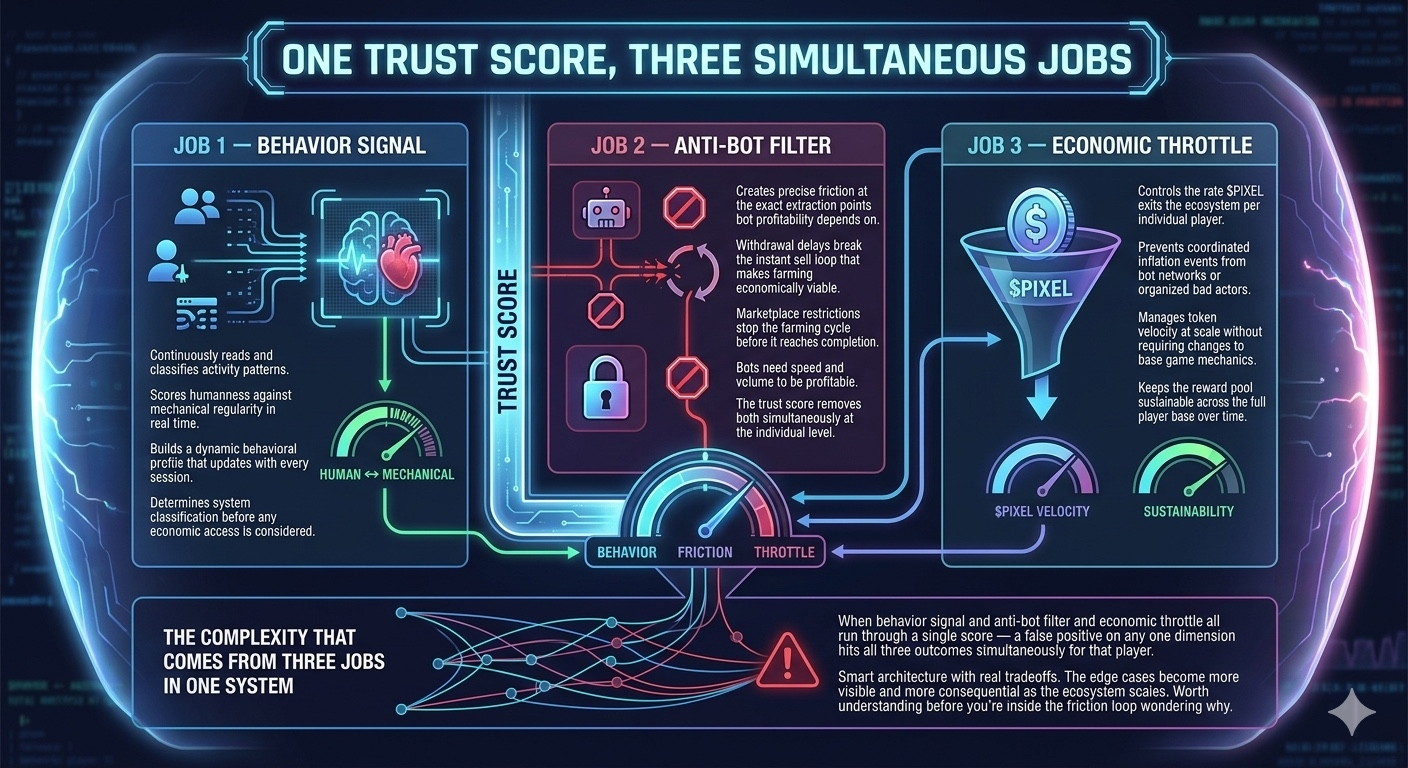 environment. production
and the story is shifting in a way that most token watchers haven’t fully mapped yet
moving from single-game token to cross-ecosystem rewards currency. as more studios plug into Stacked the demand surface for the token expands independently of whether Pixels the game has a good month. the behavioral data flowing through Stacked across multiple games also feeds back into the reward targeting system — more games means more signal, better targeting, better retention outcomes, more studios want access to the infrastructure, loop compounds
that’s an infrastructure bet. the risk profile is fundamentally different from a game token. most web3 game tokens are one bad season away from a death spiral. an infrastructure token with compounding data advantages and expanding studio adoption is a different category of asset entirely
what i keep returning to is how quietly all of this accumulated
there was no moment where Pixels announced it was becoming a behavioral economy with a reputation-gated permission layer sitting over the economic stack. it built up through decisions that each looked like gameplay updates. land ownership with real operational consequences. slot deeds tied to machine access. 30-day renewal cycles. trust scores controlling economic rights. until one day the shape of the thing was completely different from what it looked like at launch
i don’t know if that’s the future of gaming or something we’ll look back on as too complicated for mainstream adoption. but i know the infrastructure underneath it is one of the more serious things being built in web3 gaming right now
and i know i haven’t stopped thinking about it
which probably means something 👀