
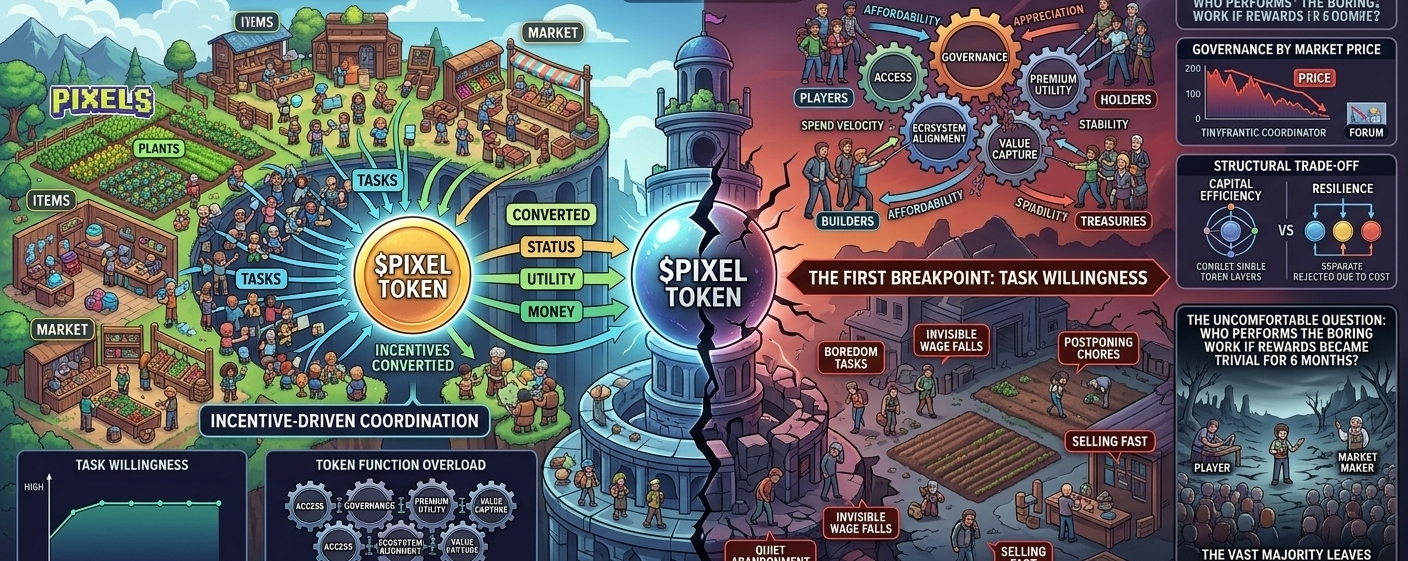
I keep returning to the same question when I study systems like PIXEL tied to Pixels on Ronin Network: what breaks first when coordination meets real economic stress? It is rarely the code. It is usually the belief that participation will remain worth the effort tomorrow. In calm periods, users mistake activity for durability. Farms are planted, items are crafted, markets clear, and token incentives appear to align everyone. But stress reveals whether that motion was genuine demand or just subsidized motion wearing the mask of culture.
The first pressure point I watch is not price itself, but task willingness. In game economies built around repetitive loops, labor enters the system because players believe outputs can later be converted into status, utility, or money. When token value weakens or reward expectations compress, the invisible wage falls immediately. Users do not announce a strike. They simply log in less, postpone chores, ignore low-margin tasks, or sell inventory faster than they replenish it. What looked like a vibrant economy can shrink through thousands of private decisions before dashboards notice anything. A coordination system depending on constant small acts is more fragile than one depending on a few committed actors.
This matters because many observers confuse daily activity with sticky demand. I do not. Activity funded by incentives is rented attention. When the rent changes, behavior changes with it. If gathering resources, crafting goods, or maintaining land stops feeling rational, then supply chains inside the game thin out. Scarcity may briefly lift prices, but it also reduces usability. The remaining users then face worse experience, higher friction, and thinner markets. Declining participation becomes self-reinforcing, not because users turned hostile, but because each user rationally responds to everyone else doing less.
There is a subtle asymmetry here. It takes months to train habits, but only days to break them. A player who built routine around recurring rewards can abandon that routine after two disappointing weeks. Rebuilding trust is slower because users remember opportunity cost. Once they discover other places to deploy time and capital, returning requires more than restored incentives. It requires restored confidence that the next withdrawal of incentives will not happen again.
The second pressure point is token function overload. PIXEL is presented as coordination infrastructure across multiple surfaces: access, premium utility, ecosystem alignment, governance framing, and value capture expectations. That sounds efficient in expansion. Under stress, it becomes crowded. Different user groups want contradictory things from the same asset. Players want affordability. Holders want appreciation. Builders want spend velocity. Treasuries may want stability. Speculators want volatility they can trade. One token can carry many narratives in a bull phase, but stress forces hierarchy among them. Someone’s use case gets sacrificed first.
I have watched capital rotate through enough narratives to know that multifunction tokens often hide governance by market price. If the token falls sharply, practical decisions get made whether anyone votes or not. Users delay purchases. Guild activity slows. Secondary markets seize. Contributors ask for different compensation. Treasury math changes. The system claims decentralization, yet price becomes the loudest coordinator in the room. No forum can outvote a collapsing exchange rate in real time.
There is also a structural trade-off between capital efficiency and resilience. Using one token across many layers is efficient because liquidity concentrates, branding simplifies, and demand can stack. But resilience usually prefers separation: different instruments for spending, saving, staking, and governance reduce contagion. Efficiency feels smart when inflows are strong. Separation feels wise when outflows begin. Most projects choose efficiency first because resilience looks expensive until the day it is needed.
The uncomfortable question I would ask is simple: if rewards became economically trivial for six months, who would still perform the boring work that keeps the world alive? Not the symbolic work, not social media enthusiasm, not temporary speculation. I mean planting, crafting, listing, maintaining, teaching newcomers, and absorbing thin liquidity. If the honest answer is “far fewer people,” then the protocol was coordinating extraction more than commitment.
I do not say this as criticism unique to Pixels. It is common across systems that mistake intention for incentive compatibility. Communities often believe shared identity can substitute for economics. It usually cannot for long. People can love a product and still stop subsidizing it with unpaid labor or idle capital. In stressed markets, sincerity becomes secondary to arithmetic.
So when people ask what breaks first, I still say belief—but not abstract belief in technology. I mean belief that everyone else will keep showing up on terms that no longer make sense. Once that doubt spreads quietly through a coordination system, the charts usually notice later.